
Treatment and exclusion solve different parts of a pest problem. Treatment controls the pest that is present. Exclusion corrects the access path or building condition that lets pests return. Sanitation, moisture correction, and follow-up may be separate scopes again. A quote that covers only treatment can be completely legitimate—but it is not the price of a pest-free building if the access condition remains.
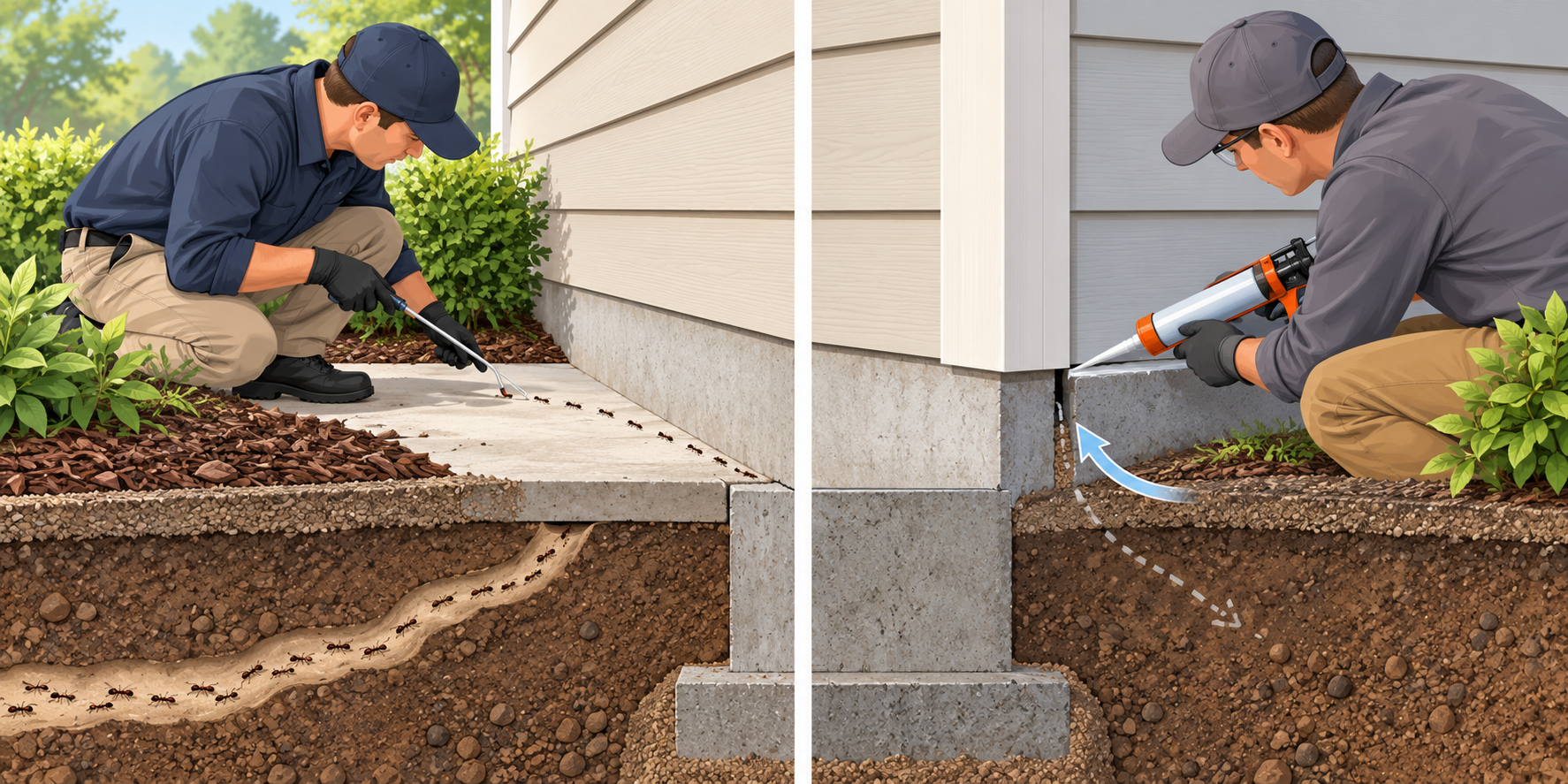
The five parts of a complete response
Integrated pest management, or IPM, combines prevention with appropriately selected physical or chemical controls. In a residential project, that often becomes:
- Identification and inspection: establish what is present and where it is entering or nesting.
- Active treatment or removal: control insects, rodents, or wildlife using a lawful method suitable for the situation.
- Source reduction: remove food, water, shelter, or moisture conditions where practical.
- Exclusion: repair or screen access points without blocking required ventilation, drainage, or occupied animals.
- Verification and restoration: monitor activity, clean contamination, and repair affected materials.
Not every problem needs every part. A wasp nest in an exposed location may be a bounded treatment. A raccoon den in an attic may need inspection, humane timing, removal, exclusion, contamination cleanup, and roof or fascia repair.
Why treatment alone can disappoint
Killing visible workers, placing a trap, or removing an animal may reduce the symptom without addressing the colony, nest, den, food source, moisture, or opening. Health Canada’s rodent guidance describes control together with closing entry points and removing food and shelter. EPA’s residential guidance similarly identifies food, water, shelter, cracks, screens, and openings as prevention targets.
This does not mean the provider must always perform building work. It means the quote should identify the unresolved path. A pest company may seal a small penetration, while a roofer, siding contractor, mason, carpenter, plumber, or building-envelope professional owns a larger repair. The homeowner needs to know whether recurrence prevention is included, recommended, or excluded.
What exclusion can include
Depending on the pest and building, exclusion may involve:
- closing a small crack or utility penetration;
- replacing a damaged screen or fitting a suitable vent cover;
- correcting a door, garage, or crawlspace gap;
- repairing roofline, soffit, fascia, siding, or chimney access;
- screening a wildlife opening after confirming it is unoccupied;
- coordinating with a tree or landscape professional where branches create access;
- correcting moisture-damaged wood or routing that work to another trade.
Do not interpret this list as permission to seal every opening. Some openings provide combustion air, drainage, drying, or mechanical ventilation. Ontario wildlife guidance also warns that an animal must not be sealed inside; timing matters when young may be present.
Compare the project totals
Ask for separate line items for:
| Scope | What it answers | May be owned by |
|---|---|---|
| Inspection | What is present and where? | Pest or wildlife specialist |
| Treatment/removal | How is current activity controlled? | Licensed or qualified provider |
| Exclusion | How is access reduced? | Pest provider or building trade |
| Source correction | Why does the condition persist? | Plumber, roofer, landscaper, envelope trade, or owner |
| Cleanup | What is removed or disinfected? | Pest, remediation, or environmental-health provider |
| Repair | What building material is restored? | Structural, roofing, electrical, siding, drywall, or finish trade |
The combined total can exceed the treatment invoice even when each line is necessary. Conversely, an expensive treatment can be the wrong purchase if the provider has not confirmed the pest or the scope includes unnecessary recurring applications.
Follow-up is part of the economics
Ask how success will be judged. It might be no new signs during a defined monitoring period, a return inspection, station checks, or confirmation that a wildlife opening is inactive. A callback guarantee may cover retreatment but not exclusion, cleanup, or repair.
For wildlife, do not assume a closed opening proves that the animal is gone. For rodents, a removal service can leave contaminated insulation or chewed wiring. For termites or carpenter ants, controlling the colony does not restore damaged wood or prove that moisture conditions have been corrected.
When a recurring plan is the wrong substitute
Recurring service can make sense when pest pressure is seasonal or persistent and the plan includes meaningful inspection and prevention. It is not automatically a substitute for fixing a leaking pipe, decayed trim, unsealed roof edge, or damaged screen. Read one-time versus recurring pest control with the exclusion proposal, not instead of it.
Three ways a quote can be incomplete
A treatment-only proposal can be appropriate when the pest is seasonal, the access route is already corrected, or exclusion is outside the provider’s trade. It is incomplete when the provider has identified an open route but has not priced its correction. An exclusion-only proposal can also be incomplete when animals remain inside or a colony is active. The right sequence depends on the pest, building, and evidence.
Ask the provider to label each line as active control, monitoring, source reduction, exclusion, cleanup, or repair. Then identify the owner of each line. A pest company may seal a minor gap but exclude roof, masonry, siding, electrical, plumbing, or structural work. A building contractor may repair the opening without treating the infestation. The total project often needs both.
Low, typical, and complex scope
Low-complexity work may be a confirmed interior insect problem with no building damage. Typical work may include treatment, one or two follow-ups, minor sealing, and a correction to food, water, or shelter conditions. Complex work may involve wildlife, termites, concealed wall or roof access, contaminated insulation, active nests, structural damage, or a shared property.
The same word—“pest control”—can cover all three. Ask what evidence places the property in the proposed scenario and what would move it into the next one. This is especially important when a service plan offers a low introductory price.
The success test should be explicit
For insects, the provider may use monitoring or a defined period without new signs. For rodents, it may combine control with inspection and exclusion. For wildlife, it may confirm that the animal has left before closing an opening. For termites or wood-boring insects, it may monitor activity while a separate professional evaluates damaged wood.
Do not accept “pest-free” as a complete performance measure without a time period, area, and callback rule. Recurrence can result from reintroduction, a neighboring unit, a new opening, or a condition outside the original scope.
Ask for one integrated sequence
The homeowner should be able to see when inspection, active control, source correction, exclusion, cleanup, repair, and monitoring occur. If several companies are involved, assign a handoff owner and a decision point for concealed conditions. That sequence is often more important than whether one contractor offers both treatment and exclusion.
Ask who owns the final verification
The pest provider may verify reduced activity, while a building contractor verifies that an opening is closed and the assembly still functions. Ask who checks each outcome and when. This prevents a treatment callback from being mistaken for a roof, electrical, moisture, or structural inspection.
Ask for a measurable endpoint
The sequence should say what reduced activity, completed exclusion, clean handoff, and finished repair mean. For example, the pest provider may document monitoring results while the repair trade documents the sealed opening; neither result automatically proves the other. Ask which conditions would trigger a return visit and which would require a new inspection. This gives the homeowner a practical way to evaluate the project without expecting one company to certify every building, health, or wildlife question. It also makes a combined quote easier to separate if the work is divided among providers.
Confirm the handoff between scopes
Ask for a written sequence showing when the pest is identified, when active control occurs, when exclusion is installed, and who verifies the result. If the provider finds moisture, damaged wood, a roof opening, or a protected animal, the next trade or authority should own that decision. A combined invoice can still contain separate responsibilities, warranties, and callbacks. Keeping them visible makes it easier to approve the useful work without paying for an unsupported all-in assumption.
Bottom line
Price treatment, exclusion, source correction, follow-up, cleanup, and repair as distinct scopes. Ask which party owns each one and what evidence will show that the result worked. The right project may be a small treatment, a treatment plus a simple seal-up, or a multi-trade repair. The quote should make that distinction visible before you approve it.