
Professional raccoon work often costs a few hundred to more than $1,500 U.S. when attic or chimney access, exclusion, cleanup, and repair are included. Broad wildlife-removal figures are only market orientation. A den with young, high roof access, contaminated insulation, damaged fascia, or a concealed entry can cost more. Canadian pricing and lawful methods must be confirmed locally in CAD.
Confirm the animal and the den
Noises in an attic or chimney do not establish that the occupant is a raccoon. Inspection should identify the species, entry point, accessible and inaccessible areas, signs of young, nesting or latrine contamination, and damage to roof, fascia, screens, insulation, or wiring.
An adult animal in an accessible space is a different project from a mother with dependent young or a raccoon using a chimney as a den. The provider should explain which condition is being priced and what evidence supports the recommended sequence.
Young animals and timing change the work
Ontario guidance advises timing some small-animal removal work so young have left the den, while British Columbia guidance gives a raccoon-specific example that a mother and young should not be separated before the young can leave with her. These are jurisdiction-specific examples, not a Canada-wide calendar. Species, season, local wildlife rules, and the actual den condition control.
Do not smoke an animal out, pour substances into a chimney, or close an opening while a raccoon or young may remain inside. Ask a qualified local wildlife professional how the property should be handled and what authority or permit requirements apply.
The full project may include
| Scope | What can change the price |
|---|---|
| Inspection | Attic, chimney, roofline, crawlspace, and species or young-animal assessment |
| Removal or eviction | Legal method, access, den condition, and number of visits |
| Exclusion | One-way or other qualified approach, screening, chimney protection, and entry repair |
| Cleanup | Nesting, feces, odor, damaged insulation, and contaminated surfaces |
| Building repair | Shingles, fascia, soffit, vents, flashing, masonry, drywall, or finishes |
| Follow-up | Verification that the entry is inactive and closure remains effective |
A wildlife company may handle only some of these scopes; verify who is responsible for the rest.
Ask whether a latrine or contaminated area is present
Raccoon sightings alone do not establish a cleanup job. CDC notes that raccoon feces may be found in attics, garages, rooftops, decks, and other raised places, so ask the inspector to identify whether feces or a latrine was actually observed and how much material is affected. Put that assessment beside the animal-control price. CDC also directs readers to local animal control for additional assistance; a wildlife removal visit does not by itself define a safe cleanup method or determine a person’s exposure risk. Do not delay a suspected cleanup while trying to apply general online timing information.
Why chimney work is different
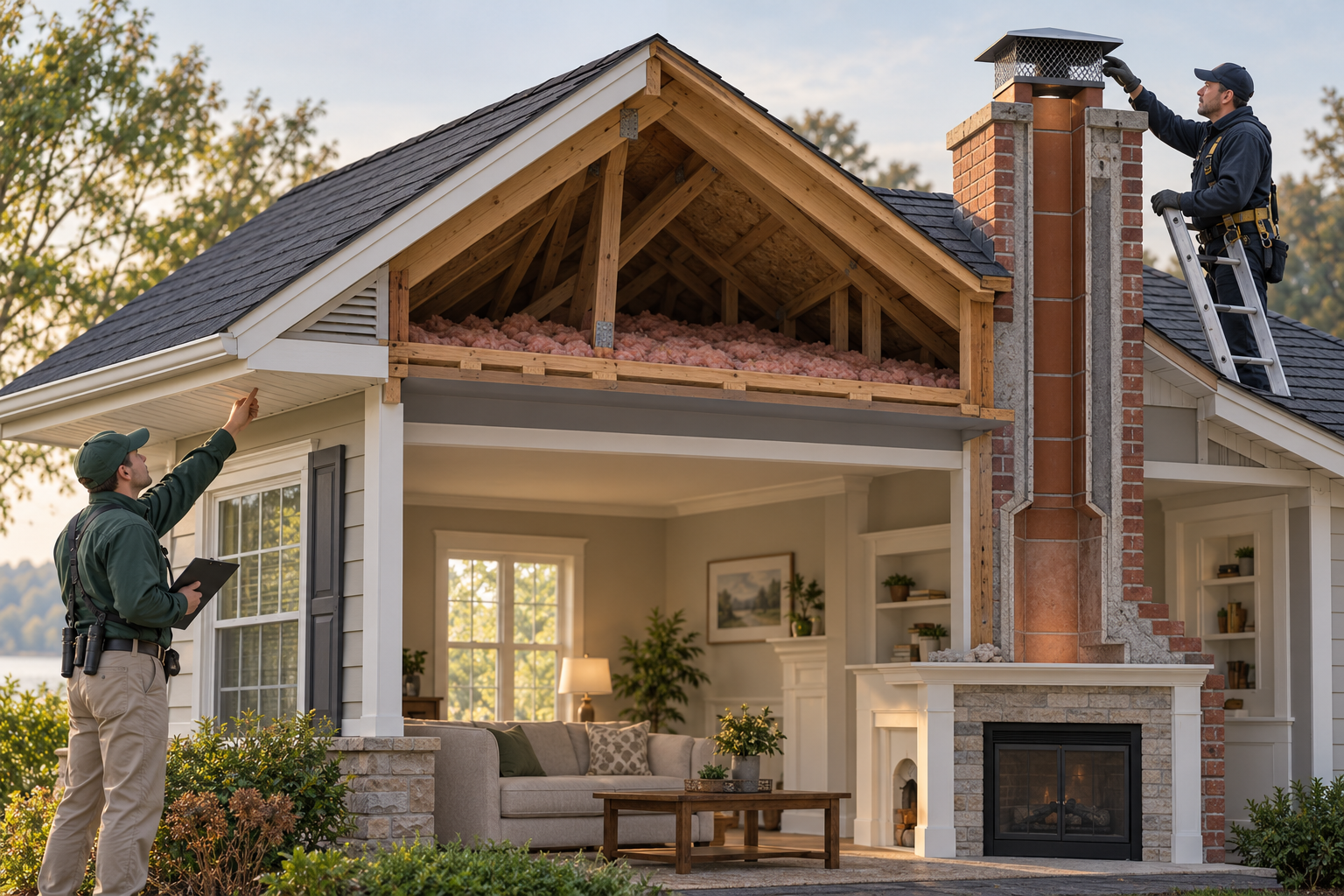
A chimney can create vertical access, heat and draft considerations, a difficult inspection, and a risk of separating an adult from young. The repair may require a cap, screen, masonry, flashing, or flue professional. Do not treat a chimney opening as an ordinary hole to be blocked.
Attic work can also involve roof access, insulation disturbance, feces, urine, and damaged wiring. A pest quote may identify those conditions without owning cleanup, electrical inspection, roofing, or structural repair.
Wildlife law is local
Trapping, relocation, hunting, poison, carcass disposal, and licensed-operator requirements vary by province, state, municipality, species, season, and property condition. Québec’s current property guidance describes a live-raccoon relocation ban for nuisance animals in specified municipalities across Estrie, Montérégie, and Centre-du-Québec after prevention fails; a separate July 2026 notice names a narrower regional area. Ask the provider to verify the exact municipality and current rule rather than relying on a regional summary or penalty table. The British Columbia, Ontario, and Québec examples show why one jurisdiction’s rule cannot be generalized.
If a person may have been bitten, scratched, or exposed to saliva from a raccoon or another mammal, use urgent local public-health or medical guidance. Removal pricing is not an exposure assessment.
Compare proposals
Ask each provider to state the species, den location, young-animal assumptions, method, visits, access equipment, exclusion, cleanup, repair, disposal, and guarantee. Confirm whether the quote assumes that the animal is already outside, whether monitoring is included, and who closes the opening.
The lowest removal price may omit the work that prevents recurrence. The most complete proposal may still exclude roof, chimney, insulation, structural, electrical, or finish repair. Price those scopes separately rather than accepting a vague “complete removal” promise.
When the inspection is incomplete, compare an inspection-only price, a fixed removal scope for the confirmed condition, and the stated cost trigger for added visits or young animals. Ask for a photograph or description of each opening and the final closure method. For chimney work, identify whether a chimney professional must check the cap, flue, masonry, or flashing; for attic work, determine whether insulation, wiring, or structural wood needs its own assessment. These handoffs can change the project total more than the animal-removal line itself.
Compare attic, chimney, and family-group projects
The quoted animal-removal amount is only one part of the project. A useful proposal states which condition it prices and how the price changes if inspection reveals a different one.
| Condition found | Work to price explicitly | Why the initial quote may change |
|---|---|---|
| Adult animal in an accessible attic | Inspection, lawful removal or eviction, follow-up, and closure of the confirmed entry | A second route or inaccessible den may require another visit. |
| Raccoon using a chimney | Inspection method, timing, confirmation the flue is clear, and who installs or repairs a cap | Vertical access and chimney function require a different trade handoff. |
| Mother with dependent young | Local rule and appropriate sequence, return visit, and temporary protection if needed | Timing and number of visits may change; a fixed “one visit” assumption may not fit. |
| Feces or latrine material | Area and materials affected, cleanup provider, and limits of the wildlife quote | Contamination work can be separate from removal and exclusion. |
A variable allowance is reasonable only when the unverified condition and its price trigger are stated. Ask whether the provider will call before exceeding the agreed amount, how added travel or after-hours access is charged, and whether the price includes a written completion record.
Set the change-order point before opening an attic or roof
When inspection cannot confirm whether the den is accessible, ask for an inspection-only fee and a separate price for the likely removal path. A fixed first-visit price may not include dependent young, a second entry, a chimney inspection, or contaminated material discovered after access. The provider should state whether any such finding pauses work for approval or automatically adds a visit or charge. That written trigger is more useful than a single “complete removal” total built around an unknown animal and building condition.
For a family group or a seasonally delayed job, ask how long temporary protection remains in place, whether a return visit is included, and whether the original quote stays valid if the lawful work window changes. Keep animal control, cleanup, roof or chimney repair, and structural or electrical assessment in separate lines unless the contract names each one. This lets the homeowner compare a removal-only proposal with a full building project without treating unpriced cleanup or restoration as zero cost.
Use completion records to coordinate the next trade
Before permanent exclusion, ask the provider to document that the den is clear and record the entry point and any inaccessible area. Give that handoff to the roofer or chimney contractor, who can confirm that a cap, soffit, vent, or flashing repair preserves the assembly’s function. A wildlife completion note does not certify structural or electrical safety or assess an exposure concern.
Bottom line
Use a few hundred to more than $1,500 U.S. only as broad orientation. Den status, young, timing, roof or chimney access, exclusion, cleanup, and repair shape the actual project. Verify the lawful local method and obtain an itemized quote that says what happens if inspection changes the assumptions.