
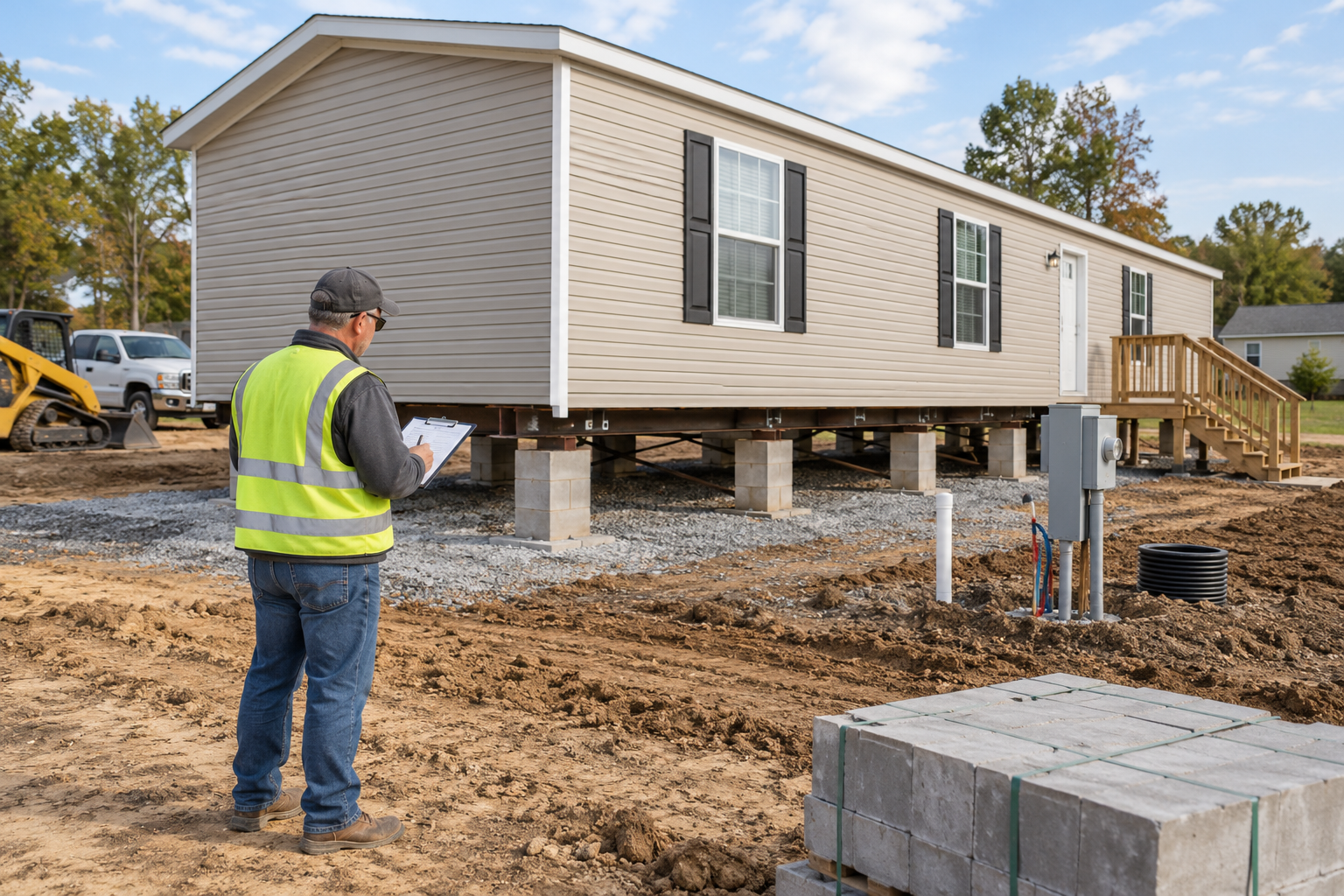
Transport is only one part of moving a used manufactured home. At the destination, the home may need a new support and anchoring system, section reconnection, utility work, belly or duct repairs, skirting, stairs, inspections, and correction of damage found during close-up. A used home can therefore cost more to install than a new home with a prepared site even when the purchase price is lower.
Inspect before committing to the move
Record the home’s age, section count, labels, chassis condition, roof and floor condition, prior modifications, and access to both the origin and destination. Ask the mover and installer who is responsible for disconnecting utilities, removing decks or skirting, protecting openings, handling transport damage, and documenting pre-existing defects.
The destination needs its own feasibility review. Confirm access, turning and staging, soil and drainage, foundation or piers, anchors, utility distances, permits, and inspection requirements. A move that is physically possible may still be uneconomic after site work and repairs.
Reinstallation cost layers
Request separate lines for:
- destination clearing, grading, drainage, and foundation readiness;
- blocking, leveling, supports, anchoring, and any engineering;
- reconnecting sections and sealing the marriage line or other close-up;
- water, sewer or septic, electrical, gas, HVAC, and duct connections;
- repairs to belly material, insulation, plumbing, roof, flooring, or openings;
- skirting, stairs, landings, finish restoration, permits, tests, and inspection corrections.
Federal U.S. installation material organizes many of these subjects, but the applicability to an existing relocated home and the responsible authority must be verified. Provincial guidance in Canada likewise does not create one national relocation checklist.
Plan for findings after the home is set
Opening or reconnecting a used home can reveal crushed ducts, wet insulation, split pipes, damaged underbelly, distorted doors, roof leaks, missing hardware, or support movement. Keep a contingency and agree on a change-order process before transport. Do not let a “setup included” label hide whether repairs, tests, and final inspection are excluded.
Use separate local quotes for the United States and Canada. No durable evidence establishes a universal reinstallation price, and exchange-rate conversion is not a market estimate. The useful comparison is the complete destination-ready cost against buying a home already installed, including the risk that the used structure cannot be economically repaired.
Price the destination-ready scenario
For a U.S. planning model, assume $10,000 for support and anchoring, $8,000 for section close-up and repairs, $9,000 for utilities and tests, and $6,000 for skirting, stairs, and correction work: $33,000 after transport. A separate Canadian model might use CAD 13,000 + CAD 10,000 + CAD 12,000 + CAD 8,000 = CAD 43,000. These are illustrative allowances, not a market survey. They exclude the purchase price, transport, and any major structural or moisture failure.
Before moving, ask for a condition report that identifies which allowance applies to the home. After set, require close-up and utility testing before treating setup as complete. If a quote has no allowance for damaged belly material, crushed ducts, failed supports, or releveling, its headline price is not comparable with a complete reinstallation.
Pass a feasibility gate before paying for transport
A move decision should be made in stages. First confirm that the home can be identified, inspected, legally moved on the proposed route, and placed at the destination. Then price origin preparation and destination readiness. Only after both ends are feasible should the owner compare carrier bids. A transport company may be able to haul the sections while another installer or authority controls disassembly, reinstallation, or occupancy approval. Get each answer in writing before paying a non-refundable deposit.
At the origin, inventory decks, porches, carports, additions, skirting, service lines, trees, and access. Ask who removes, stores, and restores them and who disconnects each utility. At the destination, confirm the prepared foundation, grade and drainage, anchors, utility distances, turn radius, crane or setting needs, and local permits. Ask the mover to inspect both sites and state whether the price assumes unobstructed routes, dry access, reusable running gear, and no delay. A distance-only transport bid does not measure those tasks.
The home’s condition can determine whether reinstallation is economical. Ask a qualified inspector or installer to review floor and roof damage, frame or chassis condition, prior repairs, labels and instructions, section connections, plumbing and duct condition, and evidence of water intrusion. Do not assume that a lower purchase price offsets unknown transport damage or a weak destination site. If a critical part cannot be seen, request a separately priced investigation and define what finding would make the move stop.
Compare the cost of completing the move
Use three totals: leaving the home in place, relocating and restoring it, and purchasing a comparable home already installed or installing a replacement. The move total should include removal and origin cleanup, disconnection, preparation, permits, transport, destination site work, foundation or supports, anchoring, close-up, utilities, inspection, finish restoration, temporary housing or storage, and contingency. Include the purchase price if the home is not already owned. Keep the destination-ready subtotal separate from optional upgrades.
A transparent quote comparison names the home sections, mileage, route, escort and permit assumptions, origin and destination tasks, and who bears costs after a failed inspection or weather delay. Ask whether transport insurance covers the actual home value and what condition documentation is required before loading. Photograph existing damage and secure a signed condition report. Clarify the process for claims and the party responsible for damage discovered during setting.
If a relocation scenario uses a planning allowance rather than a market estimate, do not add a hidden generic contingency percentage. List uncertain tasks and put a provisional amount beside each with the triggering condition. For example: access correction if the crane cannot set as planned; support repair if the engineer finds movement; belly work if a tear is exposed; route changes if an overhead clearance fails. Replace these allowances with local bids as soon as the condition is known.
Identify move-stopping findings early
A route that cannot accommodate the home’s dimensions, a destination where the home cannot be permitted, a structural condition that prevents safe lifting, or an unapproved site can make a transport quote irrelevant. The same is true if financing, title, insurance, or a lease requires documents that cannot be obtained in time. Check these constraints before paying for disconnection. For an older home, age alone should not be treated as a universal prohibition, but the actual condition and local acceptance must be established.
Use a written milestone list: documentation and feasibility confirmed; origin scope contracted; route and permits approved; destination work accepted; move completed; home reconnected and tested; final approvals and records delivered. Pay against completed milestones where the contract allows. Keep the final amount back until the contracted work and tests are finished. If the home is on leased land, get written permission and terminate the site lease according to its terms before assuming the home can be removed without additional charges.
Keep mortgage eligibility separate from setup money
Freddie Mac’s September 2026 Guide bulletin permits certain mortgages on a manufactured home that has already been moved, subject to a structural-integrity inspection, the home’s construction zone, and the rest of the lender’s requirements. The bulletin excludes delivery and setup, anchoring, site development, installation, and permanent utility connections from mortgage proceeds. This is a potential financing path after a move, not a way to pay the mover or make an infeasible destination ready. Ask the lender whether it follows the updated Guide and what records the home needs.
Make the final decision against the owner’s goal
A move can preserve a familiar home, solve a site problem, or allow a family to use land they already own. Its value is not only resale. But the comparison should include loss of use, risk that repairs exceed the home’s remaining utility, and whether the destination solves the same need. If an installed alternative costs more but avoids transport and reinstallation risk, compare both with the same site, utility, finish, and approval scope. If the quotes remain incomplete, treat the unknown as a decision factor rather than choosing the lowest visible price.
Include the home’s condition in a move contract
Before loading, compare the signed condition report with the seller’s description and the mover’s assumptions. Identify any existing roof, floor, frame, opening, belly, or utility damage, and take photographs of all sides and section joints. The move contract should state which damage predates transport, how new damage is recorded, how quickly a claim must be reported, and what repair is excluded. Ask whether the mover can refuse or delay loading if an inspection reveals that lifting would be unsafe.
At the destination, require the installer to report transport damage before covering the underside or closing the sections. A documented inspection at each handoff helps separate a carrier claim from a pre-existing repair and avoids paying for restoration twice.
Decide how much inspection is enough before moving
A pre-move assessment should be proportional to the risk and value at stake. At minimum, resolve structural handling concerns, identify open water or roof issues, and establish whether section connections and utilities can be safely disconnected. A more complete review may inspect hidden floor or belly areas, but destructive access costs money and may reveal repairs that change whether the move proceeds. Ask what decision the inspection will support before paying to open finishes.
If the owner and buyer disagree over who pays for a discovered repair, settle responsibility before transport. A clear inspection contingency can allow the move to stop or the price to change if a defined critical condition is found. This is more useful than adding an unexplained contingency after the home has been loaded.