
Window replacement in a manufactured home is often an opening and water-management project. Wall thickness, the rough opening, flange or trim, siding, interior finish, egress, and settlement can affect the product and labor. A standard window may fit, but the home’s dimensions and installation details must be verified before ordering.
Diagnose the opening first
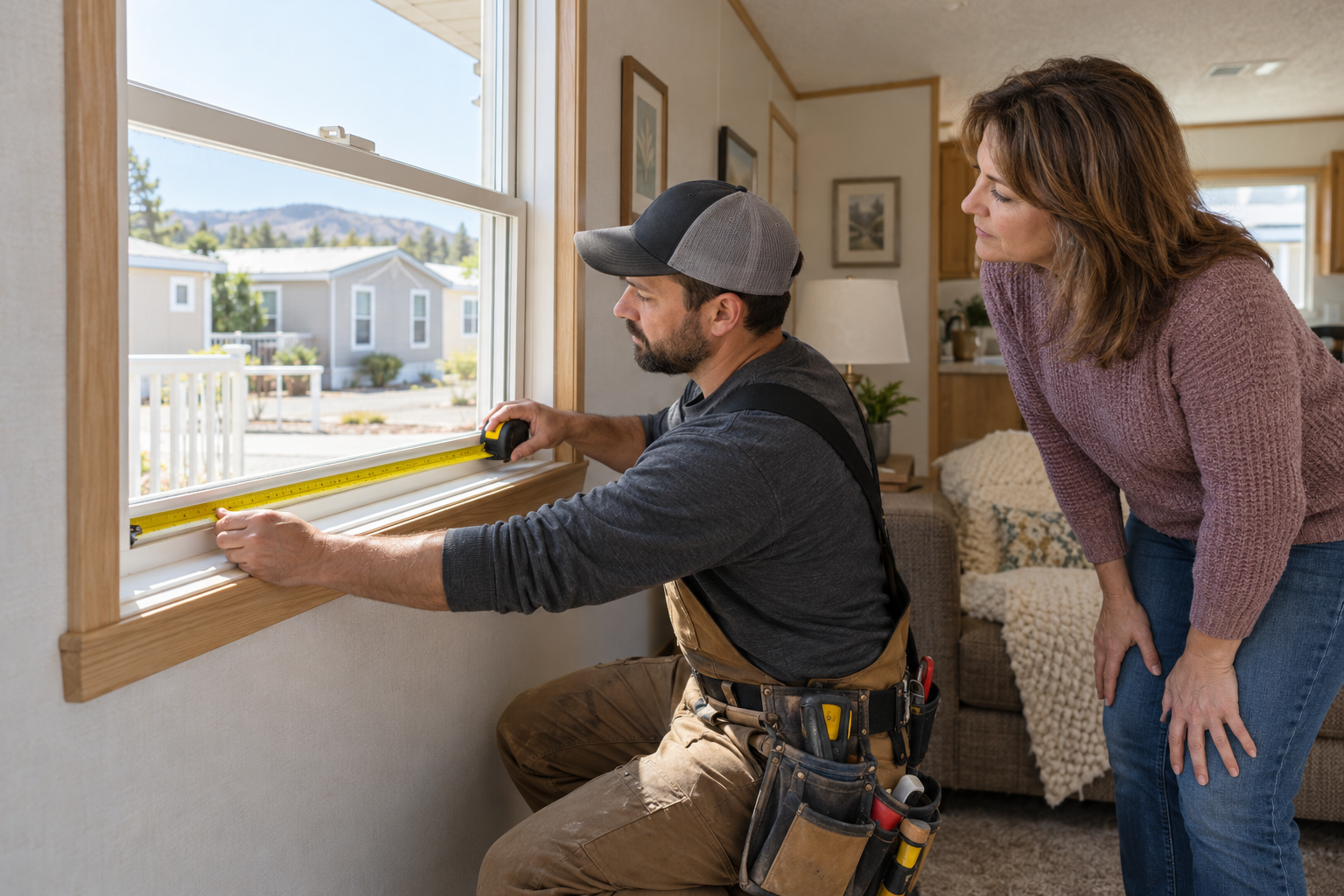
Check whether the problem is broken glazing, failed hardware, air leakage, water entry, rot, a distorted frame, or a wall or support movement. Record the opening dimensions, wall thickness, interior and exterior trim, siding, sill condition, and whether the window is a required escape opening. A window that binds may be reacting to settlement rather than failing on its own.
The home’s age, manufacturer, prior replacement, and labels or data plate can help explain the construction context, but they do not guarantee a proprietary size. Measure the actual opening and have the installer verify the replacement unit, flashing or water-management method, and finish transitions.
Choose the scope
A limited replacement may reuse a sound opening and involve the unit, flashing, sealants, trim, and interior restoration. A larger project may require framing repair, resizing, siding removal, wall or floor repair, water-damage correction, or releveling before the new window can be installed. Resizing an opening may affect structure, weather resistance, egress, or local approval.
Do not use a new window to conceal a leak or movement problem. If there is staining, soft material, or recurring water, price source correction and drying before finish restoration.
Ask for a complete quote
Separate measuring and diagnosis, window, removal, disposal, flashing or water management, trim, siding, interior finish, framing, access, permits or inspection, and repairs to concealed damage. State whether the price assumes a standard opening, intact wall, dry conditions, and no resizing. Ask how the installer handles an opening that differs from the order.
There is no universal manufactured-home window replacement price. Keep U.S. and Canadian quotes separate and compare the opening, product, installation method, access, and restoration rather than only the window unit.
Build the opening allowance
For a U.S. planning example, assume $600 for measurement and diagnosis, $900 per replacement window for six windows ($5,400), and $1,500 for flashing, trim, disposal, and restoration: $7,500. A separate Canadian model might use CAD 800 + six at CAD 1,150 (CAD 6,900) + CAD 2,000 = CAD 9,700. These are transparent assumptions, not a universal window price. Custom sizing, rotten framing, egress, safety glazing, or releveling can change the result.
Have the quote state whether it replaces the unit only or includes opening correction, flashing, trim, interior finish, and water testing. If movement or moisture caused the failure, a replacement-only scope may repeat the problem.
Verify safety and performance
Egress, safety glazing, structural openings, flashing, and product compatibility can be jurisdiction- and installation-specific. Use a qualified installer and confirm current requirements when those issues are involved. If the opening is visibly distorted or water is entering near electrical equipment, arrange an assessment before proceeding with a replacement-only scope.
Decide whether the window or the opening is failing
Before ordering, identify the symptom: broken glass, failed sash, hardware, air leakage, water at the sill, rot, a distorted frame, or a window that binds. A service repair may address an isolated sash or lock. A full replacement may be needed when the unit or frame has failed. If the opening is out of square, the floor is uneven, or other doors and windows stick, check settlement or support conditions before treating the window as the cause.
Measure width, height, wall thickness, frame depth, interior return, exterior trim, and siding. Ask the installer to confirm the rough opening and replacement unit in person. Note whether it serves as an escape opening or has safety-glazing considerations. A modern standard size is not a reason to enlarge the opening without structural and local review. Keep the data plate and old product label where available, but do not assume they reveal the actual current opening after prior alterations.
Compare the installation methods
A replacement within a sound opening may limit finish work but depends on matching the existing frame and flashing. A full-frame replacement can expose rot and allow a new water-management detail, but may add siding, drywall, trim, and insulation restoration. Resizing the opening or changing its type can affect structure, egress, exterior appearance, and permits. Ask each bidder which method they propose, why it suits the wall assembly, and what condition would require a different approach.
The lowest unit price may exclude flashing, air and water sealing, interior trim, disposal, or repairs behind the frame. Request itemized lines for measuring, unit, removal, preparation, sill and framing, flashing, water management, insulation, exterior finish, interior finish, permits, and testing. Clarify who is responsible for leakage if the window is installed into a wall with pre-existing moisture or movement.
Compare repair and replacement over the expected use
If glass, hardware, or weatherstripping can be repaired and the frame remains sound, repair may cost less and preserve the existing opening. Replacement may make sense when several components fail, parts are unavailable, leakage recurs, or performance is a priority. Compare installed cost, expected maintenance, energy use, noise, comfort, warranty, and visual match. Do not claim a payback without actual energy use, local rates, product rating, and a defensible estimate of savings.
Where multiple windows are failing, get one price for targeted replacement and another for the group. Ask whether bulk labor or shared setup lowers the total and whether each opening has the same condition. A single price per window can mask variation in wall damage and access. Keep the opening count and finish assumptions visible.
Verify water management and safety
Ask the installer to explain sill support, flashing or water-management details, sealant, drainage path, and how concealed damage is handled. If water stains or soft material are present, price source correction and drying before replacement. Confirm current local egress and safety-glazing requirements with the authority when the work changes an opening or a required escape window. Those rules depend on location and use.
After installation, retain product labels, warranty, permit and inspection documents, invoice, and before-and-after photos. Ask how the final installation is checked for operation, locking, air leakage, and water entry. Note which openings were not repaired. If leakage returns, record the timing and location before re-caulking; it may reflect flashing, siding, roof, or wall conditions rather than the new unit.
The project budget should distinguish the window product from the opening repair. This makes it possible to compare a repair, a standard replacement, and a larger wall correction without treating a custom opening as an unexpected extra after the old unit has been removed.
Plan for a group of openings
For a multi-window project, number each opening and record its size, type, condition, access, and finish. Ask the installer whether the same product and method work across the whole home or whether some openings need custom units or framing repair. Grouping work may reduce setup time, but hidden moisture and dimensions can still differ. Request a per-opening schedule and group total so the owner can prioritize the most damaged units.
If the work is phased, verify that the selected product remains available and that future units can match. Keep a spare screen, hardware, or product identifier where offered. This can reduce the cost of a later isolated repair.
Plan installation around weather and household access
Replacing a group of openings can leave rooms exposed during removal. Ask how each opening is covered between removal and installation, how rain or wind delays are handled, and whether the crew completes one window at a time. For a bedroom or required exit, keep a safe means of egress throughout the project. Confirm how pets, children, furniture, and security are handled when a main window is open.
These details can affect labor and temporary protection. Put them in the scope instead of assuming every installation is a same-day swap.
Choose where a limited budget goes first
If every opening cannot be replaced at once, prioritize active water entry, broken glass, security or safe-exit concerns, and units that are causing interior damage. Then compare comfort or efficiency improvements using actual household goals and product information. A uniform visual upgrade may be postponed if a few damaged openings create the larger risk. Ask whether the installer can phase the work without losing product availability or warranty coverage.
Keep the remaining openings on a dated list with condition and next review. This makes a partial project intentional and helps future bids use consistent measurements and product assumptions.
Ask what happens if dimensions are wrong
Custom or ordered windows can create a costly delay if the field measurement is incorrect. Confirm who measures, who verifies the order, whether the owner approves the size, and who pays for restocking or a replacement unit if it does not fit. Ask whether the opening is measured before or after removing trim and how the installer handles a concealed difference. Put the responsibility in the contract before ordering.
This question is especially useful when several openings are being replaced. A clear measurement sign-off avoids repeating the same mistake across the whole group.