
The right maintenance budget follows the home’s condition, climate, site, and installation history. A fixed annual checklist or dollar amount can create false confidence because one home may have sound supports and easy access while another has drainage, underfloor, or documentation problems that change every quote.
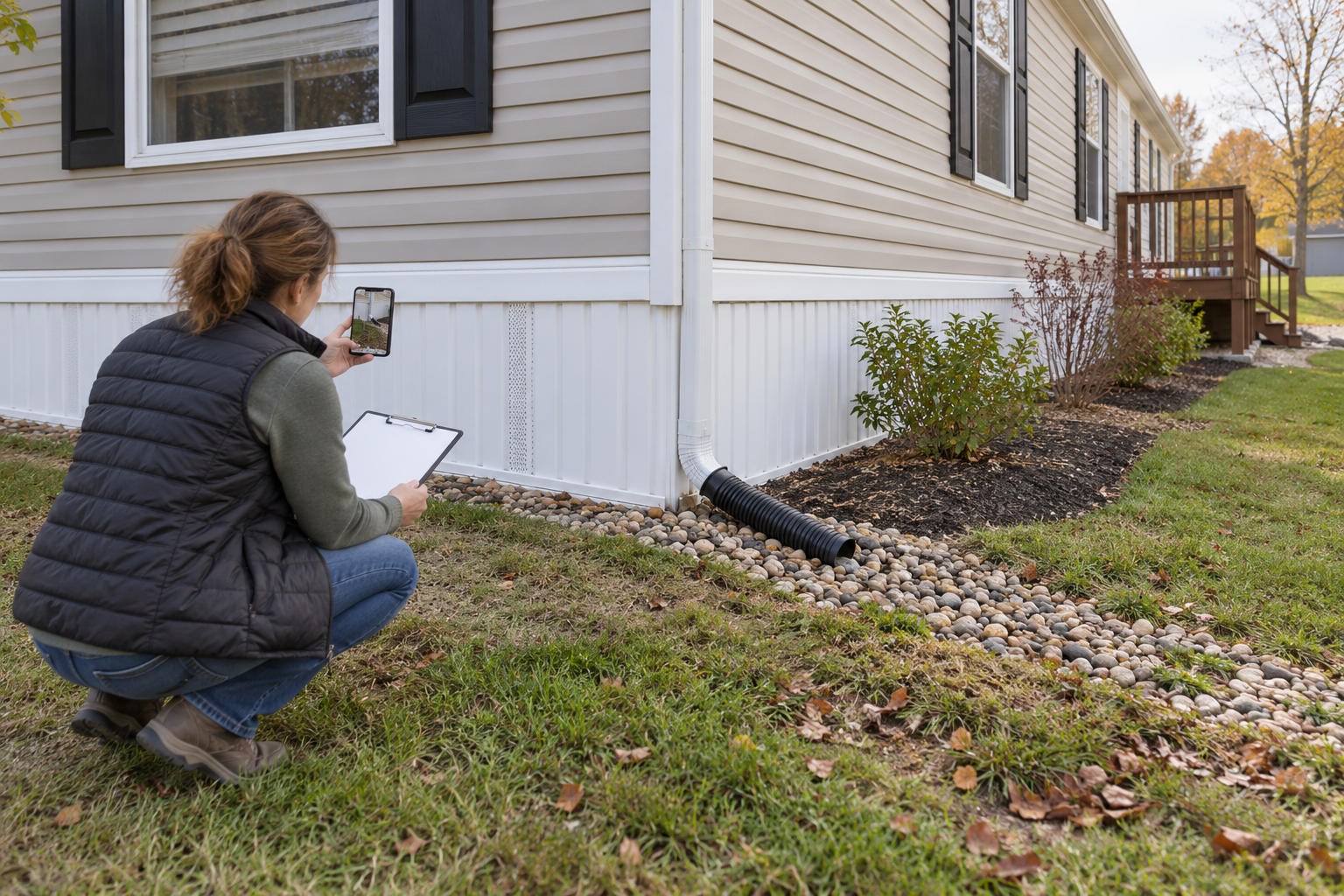
Check the systems that change repair exposure
At a sensible seasonal or annual interval, arrange safe visual checks of:
- grading, downspouts, standing water, erosion, and access below the home;
- piers, footings, shims, support contact, visible corrosion, and signs of movement;
- anchors or tie-downs where visible, without treating a visual check as a capacity assessment;
- skirting, access panels, vents where applicable, pests, and damage to the perimeter enclosure;
- the belly or bottom board, insulation, ducts, plumbing, and signs of moisture where accessible;
- roof penetrations, coatings, ponding, flashing, gutters, windows, and exterior doors;
- heating, cooling, water-heating, electrical, fuel, and utility connections;
- additions, decks, carports, stairs, and attachments that may move differently from the home.
Use the manufacturer’s manual and local requirements when they provide a more specific maintenance instruction. The federal installation standard is not a universal maintenance schedule or a repair authorization.
Let weather drive the timing
After heavy rain, inspect drainage and water below the home. After a freeze, check for leaks and exposed or damaged underfloor insulation without disturbing a hazardous area. After high wind, flooding, an earthquake, or a move, arrange a qualified assessment of supports, anchoring, connections, and utilities. Before winter, make sure the freeze-protection plan matches the piping, belly condition, occupancy, and equipment instructions.
The point is early detection, not a promise that a visual check will find concealed damage. Wet insulation, a soft floor, a sticking door, or a gap at a section joint can have more than one cause.
Turn checks into a reserve
Create separate budget lines for routine service, access and inspection, drainage, support or leveling, underbelly and insulation, equipment, utility connections, and finish restoration. Record whether a quote includes diagnosis, permits, engineering, testing, removal, disposal, and repair of the cause. Keep U.S. and Canadian reserves as separate market estimates; travel, labor, materials, and jurisdictional requirements differ.
If a contractor proposes a recurring service, ask what condition it addresses, what evidence supports the interval, and what is excluded. A low-cost check is useful when it prevents a leak or catches movement early, but it is not a substitute for an engineer, electrician, plumber, HVAC technician, or other qualified professional when the issue crosses a safety or structural boundary.
Maintenance is decision support
Keep photographs, measurements, labels, invoices, permits, inspection reports, and repair dates with the home records. This makes future quotes more comparable and helps distinguish an existing condition from a new event. It also gives a buyer, lender, or professional a clearer history without claiming that the paperwork proves current compliance.
There is no defensible universal annual budget from the available evidence. Price the actual condition and access of the home, maintain a contingency for concealed work, and treat every recurring recommendation as a scope question rather than an automatic expense.
Model a reserve instead of using a percentage rule
An illustrative U.S. planning model might set aside $300 for seasonal checks and minor sealing, $900 for one professional service visit, and $1,800 for an underfloor, drainage, or support contingency: $3,000 for the year. A Canadian household could build a separate CAD model such as CAD 400 + CAD 1,100 + CAD 2,200 = CAD 3,700. These are transparent planning assumptions, not observed national averages. A newer, dry home on a serviced lot may need less; an older home with recurring moisture, movement, or remote access may need much more.
Keep predictable maintenance separate from a capital reserve. A recurring HVAC visit is not the same exposure as a releveling, roof, water-heater, or underbelly failure. Revisit the reserve after an inspection, major weather event, move, or change in occupancy, and record which assumptions made the allowance rise or fall.
Build a condition-based annual budget
Start with the home’s actual systems, not a percentage of its purchase price. List the roof and exterior, drainage, skirting or enclosure, supports and anchoring, belly and insulation, ducts, heating and cooling, water heater, plumbing, electrical service, utilities, and any additions or section joints. For each, record its age if known, visible condition, last service or repair, access needed, warranty information, and the next question that requires a professional. This inventory shows where a small maintenance visit could prevent damage and where the owner is carrying a larger replacement risk.
Divide planned spending into routine observation, scheduled professional service, predictable replacement, and contingency. The first category may cost little but requires owner time and a way to record changes. The next includes qualified work on equipment or systems according to the manufacturer and local rules. Replacement planning is a separate reserve for aging components. Contingency covers uncertain concealed damage or a sudden failure. Do not combine all four into one annual figure: an owner’s ability to self-observe does not reduce the cost of licensed work or a major replacement.
No evidence here establishes a universal maintenance interval, annual reserve, or average repair bill for U.S. and Canadian homes. Use the manual, equipment instructions, climate, inspection history, and local professional advice to set intervals. If documentation is missing, mark the interval as unknown and ask for a baseline assessment instead of copying a schedule from a different house type. Keep U.S. and Canadian prices in their own markets and do not use a converted currency as a reserve target.
Prioritize by consequence and detectability
A practical list ranks each condition by two questions: what happens if it worsens, and how soon will the owner notice? Water entry, damaged support, unsafe electrical or fuel equipment, failing heat during freezing weather, and a roof leak near equipment may justify prompt qualified attention. A worn finish with no movement or moisture may be planned later. This is a triage tool, not a technical risk score or substitute for emergency advice.
Ask a contractor to explain what observation would mean “monitor,” what would mean “repair,” and what would require a larger assessment. A changed floor feel, recurring door binding, water that appears after storms, or a rising utility bill can be a useful signal but does not diagnose the cause. Record dates, photographs, weather or usage conditions, and previous repairs. When an issue recurs, show the history; repeated service calls may be more costly than an investigation that addresses the source.
Plan replacement without treating an allowance as a quote
For each major component, write down the likely replacement path and the adjacent work it could trigger. A roof replacement may involve tear-off, decking, flashing, section close-up, and a check of added weight. HVAC may involve electrical capacity, ducts, venting, controls, and commissioning. Underfloor plumbing may need belly access, drying, insulation, and finish restoration. A replacement fund based only on the visible appliance or surface will understate the eventual project.
Use three owner-defined planning cases: a limited repair, a normal replacement with the currently known interfaces, and a more involved case if access or concealed damage changes. Populate the cases with current local bids when possible. If no bid exists, leave a line as unknown instead of inserting a national average. Keep each assumption visible: number of sections, area, fuel, access, permit, disposal, and whether the price includes testing. Update the reserve when an inspection, repair, or purchase changes what is known.
Track spending in a way that improves the next decision
Keep a simple log of date, symptom, professional, work completed, parts or system changed, test or permit record, amount paid, and warranty. Attach the report and photographs. When a new quote arrives, compare it with prior work to see whether it repeats a temporary repair, expands the scope, or adds a new system. This history also helps when a buyer, insurer, lender, or authority asks what changed.
A maintenance budget is not a promise that every repair can be predicted. Its job is to distinguish expected upkeep from a low-probability major exposure and to keep routine work from consuming the money needed for a known replacement. Review it after severe weather, moving, a renovation, a water event, a change in occupancy, or a professional inspection. If the home has a leased lot or specific insurance exclusions, include those recurring obligations in a separate ownership-cost plan rather than calling them home maintenance.
Keep operating cost separate from repair reserve
A monthly budget can separate recurring service, utilities, property charges, and site rent from money reserved for a future repair. Equipment energy bills may reveal a performance issue but do not predict a replacement date. Lot rent, insurance, taxes, and loan payments can change ownership affordability without being maintenance expenses. Tracking them in separate rows prevents one category from hiding another. Update the reserve when a home inspection or repair identifies a known replacement, and keep an emergency amount accessible for leaks or service failures rather than treating it as planned annual work.