
Insulating the belly of a manufactured home is not the same as spreading insulation in an accessible attic. The installer may need to assess the belly barrier, moisture, pipes, ducts, wiring, floor cavities, and access before selecting a method. Repairing a leak or damaged barrier can be more important than adding insulation immediately.
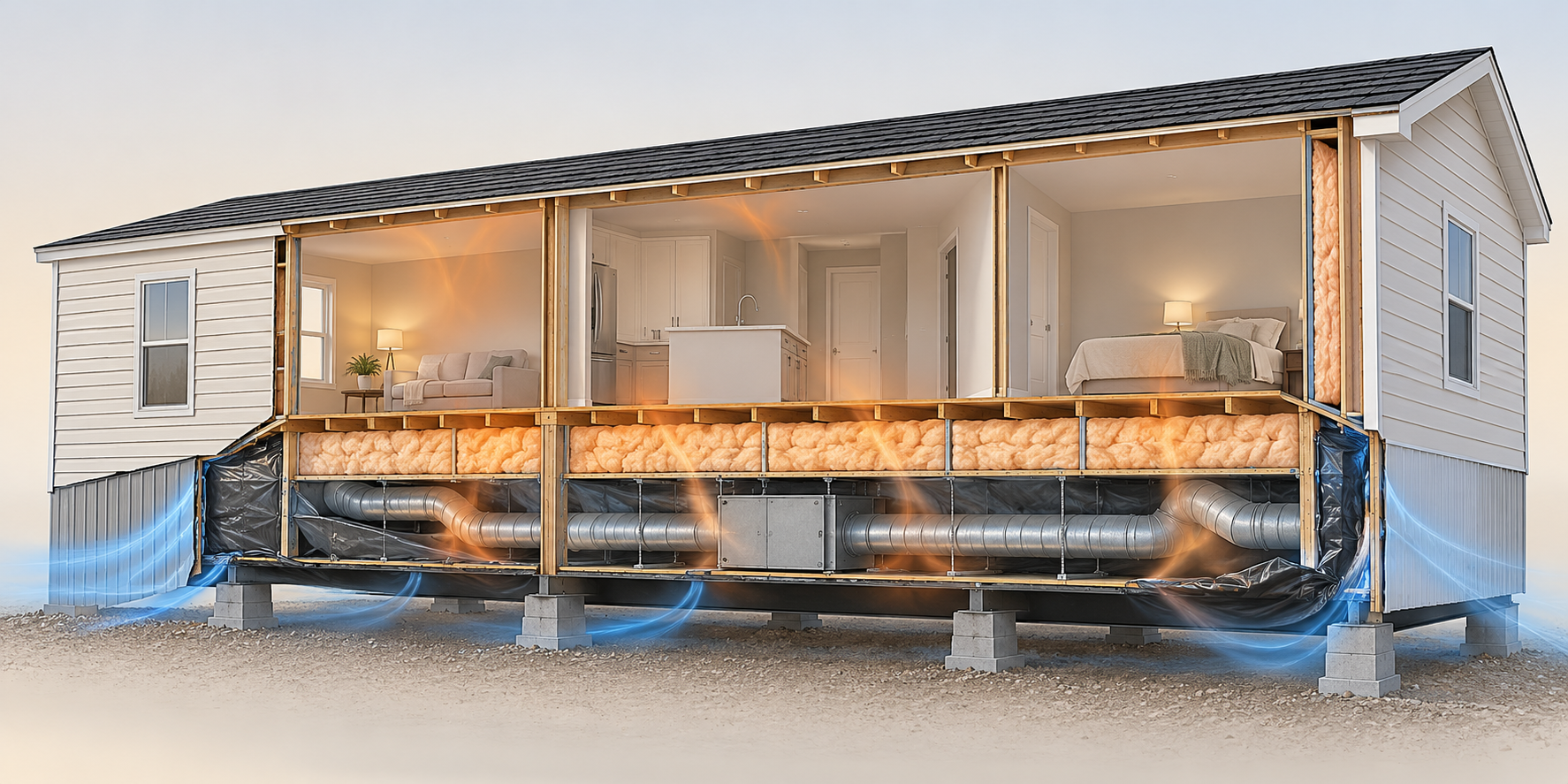
Inspect before insulating
Ask for an assessment of:
- wet, compressed, missing, or animal-damaged insulation;
- tears and openings in the belly barrier;
- duct leakage, disconnected crossovers, and unconditioned air paths;
- plumbing, freeze exposure, wiring, combustion, and structural hazards;
- ground moisture, drainage, and skirting or perimeter access;
- floor comfort, energy use, equipment condition, and the household’s goals.
DOE provides separate manufactured-home job aids for belly, sidewall, ceiling, and roof-related insulation methods. These are installer guidance, not a universal prescription. Method choice depends on the existing assembly and the trained installer’s scope.
Sequence changes the economics
Correct water and animal entry, repair the belly, fix duct or plumbing problems, and address unsafe conditions before closing the cavities. A weatherization project may include air sealing, belly insulation, duct sealing or insulation, sidewall or ceiling work, access restoration, and testing. A larger package may need an energy assessment and equipment coordination.
The expected benefit depends on climate, fuel, occupancy, equipment, air leakage, insulation condition, moisture, and the price of energy. The available evidence does not establish a universal savings percentage, rebate, or payback period. Treat a calculated payback as a home-specific estimate, not a guarantee.
Compare project scopes
For a U.S. planning example, assume $1,500 for inspection and access, $4,500 for belly-board and insulation restoration, $2,000 for duct or air-sealing work, and $1,000 for cleanup and testing: $9,000. A separate Canadian model might use CAD 2,000 + CAD 6,000 + CAD 2,500 + CAD 1,300 = CAD 11,800. These are illustrative assumptions, not a payback calculation or national market range.
The energy case depends on the existing assembly, climate, moisture, fuel, utility rates, and work actually completed. Price source correction, barrier repair, insulation, ducts, and access separately. A rebate or modeled energy saving should reduce the decision cost only after eligibility and installation requirements are confirmed.
Request a targeted belly repair, a belly-insulation restoration, and a broader weatherization option when all are plausible. Have the quote identify insulation type and area, barrier repair, duct work, access, disposal, tests, permits, and exclusions. Ask what happens if moisture, wiring, plumbing, or structural damage is found.
Use current official program pages to check rebates or low-income weatherization eligibility. B.C. energy options and Canadian rules cannot be generalized to every province, just as U.S. program guidance does not establish Canadian eligibility. Get separate local U.S. and Canadian quotes and preserve the existing-condition assumptions.
Decide what the retrofit is expected to improve
Before pricing, write down the problem the household wants to solve: cold floors, high energy use, uneven rooms, frozen plumbing, drafts, damaged insulation, or an energy-program requirement. These goals can lead to different scopes. A failed belly barrier needs repair even if the owner is also considering more insulation. Duct leakage may explain comfort or energy problems that insulation alone cannot solve. Freeze protection may require pipe or occupancy planning rather than an energy retrofit. Ask the auditor or installer to distinguish observed defects from proposed upgrades.
Gather recent utility bills, fuel type, thermostat settings, household occupancy, equipment age, and the season when symptoms occur. If bills fluctuate because of vacancy or changing rates, note that. Request an energy assessment or diagnostic tests appropriate to the home rather than treating one bill as proof that the belly is the main cause. The contractor should explain which parts of the analysis are measured, estimated, and assumed.
A useful sequence is to correct bulk water and active leaks, address unsafe wiring or combustion conditions, restore openings or damaged belly material, evaluate duct leakage and support, then choose insulation and air-sealing measures that fit the assembly. Sealing or insulating before the moisture source is controlled can hide damage. Ask the installer to document why the proposed order suits the home and whether other trades must work first.
Compare a targeted repair with a whole-house package
A targeted job may restore only wet or missing belly insulation and a local barrier section. A broader package can include belly, sidewall, ceiling, duct, air-sealing, heating equipment, and testing. The broader package may have more opportunity to reduce energy use but also costs more and may require several trades. Request an itemized proposal with individual measures and a package total so the owner can choose the work that matches budget and expected benefit.
For each measure, ask how much area is treated, how existing insulation is handled, what material and installation method are proposed, how pipes and wiring are protected, whether ducts are included, and how the work will be checked. Ask how the proposal changes if wet insulation, animal damage, damaged ducts, or inaccessible areas are found. A low bid that excludes necessary belly repair is not comparable with a complete weatherization scope.
Calculate payback from household data
No cited evidence establishes one savings percentage, incentive, or payback period for every manufactured home. If a contractor provides a savings estimate, request the baseline energy use, utility rates, weather adjustment, occupancy, equipment assumptions, measure-by-measure savings, expected service life, and any financing cost. Compare annual savings with installed cost and expected maintenance, but keep the calculation as a range when rates or use can change. Ask whether the estimate is modeled or based on a measured test.
A simple household comparison can use actual recent bills as a baseline and show low, expected, and high savings assumptions from the assessment. If no credible savings estimate exists, compare comfort, freeze-risk reduction, moisture protection, and equipment condition separately rather than claiming a financial payback. Check rebates or weatherization programs directly with the current official program administrator before deducting them from project cost. Eligibility, funding, and approved contractors may change.
Separate U.S. and Canadian requirements
The U.S. DOE job aids are installer references for manufactured-home assemblies; they do not establish one retrofit method for every home. The July 2026 federal law directs HUD to adopt energy standards through a specified process. As of DOE’s September 18 notice, DOE said its 2022 efficiency rule had no legal effect and HUD had not adopted replacement standards meeting the Act. This dated status concerns federal standards for manufactured homes and does not decide existing-home retrofit methods or Canadian energy requirements. Check current HUD and state information before relying on a compliance claim.
B.C. energy options and CSA requirements are province-specific; they do not establish a Canadian retrofit incentive or a national method. Ask the local program which work it recognizes and what documentation is required. Keep that answer separate from the installer’s technical proposal and household savings estimate.
Make closeout useful for the next decision
Keep the pre-work condition, moisture findings, material specifications, air-sealing or duct test results, photos before closure, receipts, program records, and post-work measurements. Record excluded cavities so a future contractor knows where uncertainty remains. Review actual energy use after the retrofit using comparable seasons and account for weather, rates, occupancy, and equipment changes. The result can inform another improvement, but it should not be presented as proof that the same savings will occur at another home.
Consider comfort and energy results separately
Owners may value warmer floors and fewer drafts even when a reliable bill-savings calculation is unavailable. Ask the installer which measure targets comfort and how that result will be observed. A single room may improve after duct sealing while whole-house energy use changes little, especially when heating settings or occupancy change. Do not let a contractor combine a comfort promise with a guaranteed financial return unless both are separately supported.
After the work, compare energy use across similar weather and occupancy periods. Keep utility rates, fuel, thermostat use, and equipment changes with the comparison. This provides a local record for future decisions without claiming that the same result applies to another home.
Compare the contractor’s work with the incentive rules
If a program, utility, or lender offers help, request its approved measure list, contractor rules, pre-work inspection, income or property eligibility, and required post-work documents. A grant may pay for only part of a package or require the owner to use an approved provider. Do not begin work on the assumption it can be reimbursed later. Ask whether the program changes the timing or sequence and include any gap the owner must fund.
Keep written eligibility confirmation with the proposal. This is separate from whether the work is technically suitable for the home’s belly and climate.
Federal home-energy credits are date-limited and should not be entered as current repair funding without checking the law for the work date. The IRS says Sections 25C and 25D do not apply to qualifying property placed in service or expenditures made after December 31, 2025. This does not rule out a separate state, utility, lender, or weatherization-provider route; confirm that program’s current administrator, recipient, approved measure, and payment timing before subtracting anything from the bid.
Keep the project useful if the savings estimate misses
Before signing, identify which benefits are guaranteed by the contract, which are expected but modeled, and which cannot be measured. A workmanship warranty may cover installation defects without promising a lower bill. Ask how a failed test or missed installation detail will be corrected, and how the contractor handles a result that meets the method but not the household’s hoped-for savings. This keeps the price tied to deliverable work rather than an unsupported payback promise.