
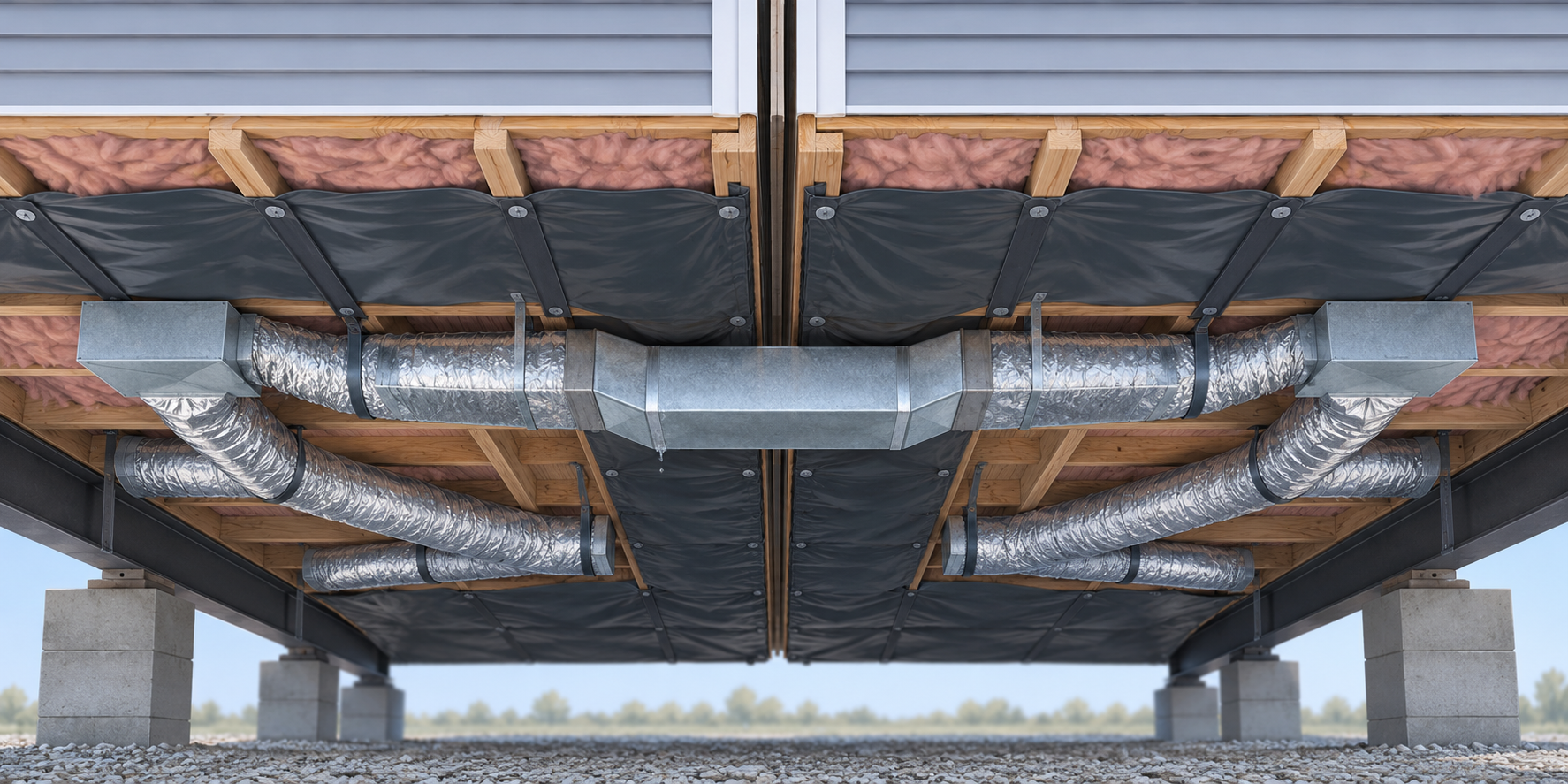
Manufactured-home ducts may run below the floor, through tight belly spaces, or across the connection between sections. A disconnected crossover, crushed run, torn flex duct, poor seal, or damaged support can reduce airflow and send conditioned air into an unconditioned area. The repair is often an access and system problem, not just a tape or replacement-material purchase.
Symptoms are clues, not a diagnosis
Uneven temperatures, weak airflow, long run times, high energy use, unusual noise, moisture below the home, and a room that never reaches the thermostat setting can all justify an assessment. The same symptoms can also come from equipment sizing, filters, registers, insulation, air leakage, or controls.
Ask the HVAC professional to identify which runs were inspected, whether the crossover was checked, how leakage or airflow was assessed, and whether the belly or insulation prevented a complete inspection. A visual check from one opening cannot establish that the full distribution system is sound.
Repair or replace the affected run
A limited scope may reseal an accessible joint, restore support, or repair a localized tear after the cause is understood. A larger scope may require removing skirting, opening or restoring the belly, replacing crushed or contaminated sections, improving insulation, correcting a crossover connection, or coordinating with plumbing and electrical work. If the duct layout or equipment is fundamentally unsuitable, an HVAC redesign may be more useful than repeated patches.
DOE treats manufactured-home weatherization and HVAC distribution as specialized subjects. The job aids are installer guidance, not a universal repair method. Product choice, access, moisture, home age, duct geometry, and the existing equipment determine what can be done responsibly.
Make the quote measurable
Separate diagnostic testing, access, belly repair, duct sealing, replacement material, insulation, disposal, equipment changes, restoration, and follow-up testing. Ask whether the price assumes dry conditions, intact supports, no animal contamination, and no plumbing or wiring conflicts. Clarify whether the contractor will test the result under normal operation.
Do not compare a duct-repair quote with a whole-HVAC replacement quote unless each states what happens to the distribution system. U.S. and Canadian pricing should be obtained independently; the evidence does not establish a universal national repair range.
Use caution below the home
Underfloor work can expose a worker to electrical, combustion, sharp, biological, structural, and confined-space hazards. Keep equipment and fuel questions with qualified professionals. If moisture, damaged wiring, or a failed support is found, correct that condition before closing the duct or belly and hiding the evidence.
Price the duct path, not only the patch
For a U.S. planning scenario, allow $600 for testing, $1,200 for access, $1,500 for a short crossover repair, and $900 for sealing and verification: $4,200. A separate Canadian model could use CAD 800 + CAD 1,600 + CAD 2,000 + CAD 1,100 = CAD 5,500. These are transparent allowances, not universal HVAC prices. A full replacement, difficult access, insulation damage, or equipment correction may exceed the model.
Ask whether the quote includes airflow testing, transition pieces, insulation, belly restoration, disposal, and commissioning. A patch that leaves a crushed or undersized run in place may not solve the comfort or energy problem. Keep duct repair separate from furnace or heat-pump replacement so the alternatives can be compared honestly.
Diagnose the distribution path before replacing material
Ask the HVAC contractor to map the supply path, return-air path, crossover, supports, insulation, registers, and any inaccessible section. Have them state whether they used a visual inspection, airflow measurement, leakage test, or operating check and what each result can establish. A room that is cold may be caused by the duct, equipment capacity, a closed or obstructed register, insulation, control settings, or air leakage; one symptom does not select the repair.
If the crossover is suspected, ask whether both ends and the connection between sections were inspected. A disconnect after leveling or movement may also point to a change in support or section alignment. Check whether the belly barrier or insulation is wet and whether an opening has let animals or debris into the duct. A good proposal names the observed failure and separates it from conditions that remain hidden.
Do not accept a generic air-sealing treatment if the duct is crushed, disconnected, contaminated, or unsupported. Conversely, replacing the entire run may be unnecessary when a localized joint repair restores the intended path. Ask the technician to explain why repair, partial replacement, or redesign is appropriate and how operation will be verified.
Compare repair scopes and access costs
A limited scope may reconnect or seal an accessible joint, restore support, and test airflow. A larger repair can require opening or replacing belly material, replacing an extended duct section, adjusting insulation, correcting the crossover, drying the area, or repairing water or animal damage. A redesign may be considered where the layout or equipment cannot deliver adequate airflow, but it should include a system assessment rather than a material substitution alone.
Separate diagnostic testing, access and removal, duct material, transitions, support, insulation, sealing, belly restoration, cleanup, and post-work verification. Ask whether the quote includes return-air changes, register adjustment, control or equipment work, permit, and a follow-up measurement. Clarify what happens if the duct is wet or contaminated, if wiring or plumbing crosses the work area, or if the belly cannot be safely closed on the same visit.
The labor cost can be dominated by reaching the duct, protecting the home, and restoring the underside rather than the replacement material. Tell bidders the home’s height, section count, skirting type, known access points, and any recent movement. Provide the same information to each and ask them to price the same length and performance goal. An accessible crossover repair and a whole-system replacement are different bids even if both are labeled “duct repair.”
Set a performance goal for the repair
Ask what result the contractor will check: restored connection, airflow at affected rooms, leakage reduction, secure support, or a documented operating test. There may be no universal pass/fail number in the evidence for an existing home, so the professional should identify the method and limitations. Keep a record of the initial symptoms and the test used; after the work, note whether comfort changed under comparable weather and equipment settings.
If the problem persists, do not add a second repair without understanding the first result. Review equipment capacity, return path, insulation, air leakage, and controls with the HVAC professional. If moisture or movement is recurring, include drainage or support assessment. This sequence can prevent repeated spending on one duct section when the larger issue is elsewhere.
Protect the belly and future access
A repair may leave a new service opening or a patch that a later trade must revisit. Ask how the access will be closed, whether insulation and barrier continuity are restored, and who owns that closeout. Keep photographs of the duct route before it is concealed. If plumbing, electrical, or insulation work is planned, coordinate the trades so the same belly area is not opened twice.
Under-home conditions can involve electrical, combustion, biological, or confined-space hazards. Use qualified trades and do not enter an unsafe area to diagnose leakage. The complete quote should say which section was inspected, which remained inaccessible, what was repaired, and what condition would trigger additional work. That information makes the total and the remaining uncertainty visible.
Check whether another trade must work first
A duct contractor may discover wet insulation, a plumbing leak, damaged supports, unsafe wiring, or a pest entry point. Set a stop-and-notify process so the crew does not cover a hazard or leave the home open without protection. Ask whether the original estimate includes another visit after the source repair and who pays to restore the duct and belly. A coordinated schedule can save the owner from paying two crews to create the same access opening.
For multi-section work, confirm which installer or contractor is responsible for restoring the section connection after the home moves or is re-leveled. Keep that responsibility separate from ordinary duct cleaning or filter service.
Compare contractor qualifications and testing
Ask who will inspect the underfloor area, who is qualified to modify the duct system, and whether the work requires a licensed HVAC contractor in that location. Request the test method, equipment calibration where relevant, and the before/after result. If the contractor only makes a visual repair, have the proposal say so. That allows a homeowner to distinguish a targeted fix from a tested performance correction and avoids assuming that a new material alone restored airflow.
Ask what remains after a partial repair
A localized repair may not correct undersized ducts, poor return air, equipment imbalance, or leakage elsewhere. Have the technician list excluded runs and explain how those exclusions affect expected comfort. If the homeowner chooses a limited first phase, agree on the symptoms or test result that would justify the next phase. This makes a staged approach deliberate instead of interpreting an incomplete improvement as a failed repair.
Keep a short record of the restored path
After the repair, note which run and crossover were opened, what material was installed, how it was supported, and what test was performed. Photograph the connection before belly restoration. If the same room later loses airflow, the next technician can check the corrected segment first and decide whether another part of the system is involved.