
The cost to move a manufactured home is not the transporter’s line alone. A complete relocation can include feasibility review, skirting and deck removal, utility disconnection, preparation, permits, route and access work, transport, destination foundation or supports, anchoring, section reconnection, utilities, inspections, and repairs. The home can be movable in theory and still be uneconomic after all scopes are priced.
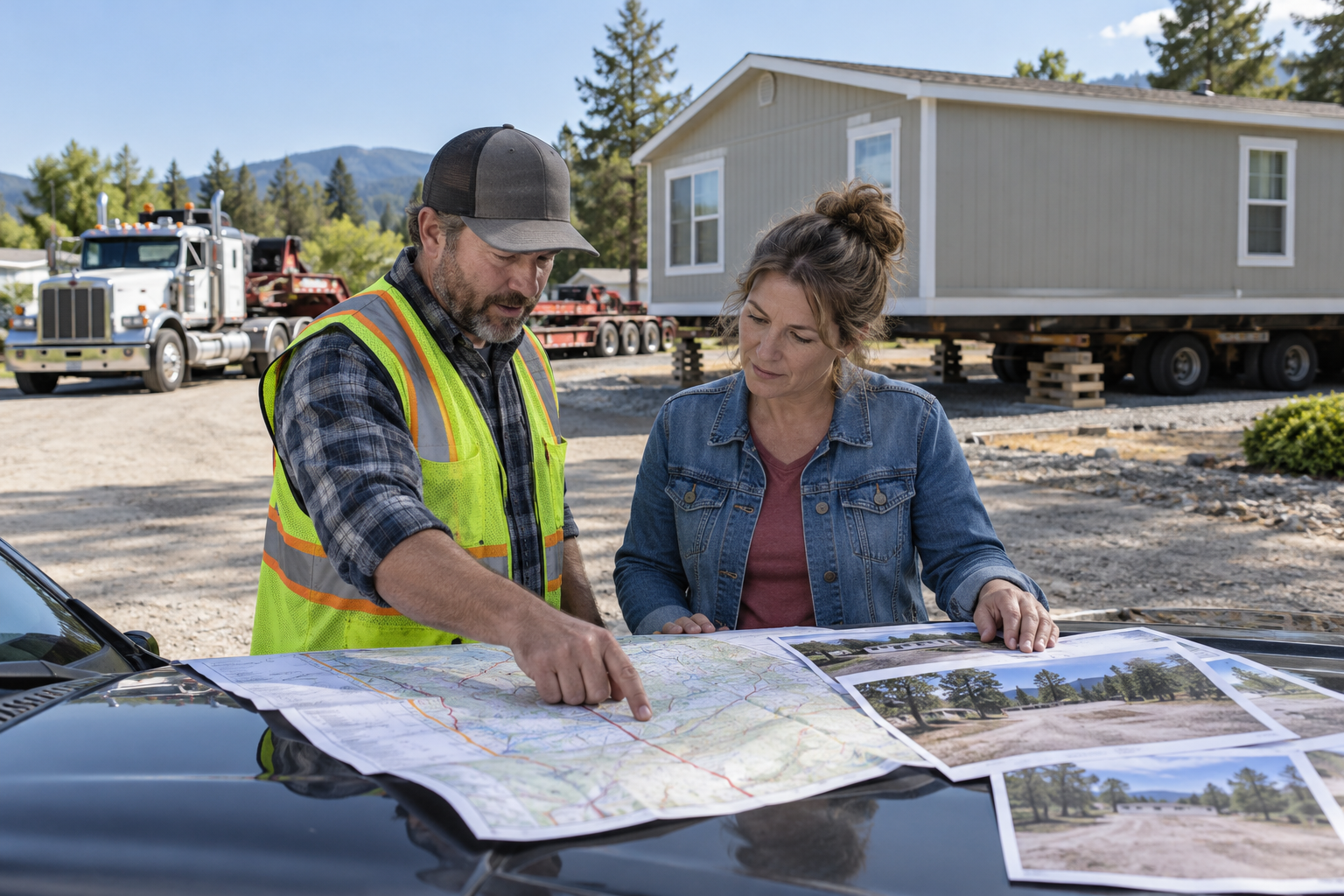
Determine whether the move is feasible
Record the home’s age, section count, dimensions, labels or data plate, serial or VIN, chassis and support condition, prior alterations, roof and floor condition, and available installation records. Inspect the origin and destination for turning radius, bridge or road constraints, overhead lines, trees, slopes, staging, soil, drainage, utilities, and equipment access.
HUD advises owners to check the authorities having jurisdiction and zoning before relocation and not to place a home in a more restrictive wind, thermal, or roof-load zone than its design allows. This is U.S. guidance and does not replace current route, transport, placement, or Canadian requirements. Do not assume a pre-1976 home is automatically prohibited or automatically accepted; verify the actual jurisdiction and home history.
Separate transport from reinstallation
Ask for distinct scopes for:
- inspection and move feasibility;
- disconnecting utilities and removing skirting, decks, steps, or additions;
- protecting the home and preparing sections or running gear;
- permits, route surveys, escorts, traffic control, and transport;
- destination clearing, grading, drainage, foundation or piers, and anchoring;
- crane or setting equipment, leveling, section close-up, and weather sealing;
- water, sewer or septic, electrical, fuel, HVAC, and duct connections;
- belly, insulation, roof, floor, opening, or transport-damage repairs;
- skirting, stairs, restoration, inspection, and contingency.
The factory-built home’s manuals, labels, section arrangement, and destination rules can change the scope. A transport-only quote cannot be compared with a destination-ready installation quote.
Make the move-versus-replace decision
Compare the complete installed relocation cost with buying a home already set up, selling and replacing the unit, or choosing another site solution. Include origin and destination restoration, lost occupancy, storage, weather delays, permit uncertainty, and the risk that concealed damage appears after the sections are set. Use a written change-order process before the move begins.
U.S. and Canadian relocation prices must be obtained independently. Distance, route, section count, access, condition, labor, and local approvals make currency conversion meaningless as a cost estimate. There is no universal national move price.
Model the complete relocation
For a U.S. planning example, allow $12,000 for preparation and disconnection, $15,000 for transport and route work, $20,000 for destination support and setup, and $10,000 for utilities, close-up, permits, and contingency: $57,000 before the home purchase price. A separate Canadian model might use CAD 15,000 + CAD 19,000 + CAD 26,000 + CAD 13,000 = CAD 73,000. These are illustrative scenarios, not moving-market averages. Distance, sections, route, condition, access, weather, and approval can change every layer.
Compare this complete destination-ready allowance with buying a home already installed or selling the existing unit. Require transport, origin restoration, destination foundation, anchoring, utilities, inspection, and post-move repairs to be identified separately; a truck-only bid is not a relocation budget.
Use qualified movers and local authorities
Structural condition, anchoring, lifting, utilities, and site approval can affect safety and property damage. Use experienced manufactured-home movers and qualified site professionals, and confirm the authorities and approvals at both ends of the move. A cheap transport bid is not a successful relocation until the home is supported, connected, inspected, and usable at the destination.
Price both ends of the route before choosing a mover
Start with a feasibility visit at the origin and destination. Record home sections and dimensions, overhead and road clearance, turning areas, staging, slope, trees, access for trucks and cranes, utility disconnection, existing decks or additions, and the receiving foundation. Ask the mover which measurements it takes and whether a survey, route check, or escort review is included. A distance estimate cannot establish that the vehicle can reach the site or that the home can be set at the destination.
At origin, price removal and storage of skirting, stairs, decks, carports, awnings, and landscaping; disconnect water, sewer, power, fuel, and communications; protect openings; and repair the departure site. At destination, price clearing, grading, drainage, foundation or supports, anchoring, crane or setting, section reconnection, utilities, close-up, permits, inspection, stairs, and restoration. Name who owns each line and whether the seller’s “transport and setup” package includes all of it.
Confirm that the home’s condition supports lifting and transport. Ask for a qualified inspection of the frame, chassis where present, roof, floor, section connections, prior alterations, and transport-damage risk. Do not assume the home can be moved because it was moved before. Reinstallation may need new support design and the actual receiving jurisdiction’s approval. Age alone is not a universal yes or no; document the home and ask local authorities.
Compare the move with an installed alternative
Build a complete relocation total and compare it with buying a similar home already installed, replacing the home at the existing site, or another available housing option. Use equivalent endpoints: a usable and approved home with services connected. Include purchase or sale, origin cleanup, route and permit charges, transport, destination work, repair allowances, utility extensions, temporary housing, storage, lost use, insurance, and financing charges during delay. Keep optional upgrades separate.
A quote comparison should identify section count, route and mileage, permits and escorts, disconnection, equipment, destination support, installation, tests, and exclusions. Ask whether the mover’s liability is limited and what transit coverage is available; check with the insurer about the home’s actual value and required documentation. Photograph existing condition and agree how damage claims are documented before loading.
Use named uncertainty allowances rather than an arbitrary percentage. Examples include crane remobilization if access is blocked, support work if an inspection finds settlement, belly repair if a tear is exposed, or route change if clearance fails. Set the dollar authority for each change and require written approval before proceeding. Replace the allowance with a local bid when the condition is resolved.
Create stop points in the schedule
Do not authorize origin disconnection until route permits, destination access, foundation acceptance, utility plan, and local placement approval are ready. Before loading, check that the home condition report and contract are signed. Before setting, confirm that the foundation and site are complete and that the crane crew has current measurements. After set, require section close-up, connection tests, inspection, and handoff documents before treating the move as finished.
A delay can create storage, lodging, weather protection, equipment standby, and remobilization charges. Ask who pays for each if the route, destination, weather, authority, or a preceding trade causes a missed date. Confirm how long a permit or utility approval remains valid and whether the contractor’s schedule depends on another party. Keep the household’s move-out, move-in, and temporary occupancy dates flexible enough to reflect unresolved approvals.
Protect the home’s records and value
Keep the transport authorization, route permits, photos, condition reports, disconnection notes, receiving-site plans, foundation and anchor records, utility tests, inspection approvals, and final invoices. Ask the installer to record which items were reused and which were replaced. If a lender, insurer, title professional, or buyer needs to know about the move, provide the documents they specifically require. A completed transport invoice does not prove that the destination setup or all service connections passed inspection.
The move-versus-replace decision is complete when the owner knows the feasible path, the total destination-ready scope, who bears each risk, and what unknown could still change the result. If a critical route, title, lease, financing, or approval question is unresolved, delay the transport commitment until the party responsible has answered it. The cheapest carrier bid is not the cheapest completed move if the home cannot be placed or occupied at the other end.
Include the lease, title, and insurance dependencies
If the home is on a rented lot, review the lease for notice, access, removal, restoration, deposit, and outstanding-fee requirements before scheduling a move. Ask the community owner to confirm the departure date and any written site-release process. If the home is secured by a loan or lien, ask the lender or title professional whether its consent or payoff is required. Arrange transit and destination coverage with the insurer and confirm when the existing policy ends.
These items do not replace transport or site cost, but they can delay or prevent the move. Include fees and timing in the feasibility stage rather than finding them after a carrier is booked.
In British Columbia, relocation generally requires a destination-specific transport permit and current home-tax clearance or an applicable deposit. Check the current Manufactured Home Act and the registrar’s requirements early; a tax balance or missing registration can affect the schedule even though it does not change the carrier’s quote.
Keep a possible mortgage after relocation separate from the moving budget. Freddie Mac’s September 2026 bulletin allows certain mortgages on homes moved from another site when inspection and zone conditions are met, but excludes delivery, setup, anchoring, site development, installation, and permanent utility connections from mortgage proceeds. Ask the lender whether it follows the updated Guide and what inspection report it will accept. Eligibility for financing a home already moved does not fund the move itself.
Coordinate the destination with the existing community
If the destination is a manufactured-home community, ask management about home age, type, dimensions, site availability, installation standards, access windows, contractor requirements, and utility handoff before booking transport. If the home is going to private land, verify zoning and occupancy eligibility separately from building or installation approval. Permission to enter a site does not necessarily authorize permanent placement.
Get the destination party’s conditions in writing and provide them to the mover and installer. If the site is not accepted, transport costs may already be committed while the home has nowhere approved to go.