
Water-wise landscaping is a design and operating decision, not a fixed product package. A conversion may include lawn removal, soil preparation, plants, mulch or mineral materials, irrigation changes, drainage or runoff measures, and establishment care. “Xeriscape” can describe very different mixes, so define the intended landscape before using a price range.
Build the scope around function
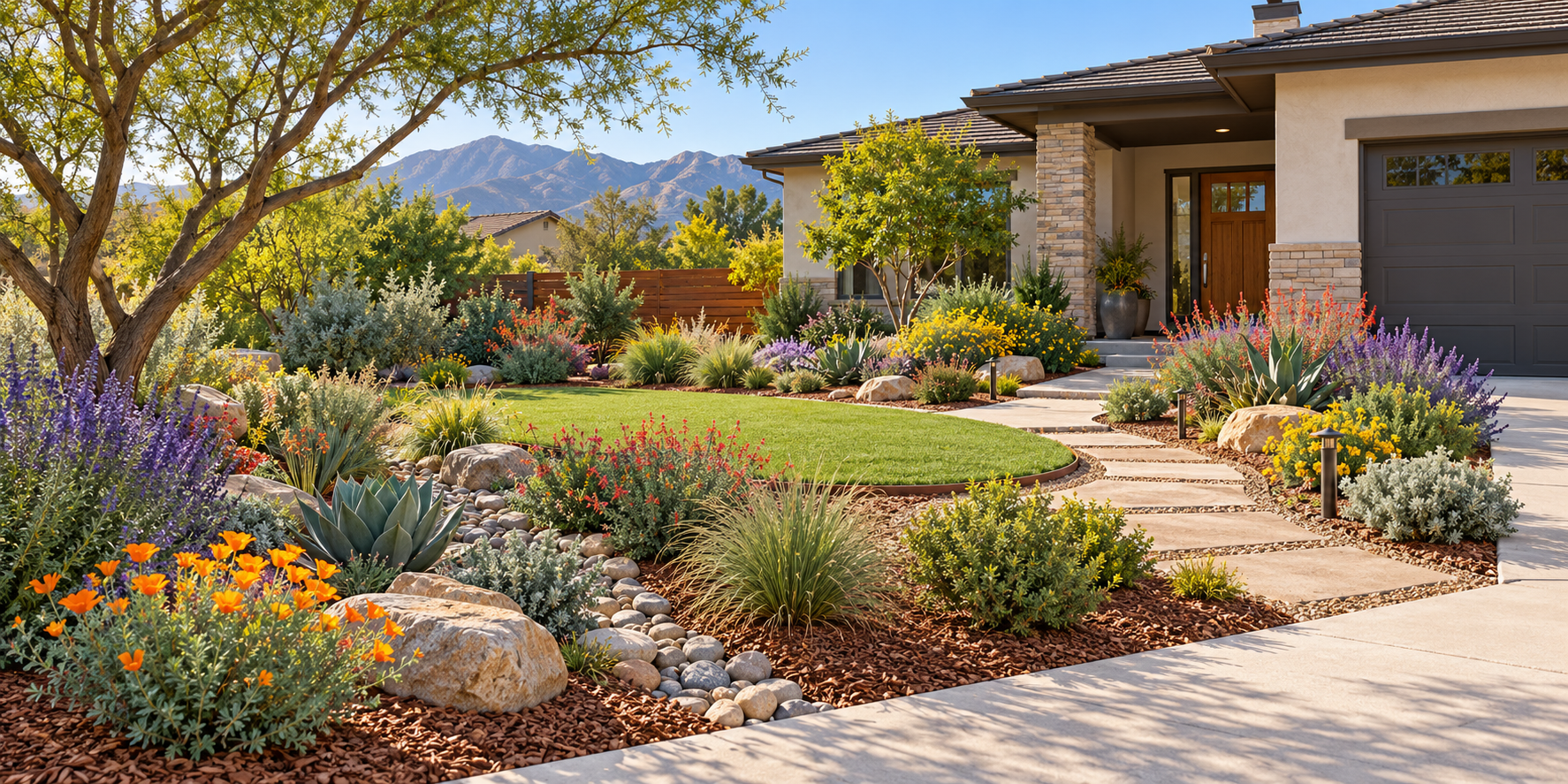
Utah State Extension emphasizes that water-wise landscaping does not require eliminating turf. Keep turf where it serves recreation, traffic, or another real purpose; consider conversion where it is nonfunctional or difficult to irrigate efficiently. Price partial and full-yard options separately.
Common cost layers include:
- design and site assessment, where needed;
- lawn removal, disposal, and minor preparation;
- plants, trees, mulch, groundcover, or mineral materials;
- drip or microirrigation conversion and controller work;
- access, delivery, edging, and surface restoration;
- establishment watering, maintenance, and replacement allowances.
EPA describes microirrigation as root-zone delivery and reports 20% to 50% less water than conventional sprinklers in its stated context. That is not a universal savings promise. Water use depends on plant selection, climate, soil, design, schedule, leaks, establishment, and local restrictions.
Cost and payback context
Angi’s 2026 specialist summaries report conflicting U.S. xeriscaping signals: one landscaping summary gives about USD 3,000 to USD 24,000, while a dedicated xeriscaping summary gives about USD 5,000 to USD 24,000. The difference reflects scope and inclusion uncertainty, not one corrected North American range. The active evidence does not establish a comparable Canadian range; do not convert either U.S. signal into CAD.
Model water savings from local rates, season, area, and baseline use. Local incentives can change a qualifying project’s outlay, but they do not establish the installed price or make savings certain. Examples illustrate how different the terms can be:
| Program example | Published incentive | Important limit |
|---|---|---|
| Southern Nevada Water Authority | $5 per square foot for the first 10,000 square feet of qualifying grass conversion, then $2.50 per square foot | Requires a pre-conversion site visit and approval; verify current eligibility and program terms. |
| Los Angeles Department of Water and Power | $5 per square foot for eligible residential turf replacement, up to $25,000 | The listed residential area is 250–5,000 square feet; pre-approval and completion deadlines apply. |
| Regional District of Nanaimo | Selected 2026 irrigation and soil-improvement rebates, including up to $400 for an eligible drip conversion | Local program; pre-approval, eligible property, professional installation, claim deadlines, and funding rules apply. |
| Town of Okotoks | $2,500 for a qualifying xeriscape conversion | The page reported the program full with new applicants waitlisted; minimum area, pre-approval, and design requirements apply. |
These programs have different service areas, qualifying work, timing, and funding. Confirm current terms with the local authority before counting an incentive toward a quote. Upfront cost, maintenance, establishment risk, and runoff performance should be compared with sod and artificial turf rather than assuming the lowest-water design is automatically lowest-cost.
Runoff and boundaries
Extension evidence describes design-dependent runoff and material tradeoffs for xeriscaping and artificial turf. Government of Canada flood-wise guidance gives rain gardens, bioswales, plants, and permeable pavement as examples, while noting that local requirements and professional advice may apply. Major grading, drainage, retaining, or wildfire-resilience work belongs in its owning scope when that is the dominant decision.