
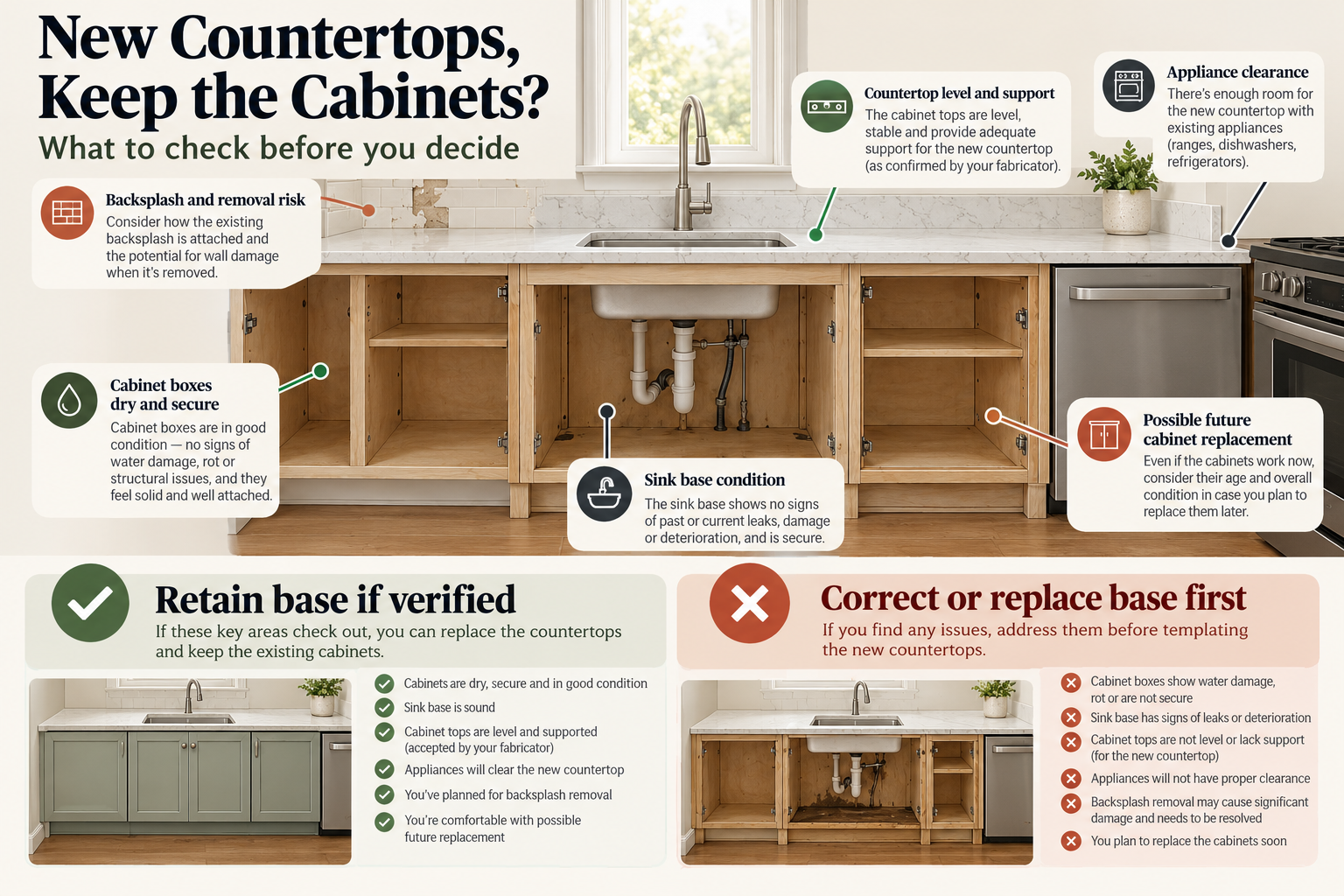
Often, but only when the existing cabinet system is sound, adequately supported, reasonably level, and suitable for the new countertop. Countertop-only renovation can save cabinet product and installation work, yet removal may reveal damage and a future cabinet replacement could require removing the expensive new surface.
Check the cabinets first
- Are boxes dry, firm, and adequately mounted?
- Is the sink base free of swelling, rot, and ongoing leaks?
- Can the cabinets support the selected surface and overhang as specified by the fabricator?
- Are walls and floors sufficiently level for the intended installation?
- Will appliance openings and clearances remain correct?
- Does the layout still solve the household’s storage and work-zone problem?
The answers need site verification. A countertop manufacturer or fabricator’s acceptance criteria are product-specific; do not use a general weight rule.
What removal can change
Existing counters may be adhered, fastened, or integrated with backsplashes, sinks, and appliances. Removal can damage cabinet tops, wall finishes, plumbing connections, or the countertop itself. Include protection, disconnects, disposal, cabinet repair, backsplash repair, and reconnection in the quote.
Fabrication and support
Templating depends on the actual cabinet position and levelness. A fabricator may need to account for appliances, sink and cooktop cutouts, overhangs, seams, edges, slab quantity, and supports. Caesarstone describes these steps for quartz, but other materials and fabricators may require different details.
Get the fabricator’s acceptance before ordering
Ask the fabricator or installer to review the actual base conditions: cabinet attachment, levelness, condition at seams, support under overhangs, sink-base integrity, and the route for removal and delivery. Have the product-specific support requirements and any needed cabinet correction written into the estimate. A visual check from across the room cannot establish whether the base meets the chosen product’s requirements.
If the fabricator will not confirm the existing cabinets until removal, ask how the discovery will be handled. The contract can distinguish removal, protection, cabinet repair or leveling, return visit, and templating after the base is accepted. Confirm whether the old counter can be removed without damage to the cabinet tops or backsplash and whether the installer will stop and request approval if the supporting surface is not ready.
A simple comparison before committing
Prepare two totals: countertop replacement on the retained cabinets, and cabinet replacement plus the new counter. Use the same surface material, sink and appliance assumptions, delivery, removal, finish restoration, and tax treatment. Add a separate allowance for a defined repair only if inspection cannot resolve it before demolition. Then consider how likely future cabinet work is and whether the counter would need to be removed again. This comparison does not predict cabinet life; it makes the cost of a second removal visible.
When keeping cabinets makes sense
Retention is strongest when the layout works, boxes are sound, the finish can accept the new surface, the sink base is reliable, and the new countertop will not be removed in a likely next phase. It is weaker when cabinets are failing, the layout will change, matching or support is uncertain, or a leak is still active.
Compare the future option
Price countertop-only work against cabinet replacement plus the new counter, including removal and possible duplicate work. A lower first cost can be poor value if the cabinets are near the end of their useful condition or if future replacement destroys the new surface.
Keep the cabinets when the new top has a stable base
Retention is a stronger candidate when the layout and storage still work, the cabinet boxes are dry and secure, the sink base is sound, the countertop support can be confirmed, and the future plan will not soon require cabinet removal. It is a weaker candidate when a leak is active, several boxes are swollen or loose, the cabinets are uneven beyond the fabricator’s acceptance criteria, or an appliance change will alter the counter opening.
Ask the fabricator to put acceptance conditions in the quote. If leveling, support, or cabinet repair is required, define who performs it and how the base will be rechecked before templating. If the support cannot be verified until after removal, set an approval point and price for the extra visit or correction. Do not rely on a general estimate that assumes a suitable base without saying how that will be determined.
Understand the value of retaining the counter base
Keeping the boxes can avoid product and installation work, but that saving must be compared with the remaining cabinet condition and likely future work. If the cabinets will be replaced soon, the new top may be lost during that project. If the layout works and the boxes are serviceable, a new top may create a durable improvement without the broader cabinet scope. The choice depends on inspection and the household’s project horizon, not on a universal cabinet age or a percentage-of-replacement rule.
Compare the retained and replaced base on the same assumptions
The retained-cabinet estimate should say whether the installer has inspected the boxes, confirmed levelness, and accepted the selected countertop support. The replacement-cabinet alternative should use the same countertop, sink, appliance, finish, removal, and tax assumptions. If cabinet replacement would require additional wall, floor, or utility work, show those lines separately rather than hiding them in a higher cabinet total.
Then note the risk that only appears after the old surface is removed: damage to cabinet tops, an unexpected backsplash interface, an unsuitable sink base, or a floor that is not level. Agree how an extra visit or correction will be approved. A price for reusing cabinets is only comparable when it includes a clear acceptance method for the base.
If the existing layout still works and the cabinet system is sound, a new counter may avoid a wider project. If the boxes are failing or the layout is about to change, compare the total with a combined cabinet and counter installation before deciding. No universal age or resale rule resolves this tradeoff.
Bottom line
Keep existing cabinets only after the boxes, support, levelness, sink base, layout, and future plan have been checked. Put fabricator requirements and removal risk in writing before ordering the countertop.