
Two countertop quotes can differ even when the material name and apparent area are similar. The missing variables are often between purchase and installation: templating, slab or sheet yield, seams, cutouts, edges, supports, handling, removal, and the condition of the cabinets beneath the surface.
A U.S. labor signal is not a fabrication schedule
Fixr’s 2026 U.S. estimate separately lists countertop installation labor at $450–$900 and old-counter removal at $50–$300. It also gives edge add-ons such as $10–$15 per linear foot for bevel or bullnose and $20–$25 for ogee or mitered profiles. These are source-defined values with varying bases; the source does not establish that they are additive to the $3,000 average replacement total or applicable to every material and installer. Keep them as quote questions, not a calculation method.
From template to installation
The fabricator may measure appliances, walls, overhangs, edge details, sink and cooktop openings, slab quantity, seam locations, and supports. Fabrication then cuts and finishes the material. Installation checks fit, holes, shims, leveling, and any required supports. Caesarstone describes this sequence for quartz; other materials have different requirements.
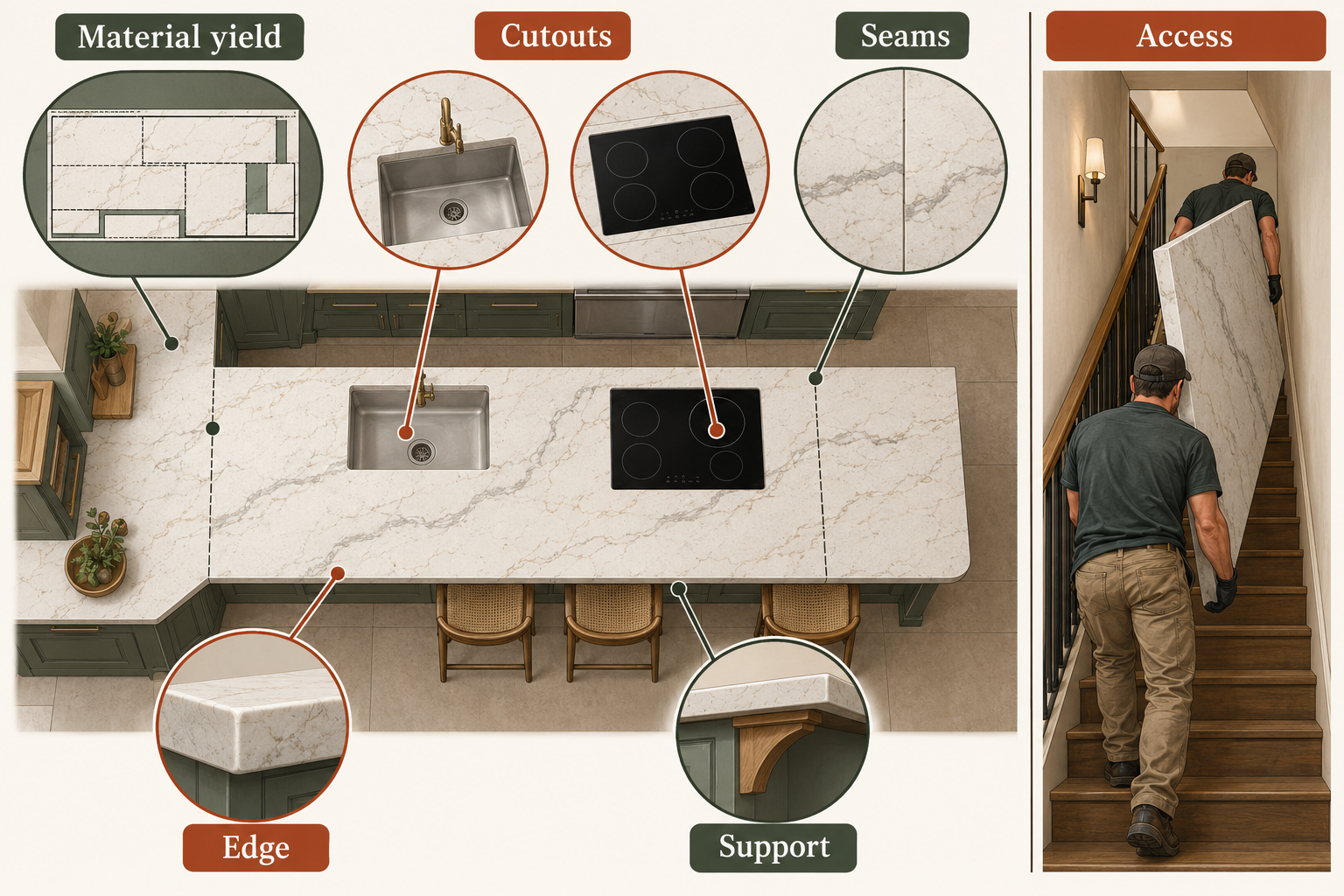
Cost drivers to expose
- Yield: A small measured area can require an additional slab or sheet because of layout, pattern, grain, or minimums.
- Cutouts: Sinks, cooktops, faucets, soap dispensers, and other openings require measurement and fabrication.
- Seams: Number, location, access, material, and pattern affect fabrication and appearance.
- Edges: A simple edge differs from a laminated, shaped, waterfall, or otherwise finished edge.
- Supports: Overhangs and material-specific requirements may need cabinet changes, brackets, or other support.
- Handling: Weight, fragility, stairs, elevators, narrow paths, and long carries affect labor and risk.
- Removal: Existing counters, backsplashes, sinks, and disposal may be separate.
- Base condition: Uneven or damaged cabinets may need repair before templating or installation.
Required work versus options
Separate what is needed for safe fit and support from aesthetic options such as a premium edge, waterfall end, or extra seam preference. A support requirement is not the same as a design upgrade. Ask the fabricator to identify material-specific assumptions in writing.
Make quotes comparable
Provide the same cabinet plan, measurements, sink and appliance information, edge selection, backsplash boundary, access description, and removal assumption. Compare material quantity, templating, fabrication, cutouts, seams, edges, supports, delivery, installation, taxes, reconnection, and exclusions.
The evidence does not support one universal fabrication surcharge or per-square-foot rate. Minimums and local labor can dominate a small project. Canadian and U.S. pricing must be quoted in their respective markets.
Follow the price through each handoff
At the estimate stage, make sure the drawing shows the actual cabinet positions, appliances, sink, edges, and overhangs. At template, confirm that the site is ready and that the selected sink and cooktop dimensions are final. At fabrication, ask who approves seam placement, how pattern or grain direction affects material use, and who pays if a late change requires a new cut. At delivery, check the access route and whether the installation crew needs the counters, cabinets, or adjacent rooms cleared. At installation, identify who checks the base and what happens if it is not ready.
Each stage has a different cost or change-order risk. A countertop-only price may exclude removal, plumbing reconnection, backsplash work, cabinet leveling, and delivery. A complete quote may include some of these but still exclude permit, appliance, or finish restoration. Ask for a line-by-line scope and responsibility matrix so the same task does not disappear between the fabricator, cabinet installer, and general contractor.
Separate unit rates from project totals
If a quote uses a square-foot, linear-foot, slab, or minimum project amount, ask what that unit includes. A per-area material figure may omit fabrication; a project total may bundle the two. A minimum charge may cover setup and site work rather than extra material. Do not multiply a published rate by room area unless its measurement method and included tasks match your plan.
The evidence does not establish a universal fabrication surcharge. Compare the actual measured drawing, material quantity, cutouts, seams, edge, supports, removal, delivery, and installation assumptions instead.
Use a scope sheet before requesting bids
Attach a cabinet plan with finished dimensions, the selected sink and cooktop, faucet holes, overhangs, edge profile, backsplash boundary, and access notes. Ask each fabricator to return a drawing showing seams and cutouts, plus a written scope for template, material quantity, fabrication, supports, delivery, removal, installation, taxes, and exclusions. If the surface is not selected, ask the estimator to mark which assumptions remain provisional.
Compare one line at a time. A difference in total may come from material yield, a second slab, access, an edge, a template visit, or removal rather than labor. Ask which lines are fixed and which can change after template. For any proposed optional feature, request its incremental amount on the same base design so you can judge its value without obscuring necessary support or fit work.
Decide who owns the critical handoffs
In a bundled job, one provider may manage template, fabrication, delivery, and setting the counter. In a separated job, the cabinet installer may be responsible for the base while the fabricator sets the finished top and the plumber reconnects the sink. Ask who verifies readiness, who can stop the sequence, who approves a late change, and who returns if a measurement or opening is incorrect.
If the home has a tight stair, elevator, narrow doorway, long carry, or occupied route, include that information before the quote. A counter that fits the plan may not fit the delivery path in one piece. Ask whether the material can be carried and installed as quoted, and what a seam or alternate route would change. Do not assume that access is covered simply because delivery appears on a proposal.
Bottom line
The finished countertop is a fabricated assembly. Ask what happens at the template, shop, delivery, and installation stages; that is where apparently similar material prices become different project totals.