
Storage retrofits add useful access inside existing cabinets without replacing the whole kitchen. Common examples include pullout shelves, drawer conversions, corner mechanisms, pantry pullouts, and waste or recycling units. The installed result depends on the cabinet opening, box condition, hardware, and labor—not hardware price alone.
What the retrofit may include
- measuring the clear opening, depth, height, and obstructions;
- selecting hardware and a compatible mounting approach;
- removing shelves or doors when necessary;
- installing slides, frames, baskets, drawers, or pullout shelves;
- adjusting fronts and checking clearances;
- repairing or reinforcing a cabinet that cannot accept the hardware as found.
Manufacturers may publish dimensional, load, clearance, and installation requirements. Treat those requirements as product-specific. Do not assume a heavy pullout is suitable for an old, damp, loose, or poorly mounted cabinet box.
Hardware versus installed cost
Separate hardware, shipping, measurement, installation, cabinet modification, door or front adjustment, and finish repair. Small retrofit jobs may carry a site-visit or minimum labor charge. A low hardware price can be outweighed by a difficult corner, restricted access, removal of a fixed shelf, or a custom front.
Choose the mechanism from the opening and contents
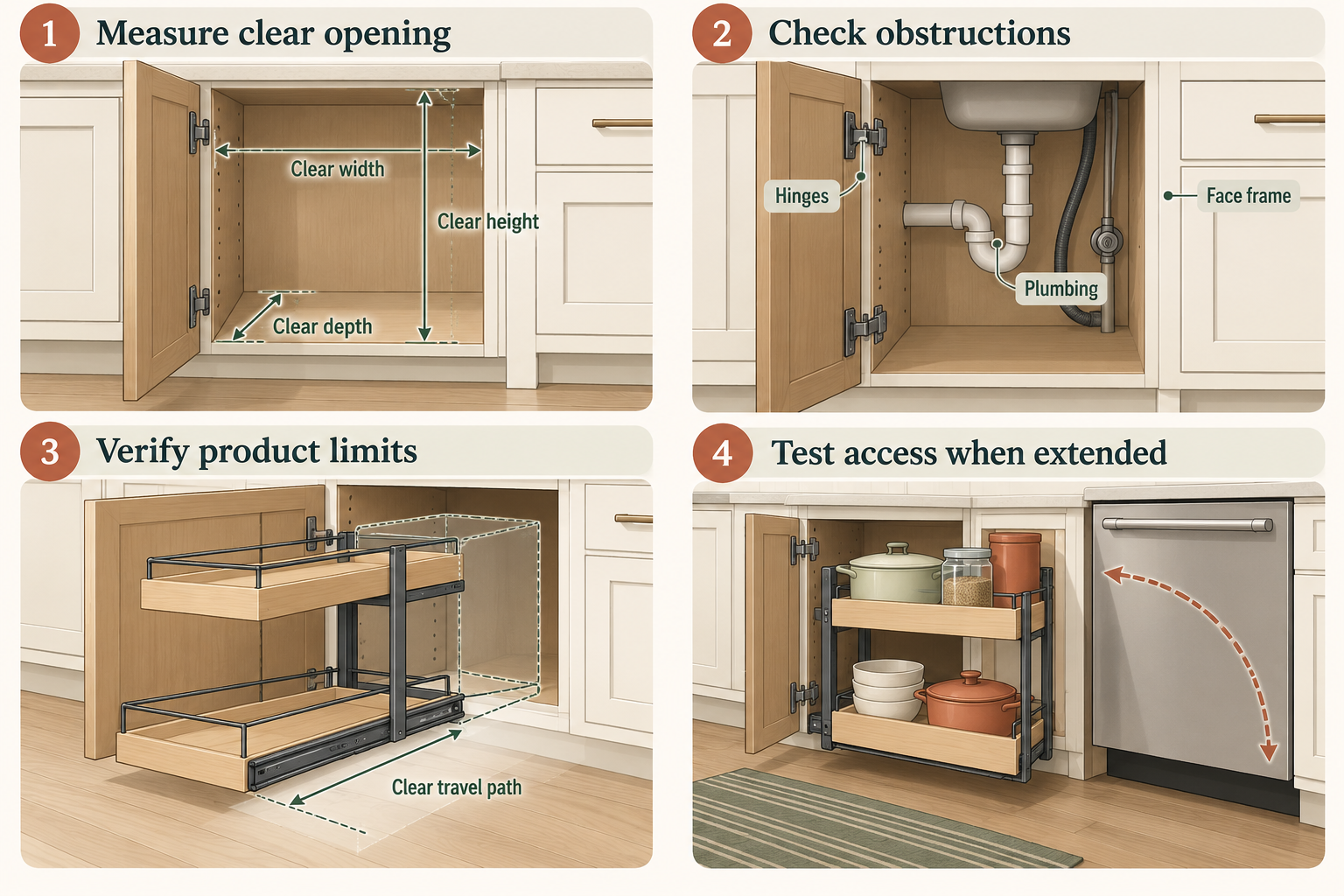
Start by measuring the clear opening with the door in its normal position, then note depth, height, hinge projection, plumbing, outlet, face-frame, and fixed-shelf obstructions. A catalog width is not the same as usable interior width. If the cabinet is irregular or out of square, ask the supplier or installer to verify the fit before ordering and identify any field trimming or reinforcement they will accept.
| Storage problem | Mechanism to compare | Tradeoff to check |
|---|---|---|
| Items are hard to reach at the back | Sliding shelf or pullout | Clearance at the face frame and remaining depth after hardware |
| Small items disappear on a shelf | Drawer conversion or organizer | Drawer-box dimensions, slide attachment, and usable height |
| Corner space is awkward | Corner pullout or turntable | Door opening, hinge interference, and usable corner volume |
| Waste or recycling is inconvenient | Pullout bin | Plumbing clearance, door attachment, capacity, and cleaning access |
These are selection prompts, not a guarantee that a particular product fits. Use the manufacturer’s current dimensions, load information, and installation requirements for the selected model. Do not infer a safe load limit from the cabinet’s apparent size or another product’s specification.
Build the installed estimate
Request separate amounts for the mechanism, shipping, measurement, removal of existing shelves, cabinet modification, reinforcement, new fronts or hinges, installation, adjustment, and finish repair. Include minimum labor or a site visit where applicable. A single pullout may require a minimum visit even when the hardware itself is inexpensive; several compatible units may share setup work, but ask the installer rather than assuming a per-unit discount.
If the box is damp, loose, or damaged, price repair and correction of the cause before installing hardware. Record the product model and keep its instructions and spare parts information with the home documents. That makes later adjustment or replacement easier and helps avoid buying a different mechanism that uses incompatible mounting points.
Measure in the order the installer will use
First clear the cabinet and measure the actual interior opening, not the nominal cabinet width. Then note the face frame or frameless front, door and hinge swing, interior depth, fixed shelf, rear wall, plumbing, and any shelf supports. Compare these measurements with the exact product’s minimum and maximum opening, mounting area, and travel. If the unit needs a filler, spacer, or cut, have the seller confirm that modification in writing.
Next test the loaded use. Think about the size and weight of typical items, how frequently they are accessed, and whether the extended mechanism blocks an adjacent door, dishwasher, or walkway. Manufacturer load information applies to the selected product when installed as specified; it does not validate an old cabinet or its wall attachment. Have the installer assess the supporting box if its condition is uncertain.
Prioritize the retrofit that solves the actual problem
A full set of organizers can cost more and use cabinet volume that might be better preserved. Start with the cabinet where access is most frustrating, price the mechanism and installation, and confirm the result before repeating it in the rest of the kitchen. A pullout for heavy cookware, a shallow divider for trays, and an organizer for small food items are not interchangeable just because they fit the same opening.
If several cabinets need work, ask whether the installer can complete them during one visit and whether any opening needs different hardware. Keep that quote separate from a full cabinet replacement estimate. If doors, boxes, or the room layout are already failing, a retrofit may be removed in the next project and should be evaluated as a temporary improvement rather than a replacement strategy.
When retrofit beats replacement
Retrofit is strongest when the boxes and layout work, the storage problem is localized, and the hardware adds access without compromising the cabinet. It is weaker when many boxes are failing, the openings are too small, the layout is fundamentally wrong, or the retrofit would be removed during a planned replacement.
The 2026 U.S. Houzz study reported that 76% of surveyed projects added or upgraded built-in features, with pantry cabinets appearing in 47%. Those survey observations establish that storage is a common project concern, not that one organizer is appropriate or cost-effective for every kitchen.
Check the surrounding system
Look for sink leaks, swollen panels, cabinet movement, hinge conflicts, door swing, countertop overhang, plumbing, and electrical obstructions before ordering. Correct moisture problems first. If new cabinets or a storage wall are needed, compare adding cabinets and pantry storage.
Bottom line
Price a pullout retrofit from measured clearances and the actual cabinet condition. Include hardware, installation, modifications, fronts, minimum charges, and future replacement risk before calling it a low-cost alternative.