
Countertop material price is only the beginning. Installed cost also depends on sheet or slab yield, templating, cutouts, seams, edges, supports, access, removal, and the fabricator. Performance and repairability vary within each material family, so compare the actual product and project rather than a label alone.
A replacement range does not rank materials
Fixr’s 2026 U.S. guide gives a $3,000 average and $1,400–$5,250 range for a source-defined standard-material replacement project illustrated around 35 square feet. This provides broad scale context only. It does not show that any one material family costs that amount, and it is not a comparable installed range for every material in the table below. The source separately lists area prices and premium options with different bases, so do not use those figures to rank materials without a matched quote.
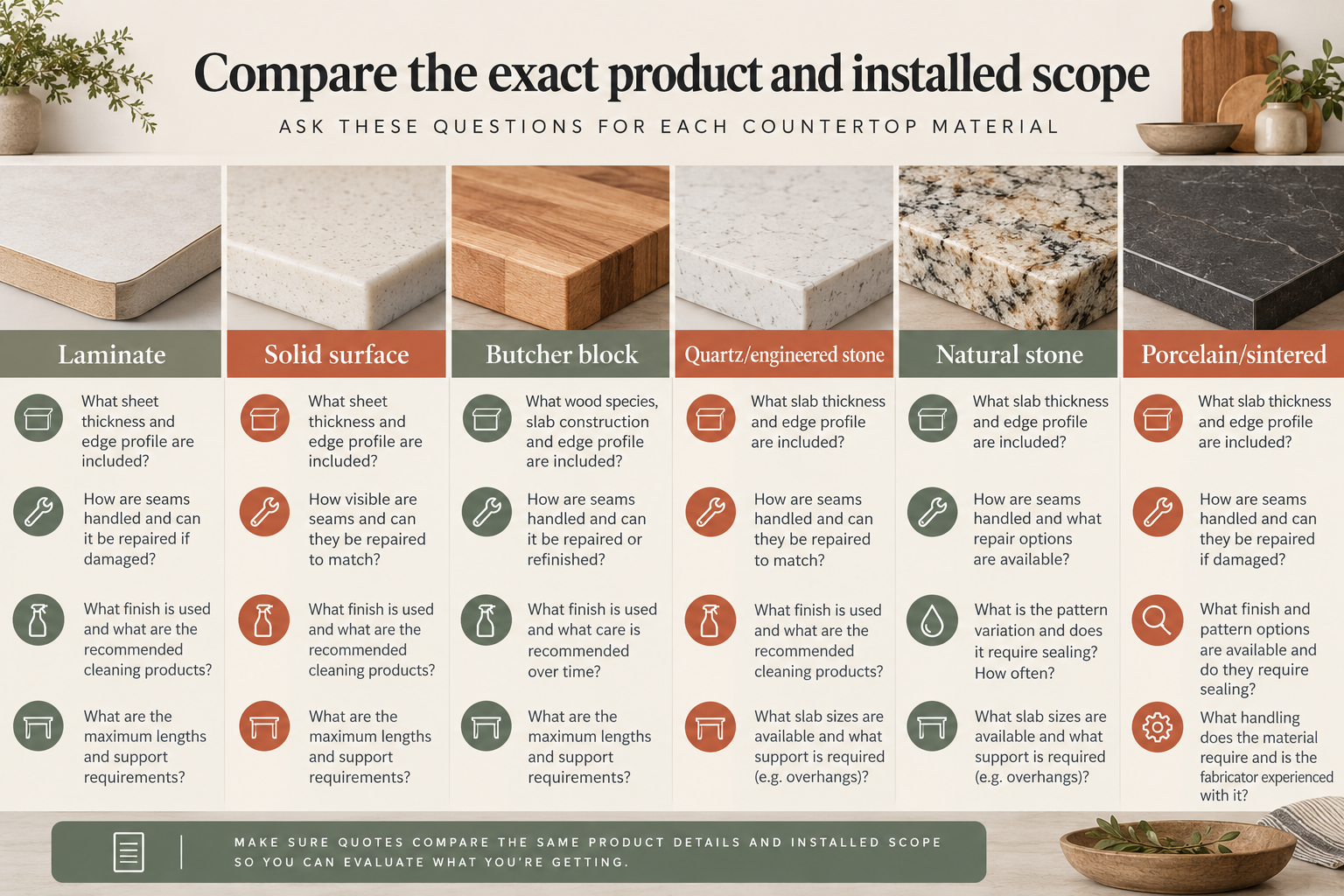
Material families in the decision
| Family | Budget questions | Caution |
|---|---|---|
| Laminate | Sheet size, edge, sink cutout, substrate, and installation | Damage and repair limits vary by product and edge detail |
| Solid surface | Seam and edge options, integrated details, and repair approach | Product-specific fabrication and care apply |
| Butcher block | Species, thickness, finish, sink exposure, and maintenance | Water and finish condition affect upkeep |
| Quartz or engineered stone | Slab yield, seams, edges, cutouts, and support | Vendor guidance is not a universal rule for every product |
| Granite and natural stone | Slab selection, pattern yield, sealing, edges, and handling | Each slab and stone type can behave differently |
| Porcelain or sintered surface | Fabricator capability, handling, edges, and substrate | Installation and material requirements are product-specific |
The table is a comparison framework, not a performance ranking or a complete material inventory.
Installed cost is a workflow
Caesarstone’s quartz fabrication guidance identifies templating around appliances and overhangs, slab quantity, seams, edge selections, supports, fabrication, and installation. These are common quote questions, but the source is vendor-specific. Ask the fabricator which requirements apply to the selected material.
Compare the ownership tradeoffs
Ask how the material handles the use and maintenance you expect, how localized damage is repaired, whether a matching replacement can be obtained, and what happens if the cabinet or sink base later needs work. A surface that is inexpensive to buy can be costly to fabricate or difficult to match. A premium surface can be poor value if the supporting cabinets are likely to be replaced.
Avoid universal claims such as “never stains,” “cannot chip,” or “always resists heat.” Technical performance varies by product, installation, use, and maintenance. Use current manufacturer documentation for a specific product when a decision depends on compatibility or care.
Price both markets independently
Canadian specialist guides and U.S. market sources use different definitions and do not establish one comparable North American band. Use local quotes in the actual currency. Make sure the same quote includes or excludes removal, delivery, fabrication, cutouts, edge work, supports, installation, taxes, and plumbing or appliance coordination.
Compare a specific product, not a material nickname
Before selecting a family, ask for the exact product line and the fabricator’s written care and installation requirements. Similar names can describe different thicknesses, surfaces, edge details, backing, warranties, and repair routes. Confirm whether the quote includes the selected finish and color, usable slab or sheet quantity, pattern direction, seams, cutouts, edge profile, delivery, installation, and any material-specific support.
Ask the supplier what common damage can be repaired, how visible a repair may remain, and whether a replacement section can be matched later. Ask about routine cleaning and any sealant or care requirements from the product maker. These questions help compare ownership effort without relying on broad promises that a surface is “maintenance free,” stainproof, or impossible to damage.
Match the material to the way the kitchen will be used
| Priority | Questions for the selected product |
|---|---|
| Lowest initial material price | Does fabrication, edge work, delivery, and installation change the comparison? |
| Continuous appearance | How many seams are expected, and can the pattern or grain be aligned? |
| Localized repair | Who performs the repair, what finish can be restored, and what may still show? |
| Low routine upkeep | What cleaning or periodic care does the manufacturer require? |
| Future cabinet work | Could replacement of the base units require removal of the new top? |
This is a decision framework, not a material ranking. For example, a low-cost sheet product can be attractive on a simple run but a poor fit if the desired edge or sink detail is unavailable. A visually continuous slab may require seams or additional material because of the pattern and layout. Use the fabricator’s drawing and the product documentation for the chosen surface before comparing totals.
Ask product-specific questions before choosing
For laminate, confirm whether the selected sheet and edge treatment can produce the desired sink and end details. For solid surface, ask how seams and integrated or shaped details are priced and repaired by the product’s fabricators. For wood, ask about species, finish, sink exposure, and the care schedule the manufacturer recommends. For quartz or natural stone, confirm slab selection, pattern yield, seam visibility, cutouts, and the fabricator’s support requirements. For porcelain or sintered products, verify that the fabricator can handle the selected thickness, edge, opening, and transport route.
These are quote questions, not performance rankings. They help distinguish a lower material price from a lower installed or ownership cost. Ask each supplier to identify the documentation that applies to the exact product, including care, warranty, repair, and installation requirements. A statement about a whole material family may not apply to the specific surface offered.
Include replacement and repairability in the decision
Consider how much of the countertop can be changed if the sink, cabinet, or layout changes later. A local repair may preserve a surface but leave a visible mark; a replacement may require a larger area or a matching slab. Ask whether the selected color or pattern is stocked, made to order, or likely to be discontinued, and whether a remnant can be retained. This is a planning consideration, not a guarantee of future availability.
Bottom line
Choose a material by the complete project: fabrication route, support, access, care, repairability, matching, and the condition of the cabinets beneath it. Raw material price is not an installed-cost comparison.