
Countertop repairability depends on the material, damage, support, seams, and whether a visually acceptable match is possible. A chip, stain, scratch, burn, seam failure, delamination, or structural movement does not lead to the same remedy across laminate, stone, quartz, solid surface, or wood.
Diagnose before choosing the remedy
| Condition | Possible direction | What must be checked |
|---|---|---|
| Localized chip or scratch | Repair or touch-up | Material, color, depth, and visibility |
| Worn or outdated surface | Refinish or replace | Product compatibility, substrate, and expected durability |
| Open seam or failed edge | Repair or replacement | Movement, support, moisture, and matching |
| Laminate delamination or burn | Limited repair or replacement | Extent of damage and substrate condition |
| Wood surface wear | Sanding/refinishing or replacement | Moisture, finish, thickness, and sink exposure |
| Cracked or moving surface | Assessment before repair | Cabinet support, substrate, installation, and cause |
The table provides decision directions, not a safe repair procedure. A visible defect can be a symptom of movement, water, or inadequate support.
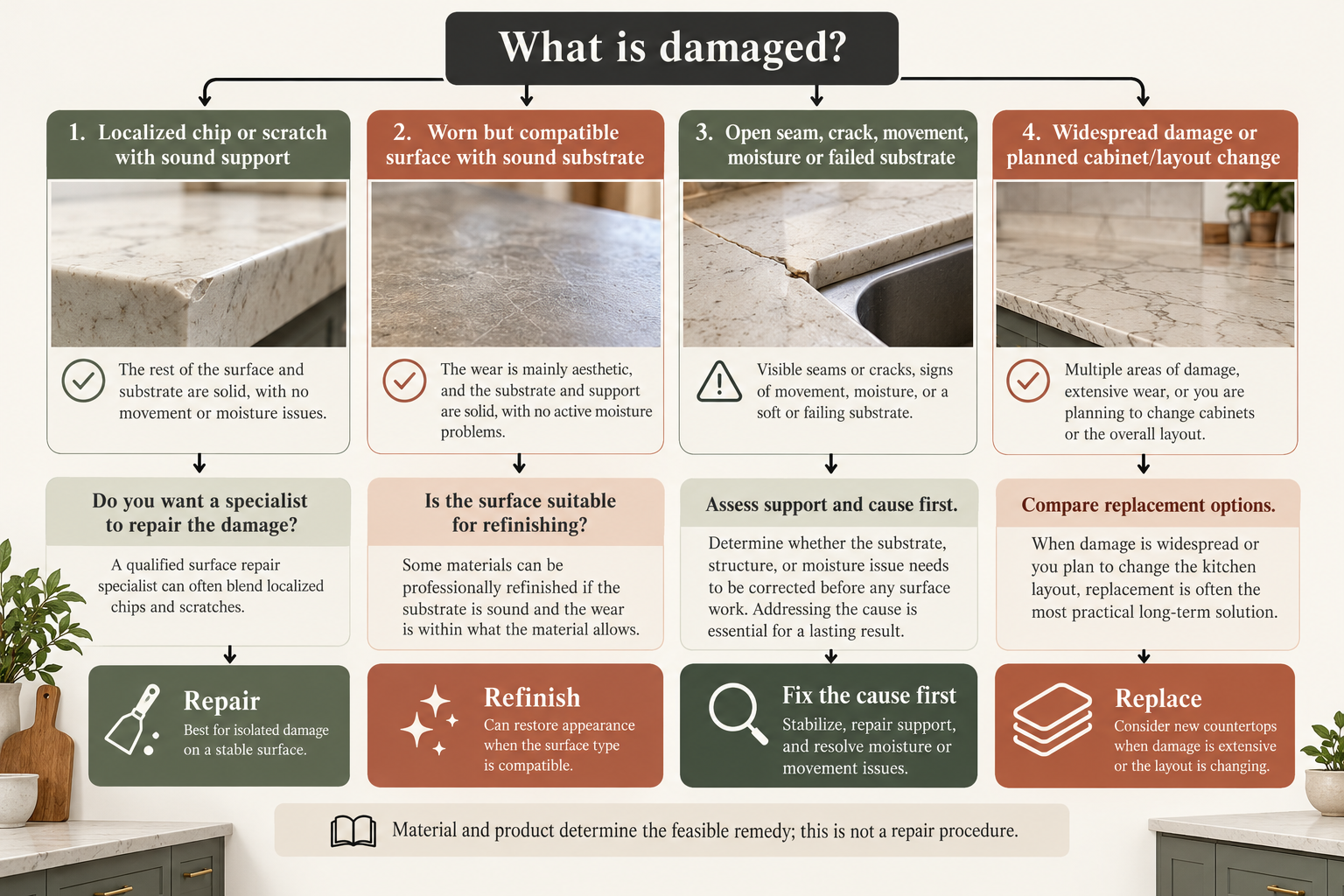
Repair versus replacement economics
Repair is strongest when the defect is localized, the underlying support is sound, and a qualified repair can produce an acceptable result. Replacement is stronger when damage is widespread, matching is impossible, the material no longer suits the use, or the countertop will be removed for cabinet or layout work.
Refinishing may improve appearance but does not correct a failing substrate, cabinet, seam, or water source. A new countertop over damaged cabinets can transfer the problem into the new surface.
Fabrication is part of replacement cost
Replacement can include removal, templating, material yield, sink and cooktop cutouts, seams, edges, supports, delivery, installation, and reconnection. Caesarstone’s quartz workflow illustrates these quote drivers but should not be generalized to all materials.
What a repair specialist should identify
Ask the professional to name the countertop material and distinguish the visible defect from its likely cause. An edge chip, open seam, surface scratch, stain, burn, loose laminate, or crack needs a different assessment. Record whether the defect is local, repeated, moving, near a sink, or associated with cabinet or floor movement. A repair estimate should state the affected area, preparation and finish work, expected appearance, warranty, and what it cannot restore.
The estimate should also address the supporting assembly. If a seam has opened or a surface has cracked, ask whether the cabinets are level, the top is supported as specified, and the condition could return. A repair that only treats the visible mark may not be durable when movement or water remains. Keep any cabinetry repair, leak correction, or structural assessment as an identified related scope rather than assuming a countertop patch includes it.
Material changes the available remedy
For laminate, ask whether the damage is limited to an edge or surface layer or whether the substrate has swollen or separated. For wood, ask whether the wear is in the finish or deeper in the surface and whether sink exposure affects the proposed treatment. For solid surface, quartz, natural stone, porcelain, and other sheet or slab products, ask the product-specific specialist what can be repaired, whether the color or pattern can be matched, and what appearance difference to expect. These are discussion prompts; the selected material and qualified repairer determine the feasible method.
When repair is unlikely to solve the problem
If a crack or open seam is moving, ask about cabinet support, installation, and moisture before approving a cosmetic repair. If a laminate surface has swollen or separated, an appearance patch may not correct the substrate. If damage is widespread or the selected surface cannot be matched, ask the specialist to compare repair limits with replacement scope. If the countertop will be removed to replace the cabinets or change the layout, a repair may have little value unless the homeowner needs a short-term bridge.
These are decision boundaries to discuss with a qualified fabricator or repair specialist, not instructions for testing, cutting, sanding, or treating the material. The exact product, damage, and supporting system determine what is feasible. Ask whether a repair is expected to restore function, appearance, or both, and what limitation remains after the work.
Compare the decision honestly
Ask a qualified fabricator or repair specialist to identify the material, failure mechanism, feasible repair, appearance limit, warranty, and risk of recurrence. Price a repair and a complete replacement with the same surrounding assumptions. Canadian and U.S. market figures are not directly interchangeable, and the evidence does not establish one universal repair threshold.
Separate the remedy from adjacent work
A countertop quote may exclude a leaking faucet, sink replacement, cabinet leveling, substrate repair, or water-damaged floor. Ask which professional is responsible for each issue and whether that work must happen before the counter is repaired or replaced. Likewise, removing a backsplash or changing a sink can affect adjacent surfaces beyond the defect being priced.
Compare a repair quote and a replacement quote with the same cabinet, plumbing, removal, delivery, installation, and finish assumptions. If the repair needs a future removal anyway, include that likely duplicate work. If it preserves a sound surface and supporting cabinets, compare disruption and lost use as well as the immediate total.
Bottom line
Repair when the damage is bounded and the supporting system is sound. Refinish when the surface is the problem and the substrate is suitable. Replace when condition, function, matching, or future cabinet work makes a patch a short-lived detour.