
An inspection report that names galvanized or polybutylene plumbing creates a condition-and-risk decision, not an automatic order to replace every pipe. The material, age, visible condition, leak history, accessible evidence, location, and expected ownership horizon all matter. The first useful spend may be confirming what material is actually present and which parts of the house it serves.
Why the materials should not be treated as identical
Galvanized steel and polybutylene have different histories, connections, and replacement questions. Galvanized pipe can corrode internally and restrict flow as well as leak. Polybutylene may appear in an inspection even when no active leak is visible. The material name alone does not establish the condition of every run, a failure date, or an insurance outcome. Ask the inspector or plumber to identify where the material was observed, whether it is a supply pipe or a separate service-line component, and how much of the home was accessible. A fitting in a utility room is evidence of that location; it does not map concealed branches by itself.
A useful assessment records the visible pipe material and connection type at representative points, the fixtures or branches served, active leaks or corrosion symptoms, repairs already made, and the areas that could not be seen. For galvanized systems, ask whether the concern is leakage, restriction, or both, and what observation supports it. For polybutylene, distinguish confirmed pipe from a label repeated in a report without a located sample. If a broader scope is recommended, request a route drawing and an explanation of how the known evidence supports its boundary. This turns an inspection note into a priceable decision rather than an all-or-nothing conclusion.
EPA identifies old piping as a leak risk and discusses galvanized pipe in the context of partial lead-service-line replacement. That context does not establish the condition of every galvanized interior system. Keep the service line separate from house-side legacy piping, and ask an inspector or plumber to distinguish confirmed material from a guess based on one exposed fitting.

Three choices after an inspection
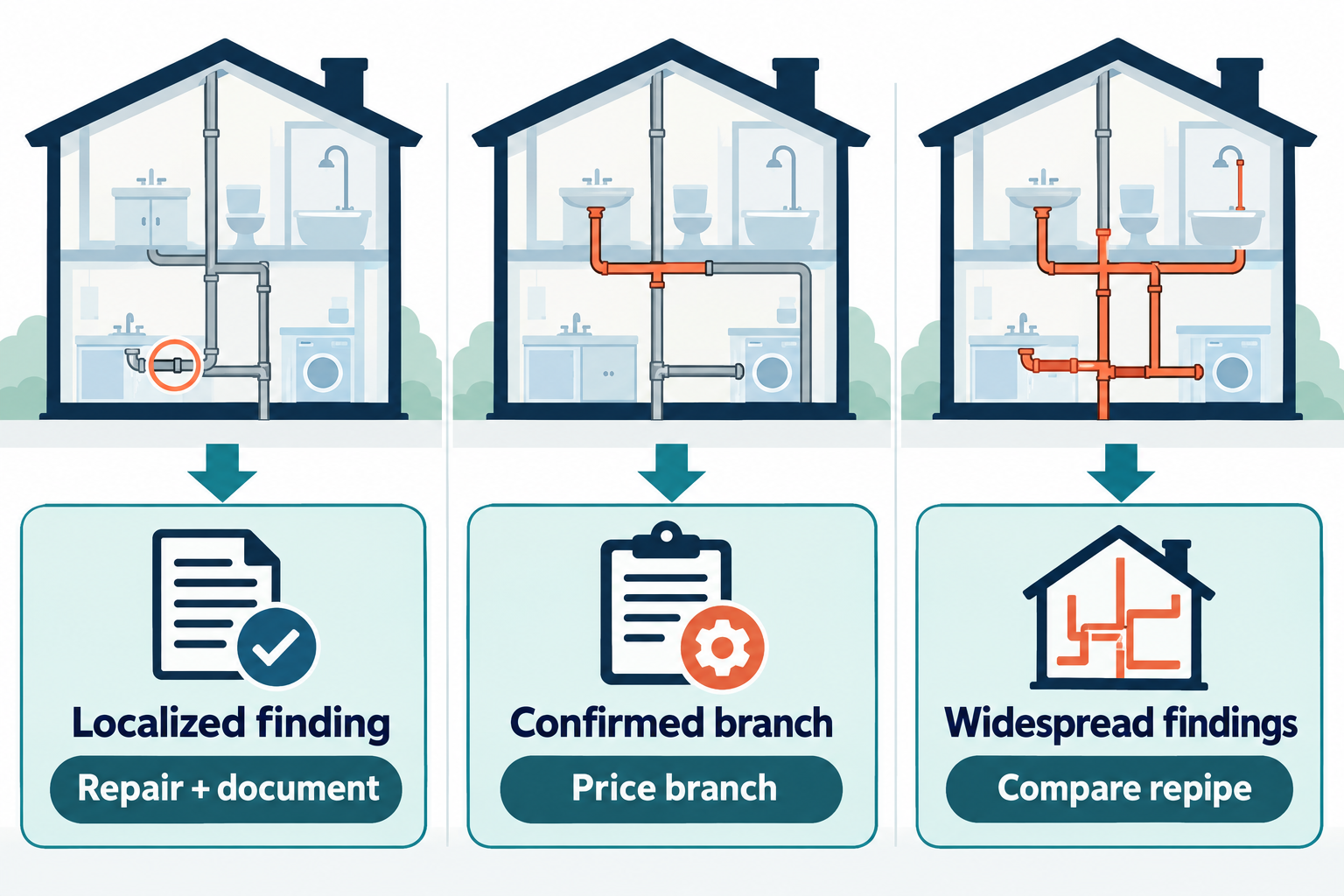
| Situation | A proportionate next step | What the price should answer |
|---|---|---|
| One localized failure and otherwise limited evidence | Repair the accessible failure and document what remains unknown | Does the work correct the leak, or only the exposed connection? |
| A confirmed affected branch or repeated issue | Price that branch or area separately from a larger repipe | Which fixtures and legacy sections remain in service? |
| Widespread findings or several planned openings | Compare a systematic replacement with continued repair | What added access and restoration buy a broader correction? |
Monitoring can be a legitimate choice when there is no active symptom and the owner understands the uncertainty. It is not the same as proving the system is sound. Conversely, an inspection label alone does not make whole-house replacement the only reasonable scope. The paid step should answer a specific question about material, condition, extent, or repairability.
What moves the cost
The main drivers are the number of fixtures, access through finished surfaces, crawlspace or slab routing, material and transition choices, shutoff condition, temporary water arrangements, disposal or abandonment, and finish restoration. A home with exposed basement piping may be much simpler than a home with the same fixture count over a slab or behind finished cabinetry.
Market sources can help establish a broad repipe planning range, but available market research does not establish a normalized US or Canadian price for legacy-material replacement. Treat any online amount as a scope example. Ask bidders to price the same included runs and state the restoration boundary. A quote should distinguish confirmed material from an assumption and show whether the assessment reached each branch, floor, and fixture connection. Two estimates can differ because one includes a broad replacement route while another prices only visible or reported sections.
Do not multiply a whole-house repipe estimate by the number of rooms or infer the price from one exposed fitting. The work may be governed by the route to reach a branch, whether a slab or finished surface must be opened, the condition of shutoffs and transitions, and what finish restoration is included. If the inspection was visual and access limited, ask the contractor to list the concealed areas that remain unknown and the specific finding that would trigger an added scope. An exploratory opening can sometimes make a later fixed scope more meaningful, but it also has its own access and finish cost.
Purchase and insurance questions
An inspection finding can affect a purchase negotiation or an underwriting conversation, but insurer and lender responses vary by carrier, region, policy, material, condition, and current practice. Ask the insurer or broker what written documentation, inspection, repair, or replacement it requires for this property. Do not rely on a contractor’s broad statement that a material is “uninsurable.”
For a purchase, first identify the evidence behind the report and obtain a priced scope rather than discounting the home by an unexplained worst case. A buyer, seller, and long-term owner may prefer different timing, but a deadline is not evidence about concealed pipe condition. If an insurer, lender, or sale agreement sets a requirement, ask that party to identify the condition it needs satisfied and then compare the smallest compliant repair with any broader option. Record the deadline, required document, and acceptable completion evidence in writing; an informal phone statement may not answer what the policy or transaction actually requires. If the condition is “replace,” ask whether the request concerns only a confirmed segment or the whole distribution system, and have the provider identify the inspection or receipt it will accept. This can prevent a homeowner from buying a larger scope than needed to resolve the stated condition.
Separate lead-service-line issues
Galvanized or polybutylene interior plumbing is not the same question as a lead service line. Lead involves drinking-water exposure, responsibility, testing, and local utility or public-health guidance. Keep that work separate and do not infer that a galvanized interior pipe is a lead service line without evidence.
A practical quote comparison
Ask each bidder for:
- the material identification, areas inspected, and areas that were not visible;
- the photos, symptoms, or other basis for the condition assessment;
- local repair, affected-branch replacement, and broader repiping options where each is reasonable;
- included runs, fixtures, valves, transitions, and old pipe left in place;
- openings, protection, cleanup, finish restoration, and water interruption;
- permit, inspection, testing, warranty, and hidden-condition assumptions; and
- the rate and approval process for changes after access is opened.
If two proposals recommend different work, compare the evidence and endpoint rather than only the totals. One bid may correct an active leak; another may reduce future exposure to a larger system. They are not equivalent until their included piping, access, finish work, and remaining legacy sections are clear.
Decide by failure pattern and ownership horizon
Local repair is easier to justify when the system is otherwise sound and the finding is narrow. Planned replacement becomes more attractive when failures recur, symptoms appear across separate areas, access is already open, or the owner expects a long stay. A sale, insurance condition, or major renovation can change timing, but it should not turn uncertainty into certainty.
Compare the likely sequence of work, not just one invoice. A targeted repair may preserve finishes now but require another visit if a separate branch fails. A systematic replacement costs more initially and may require broader access, but can consolidate planned openings. Available research does not establish a universal price or service-life threshold for either material. The useful decision is “monitor with a documented plan,” “replace the affected branch,” or “price systematic replacement,” based on the property evidence.
Make future service part of the replacement choice
If replacement is selected, ask where new valves, transitions, and accessible runs will be located and how they will be identified. A system that is technically new but difficult to isolate can create future service costs. Request photographs before finishes close and retain the material, warranty, and route information. This documentation can help distinguish the new system from legacy sections that remain in place.
Do not promise that a repipe eliminates every leak risk. Fixtures, valves, service lines, and connections can still fail. The benefit is a defined reduction in the known legacy-system exposure, not a guarantee of zero future plumbing work.