
Wallpaper removal is unpredictable because the visible paper does not reveal the number of layers, adhesive, wall substrate, or the damage that may appear underneath. The next finish should be part of the budget from the beginning.
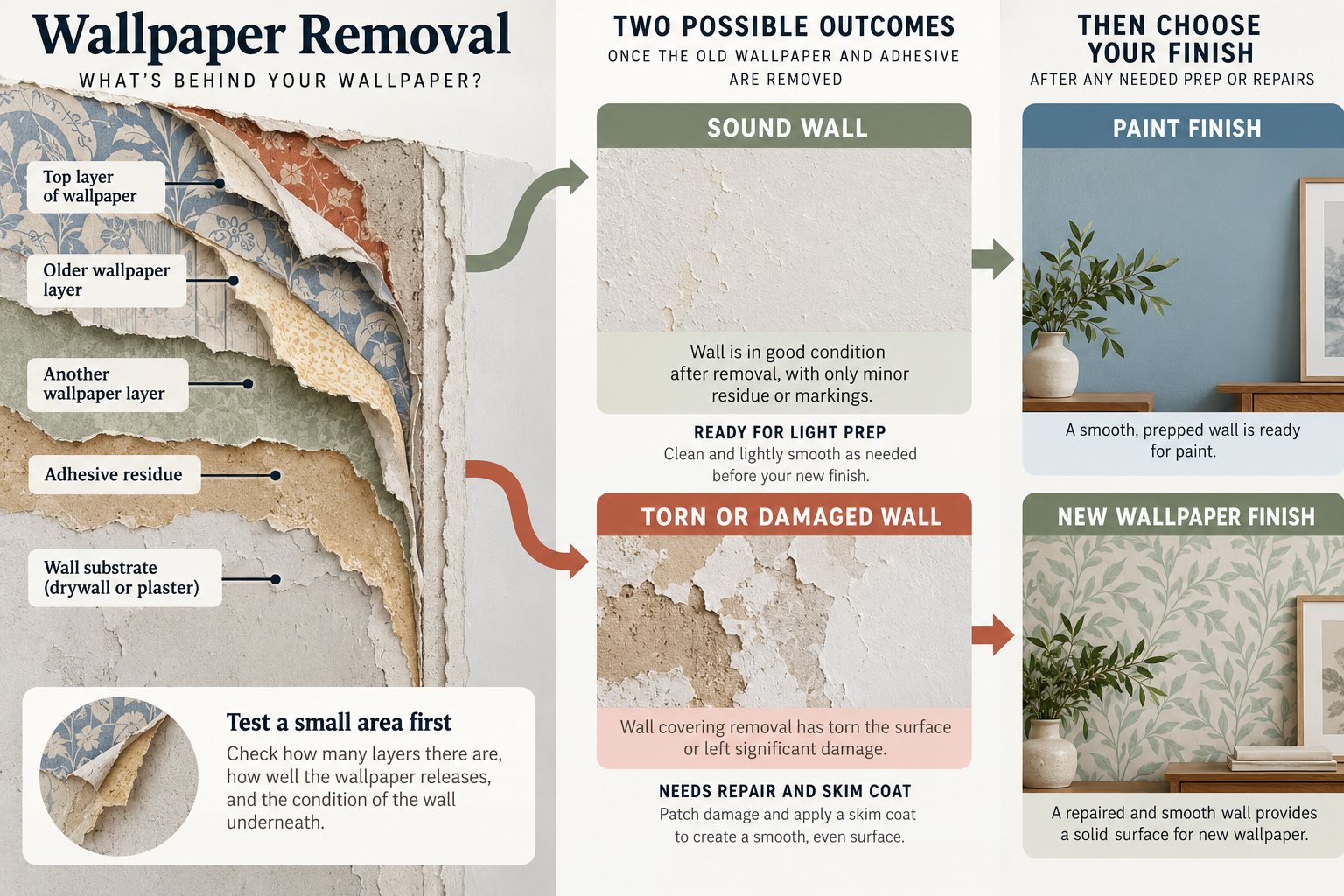
What makes removal difficult
Multiple layers, strong adhesive, painted paper, corners, plaster, drywall paper, seams, moisture damage, and limited access can add labor. Removing the covering may expose holes, torn paper, uneven joint compound, stains, or a surface that needs skim coating and primer before paint or new wallpaper.
No reliable current U.S. or Canadian removal range was established by the available sources. Canadian market observations inform the preparation and removal context, but exact figures require local re-verification. Ask for a site visit or a clearly stated allowance rather than assuming a per-room rate.
Keep the method safe
The appropriate removal approach depends on the material and surface. Avoid turning this cost guide into a DIY chemical or steam procedure. Older coatings or related materials may require lead or asbestos assessment before disturbance; obtain qualified local advice when applicable.
Compare the complete project
Request separate lines for removal, disposal, wall repair, skim coating, sanding, primer, paint or new wallpaper, furniture, protection, and cleanup. Ask how additional damage will be priced after a test area or removal begins.
Why removal is hard to price in advance
The visible paper does not reveal how many layers are present, how strongly they are bonded, whether the wall is drywall or plaster, or how much previous repair lies underneath. Painted paper, vinyl-coated coverings, old adhesive, seams, corners, and moisture damage can change the labor. The next finish should be included in the budget because removal often exposes a surface that is not ready for paint or new paper.
What can be revealed
Stripping may expose torn drywall paper, holes, failed joint compound, stains, uneven plaster, incompatible coatings, or a wall that was never finished for direct decoration. A contractor may recommend patching, skim coating, sanding, primer, or a new finish across a larger area. That is not necessarily an upsell; it may be the preparation needed to produce the result the homeowner expects.
Ask for a test area or a clearly stated allowance. The contractor should explain how additional damage will be measured, who approves it, and what happens if removal reveals moisture, contamination, or a legacy coating.
Removal before paint versus new wallpaper
If the wall will be painted, the budget may include more sanding, stain blocking, or skim coating to achieve a uniform surface. If it will receive new wallpaper, the surface may need a specific primer and a smooth, stable base. Re-papering over existing material can be possible in limited cases, but it should be evaluated against thickness, adhesion, future removal, and product requirements rather than assumed to save money.
Safety and method boundary
The appropriate method depends on the material and substrate. This article does not prescribe chemical, steam, scraping, or other do-it-yourself procedures. Older coatings or related materials may require lead or asbestos assessment before disturbance. U.S. and Canadian guidance differs, and appearance cannot identify a particular material.
Keep hazardous-material assessment, mold, moisture-source correction, and major restoration separate from ordinary wallpaper removal. A finish contractor can price restoration after those conditions are resolved.
Cost scenarios
A simple project has one layer, sound drywall, clear access, and a wall ready for modest preparation. A typical project includes multiple layers, adhesive cleanup, patching, primer, furniture protection, and a new paint or paper finish. A complex project includes plaster, damaged paper, broad skim coating, high walls, moisture, old coatings, or a safety assessment.
No reliable current U.S. or Canadian removal range was established. Canadian market observations help identify preparation and removal drivers but require local re-verification. Ask for a site visit rather than assuming a per-room price.
Quote checklist
Request layer and substrate assumptions, test-area findings, removal, disposal, wall repair, skim coating, sanding, primer, paint or wallpaper, furniture, protection, access, and concealed-condition terms. Compare the complete next-finish project, not removal labor in isolation.
Test the wall condition
Wallpaper removal can reveal more than paper and adhesive. Multiple layers, painted paper, vinyl faces, weak gypsum paper, old plaster, patching, and moisture damage each change the method and the amount of restoration. A small test area can help establish how the covering releases and what the substrate can tolerate, but it does not guarantee the condition of every wall.
Ask whether the quote assumes one layer, what tools or moisture exposure are allowed, and how the contractor will protect trim, flooring, cabinets, outlets, and fixtures. Removal that is fast on an open wall may be slow around openings and corners.
Substrate damage is a separate cost driver
Peeling the paper can lift drywall face paper, expose old compound, or reveal cracks and stains. The next finish may then require sealing, skim coating, sanding, primer, and paint. If the wall is soft, damp, repeatedly moving, or broadly damaged, board or plaster repair may be a better comparison than additional cosmetic preparation.
Do not treat a removal price as proof that the wall will be ready to paint. Define the intended finished surface and the number of preparation passes included.
Safety and method boundary
Older coatings and adhesives may raise material or disposal questions that depend on the home, jurisdiction, and work method. Do not infer safety from appearance or treat ordinary wallpaper removal as hazardous-material assessment. Obtain the appropriate local advice when the age or condition makes that relevant.
Price the next finish
Compare removal-only, removal-and-paint, and removal-and-new-wallpaper scopes using the same assumptions for wall repair, skim coat, primer, paint, access, furniture, protection, disposal, and cleanup. The useful budget ends with a defined next finish, not a bare wall whose restoration remains unknown.