
Stairs are not priced like an empty rectangle of floor. Each tread, riser, nosing, return, landing, railing interface, and transition adds measurement and detail work.
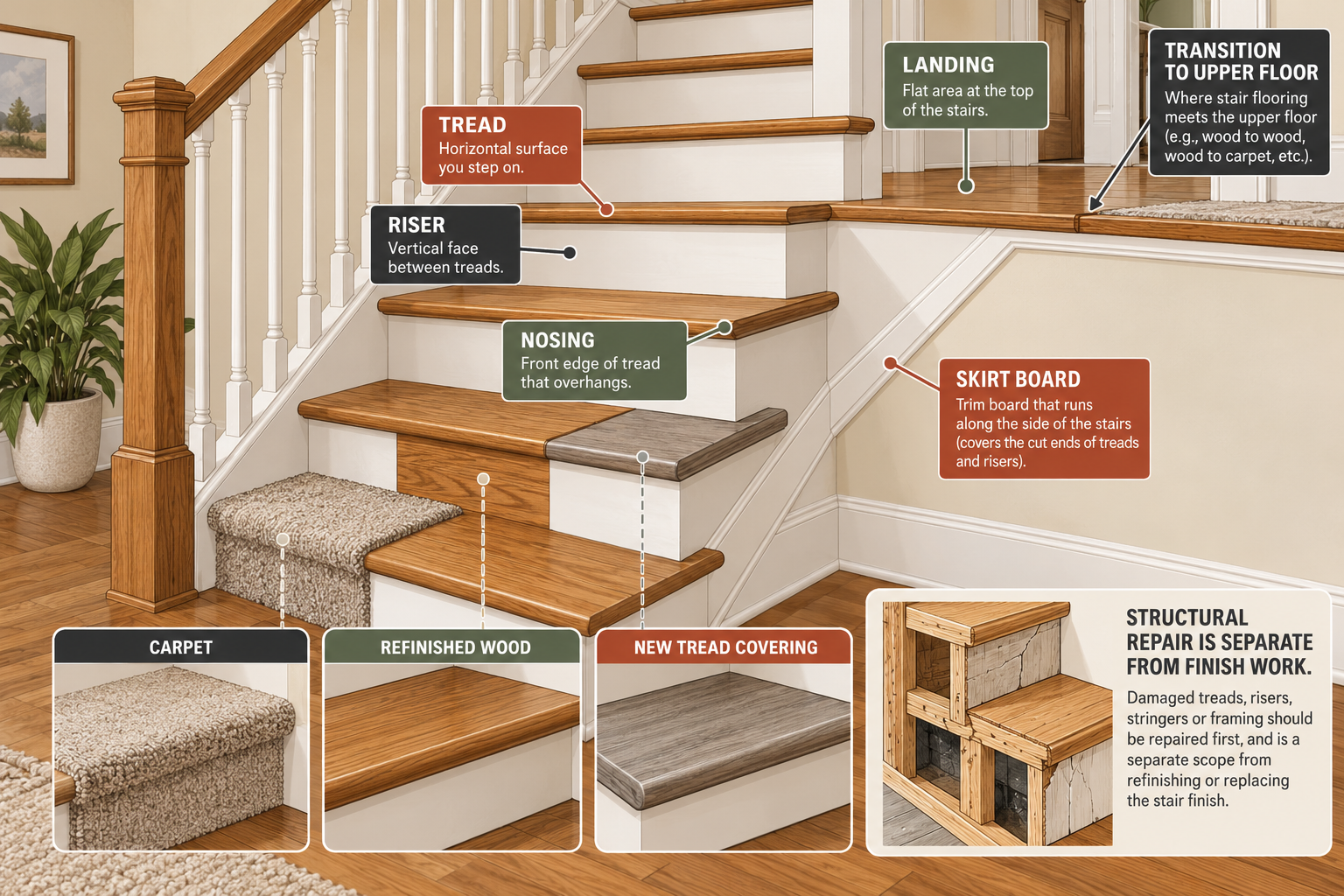
Replacement versus refinishing
Replacement may include removal of carpet or an existing finish, substrate or tread repair, new material, nosings, risers, edge details, and finishing. Refinishing may fit when the existing wood is sound and has enough material for the proposed work, but it can still require repairs, sanding, coating, protection, and cure-time planning.
A broad U.S. market observation places flooring work at about $11–$160 per step across flooring types. The range mixes materials and scopes, so it is not a quote or a universal rate. Canadian flooring examples do not establish a comparable per-step range.
What drives labor
Stair geometry, open or closed sides, winding steps, landings, access, old finish removal, matching adjacent floors, detailed nosings, paint or stain work, and occupied-home protection can change the budget. Floor height and transition details matter at the top and bottom of the run.
Quote questions
Ask for the number and type of steps, finish on treads and risers, nosing treatment, removal, disposal, repairs, railing or trim interfaces, material, finish coats, protection, and cleanup. If the staircase itself has movement or structural concerns, separate that evaluation from the finish price.
Why stairs cost differently from flat flooring
A room floor is usually measured as an area. Stairs are a sequence of individual surfaces and edges. Each tread, riser, nosing, return, landing, skirt board, and transition can require separate fitting. The installer may need to protect walls and railings, work around occupied circulation, and coordinate the top and bottom connection with adjacent floors.
The existing construction matters. Carpeted stairs, painted treads, solid wood, engineered material, and a stair system with damaged or uneven treads each create different preparation. Replacing a finish does not automatically repair movement, a loose tread, a damaged stringer, or a railing problem.
Refinish, replace, or change the finish
Refinishing can fit when existing wood is sound, sufficiently substantial for the proposed work, and worth preserving. The scope may include removal of carpet or paint, repairs, sanding, stain or clear finish, edge work, protection, and cure time. Stairs can be more labor-intensive than a room because of handwork and detail around nosings and corners.
Tread or riser replacement may be considered when material is damaged, the appearance must change, or the existing surface cannot accept another finish. The quote should state whether it covers only the visible tread or also the substrate, nosing, riser, skirt, trim, and adjacent floor.
Carpet replacement includes measurement, cuts, cushion or pad, tack strips, seams, stair edges, transitions, removal, and disposal. Pattern, winding stairs, open sides, and landing connections can change the installation.
Safety and structural boundaries
Stairs are a safety-sensitive part of the home. A finish quote should not imply that new carpet, wood, or paint corrects a loose tread, unsafe edge, damaged stringer, inadequate railing, or structural movement. If the staircase moves, sags, or has a damaged support, price that assessment separately before selecting the finish.
Likewise, a change in finish height can affect nosings, risers, doors, and transitions. Ask how the final geometry will be maintained and what local requirements apply to any alteration. The article covers finish economics; it does not approve a particular stair design or structural repair.
Cost scenarios
A simple project has straight accessible stairs, a standard finish, sound treads, and limited trim work. A typical project includes removal, repairs, nosings, landings, protection, and connections to two floor finishes. A complex project includes winding steps, open sides, custom woodwork, damaged substrate, pattern matching, occupied-home access, or structural and railing questions.
The available U.S. observation of roughly $11–$160 per step mixes materials and scopes, so it is a planning signal rather than a universal stair rate. Canadian flooring examples do not establish a comparable per-step range. Request a site-specific bid in the relevant market.
Quote checklist
Ask for the number and geometry of steps, tread and riser finish, nosings, landings, material, removal, disposal, repairs, sanding or coating, carpet and cushion if relevant, railing and trim interfaces, adjacent-floor transitions, protection, furniture, cure time, and cleanup. Confirm what is excluded as structural or code-related work.
The best stair budget explains every visible edge and connection. A per-step number without a defined finish and restoration scope is not enough for a safe comparison.
Price the route through the house
Stair work can affect access between floors for part of the project. Ask how many days the stairs will be unavailable, whether work proceeds in stages, and what temporary access arrangements are possible. The answer depends on the layout and chosen finish; do not assume a contractor can leave every tread usable while coatings cure or material is installed. Include this disruption when comparing a refinishing plan with replacement.
Ask each bidder to count and describe the same surfaces: treads, risers, landings, edges, nosings, skirt boards, and transitions. A quote based on “steps” may include only tread coverings, while another includes risers and finishing. Open-sided stairs, winders, trim returns, and railings create detail work that a simple count does not represent. Photos and a site measurement help establish whether all bidders saw the same geometry.
Keep finish changes separate from repairs
A new finish can change appearance and traction, but it does not repair a loose tread, moving support, or damaged railing. If the staircase has a functional or structural concern, have that scope assessed separately and coordinate the finish after the condition is addressed. Likewise, changing material thickness can affect the relationship among tread, riser, nosing, and adjacent floors; ask how the installer will maintain a consistent completed profile and which local requirements apply.
A comparison should show removal, disposal, repairs, material, edge details, finish coats, protection, and cleanup. If painting or staining is separate, name the responsible contractor and the expected handoff condition. This is especially useful when carpentry and finish work are split across bids.