
Engineered wood has a real-wood wear layer over a constructed core, but products are not interchangeable. Installation cost depends on the named product, the substrate, and whether the system is nailed, stapled, glued, or floated.
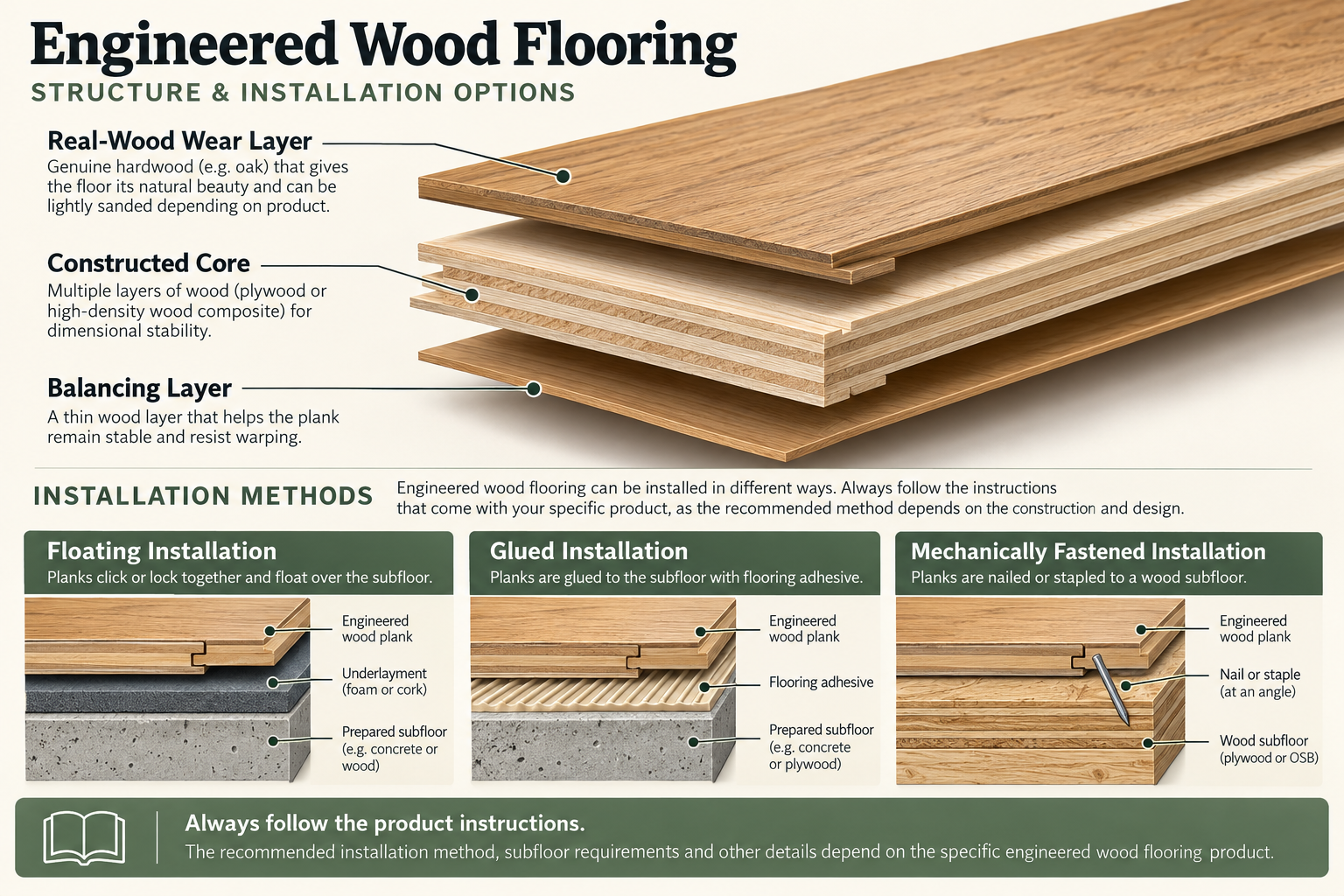
Product and installation choices
Thickness, wear-layer construction, board size, finish, pattern, and transitions affect material and labor. A floating installation can have a different preparation and underlayment scope from a glue-down or mechanically fastened system. The product’s current instructions and warranty conditions control the allowable method.
NWFA guidance supports treating moisture, substrate condition, construction, and regional climate as installation factors. It does not establish one universal engineered-wood method or price. Over radiant heat, the heating layout and fastening restrictions require a separate product and system review.
Market context
A Canadian market observation places solid hardwood above engineered hardwood in that cited market, while noting that it is not a complete price study. U.S. and Canadian figures should remain separate, because labor, product availability, taxes, and measurement bases differ.
What to include in the budget
List removal and disposal, moisture and substrate checks, leveling, underlayment or adhesive, delivery, acclimation or conditioning, cuts, stairs, thresholds, baseboards, furniture handling, and cleanup. Ask whether finish repair after installation is included if a factory-finished board is damaged.
Questions before approving the quote
Ask for the exact product and installation method, substrate assumptions, flatness and moisture requirements, floor-height change, transition details, radiant-heat compatibility if relevant, and the treatment of concealed damage. Compare complete system scopes rather than material prices alone.
What makes engineered wood a separate decision
Engineered wood is a family of products rather than one uniform system. The construction, top wear layer, core, finish, board dimensions, locking profile, and manufacturer-approved installation methods can differ. Some products are designed to float, some to glue or fasten, and some have limitations on below-grade or radiant applications. The exact product controls the installation decision.
That difference affects cost. A floating system may change fastening labor but still need careful substrate preparation, underlayment, expansion space, and transitions. A glued or fastened system can require more preparation and installation time. A product with a thin wear layer may have different lifecycle economics from one that can be professionally refinished under stated conditions.
Material and installation structure
Separate the budget into product, delivery, preparation, attachment, finish restoration, and room logistics. Product cost changes with construction, finish, width, length, grade, texture, and availability. Installation labor changes with room geometry, cuts, thresholds, closets, stairs, furniture, and whether the work continues through several rooms.
Preparation may include removal, subfloor repair, leveling, moisture assessment, underlayment, adhesive, or correction of movement. Do not use an engineered-wood product to bypass a damaged or unstable substrate. A ready-looking surface can still fail the product’s flatness or moisture requirements.
Subfloor, moisture, and below-grade questions
Ask what the selected manufacturer requires for the substrate and whether the installer will document the relevant condition. A wood subfloor may need attachment or flatness correction. A concrete substrate may require moisture information and an approved installation method. Below-grade use, radiant heat, and damp areas can require product-specific limits.
The evidence does not support a universal statement that engineered wood is suitable for every basement, slab, or radiant system. If a product is used over radiant heat, confirm the named product, installation method, surface-temperature limits, underlayment, and heating-system controls. Do not convert a general material advantage into a compatibility approval.
Lifecycle economics
Engineered wood can be attractive when the homeowner wants a wood appearance with a particular installation method or dimensional construction. The long-term decision includes repairability, matching, finish durability, and whether the wear layer permits the proposed future refinishing. A product that costs less to install may be less flexible to refinish; a premium product may be difficult to match later if it is discontinued.
Keep spare boards when practical. Record the product name, color, finish, lot information, and installation date. Those details can reduce the cost of a future localized repair even when the original installation was otherwise successful.
Comparing engineered and solid wood
Solid and engineered wood should be compared as complete systems. Consider the exact installation method, substrate, moisture context, finish, repair path, future refinishing, height, stairs, and transitions. Neither category is automatically cheaper. A simple factory-finished installation over a ready substrate can differ greatly from a site-finished multi-room project with subfloor correction.
Quote checklist
Ask for the product construction and wear-layer description, approved attachment method, substrate and moisture assumptions, underlayment or adhesive, removal and disposal, floor-height effect, transitions, stairs, trim, furniture, acclimation or conditioning requirements, radiant-heat compatibility, finish repair, and warranty conditions. Require a clear change-order method for concealed substrate damage.
The useful estimate explains why this product fits the home and what conditions would make the price or installation method change. Material price alone cannot answer that question.
Compare products by construction
Two engineered floors can look similar while having different wear layers, cores, joint profiles, finishes, and approved installation methods. Ask for the manufacturer’s product name and installation instructions. A floating product, a glue-down product, and a fastened product should not share one generic labor assumption.
Construction also affects repair and future refinishing. Confirm whether the selected product is intended to be refinished under any stated conditions, and do not assume that a wood appearance guarantees the same repair path as solid boards. Keep spare boards and product information for future matching.
Below-grade and radiant decisions
Below-grade use, concrete slabs, moisture, and radiant systems require more than a material preference. The substrate, underlayment, temperature, humidity, adhesive or fastener, and product documentation must align. A product marketed as stable or water resistant is not a universal approval for a damp room or unknown slab.
Ask who is responsible for testing or documenting the condition. If the installer says an underlayment solves the issue, ask which product instruction supports that statement. Keep heating-system repair, source moisture correction, and structural work outside the finish allowance.
Lifecycle tradeoffs
Engineered wood may offer useful installation flexibility, but a thinner wear layer, discontinued finish, or difficult matching can change future cost. A product with a higher initial price may be easier to repair, while a less expensive product may be adequate if the room is stable and the owner accepts its finish limits. Compare the complete ownership decision instead of ranking products by nominal price.
Final comparison questions
Ask each bidder to identify product construction, wear layer, installation method, substrate, moisture and flatness assumptions, underlayment or adhesive, removal, disposal, trim, transitions, stairs, furniture, radiant compatibility, warranty conditions, and concealed-damage pricing. A clear answer to those questions is more valuable than a broad claim that engineered wood is cheaper or more stable.
Attachment method changes the estimate
Engineered flooring may be approved for floating, glue-down, or mechanically fastened installation, but the permission belongs to the named product and system. Each method changes preparation, underlayment or adhesive, layout, labor, repair access, and sometimes the way the floor meets adjacent surfaces. Ask the installer to identify the method in the bid rather than pricing “engineered wood” as one generic category.
Floating installation can reduce some fastening work, but it still needs a base that meets the product’s flatness, moisture, and movement requirements. Glue-down work can require more substrate preparation and a compatible adhesive. Fastened work can require careful review of the subfloor and any radiant components. These are scope differences, not a universal ranking of methods.
Product construction matters later
The visible surface does not reveal the remaining wear layer or the limits on future refinishing. Ask for the product construction and the manufacturer’s current care and repair information. A thicker wear layer may provide more future options, but it does not make a product suitable for a damaged or wet base. A product that cannot be refinished may still be a sensible choice when replacement of individual pieces and a lower initial price are the priorities.
Record the collection, color, lot, installation method, and purchase date. Keep spare boards when practical. Matching an aged floor depends on more than the product name: light exposure, finish wear, board variation, and the way the replacement piece is accessed can all affect the result.
Compare engineered wood with the real alternatives
Solid hardwood may offer a different refinishing path but can have different installation limits. Laminate or resilient flooring may change the material and preparation cost but can also change moisture tolerance, sound, transitions, and repair expectations. Refinishing an existing hardwood floor may avoid removal but may not be feasible if the remaining wear layer or damage is unsuitable.
For each option, compare removal, substrate work, installation, trim, disruption, future repair, and the risk of a product-specific compatibility issue. That comparison gives the homeowner a lifecycle budget rather than a claim that engineered wood is automatically the least expensive choice.