
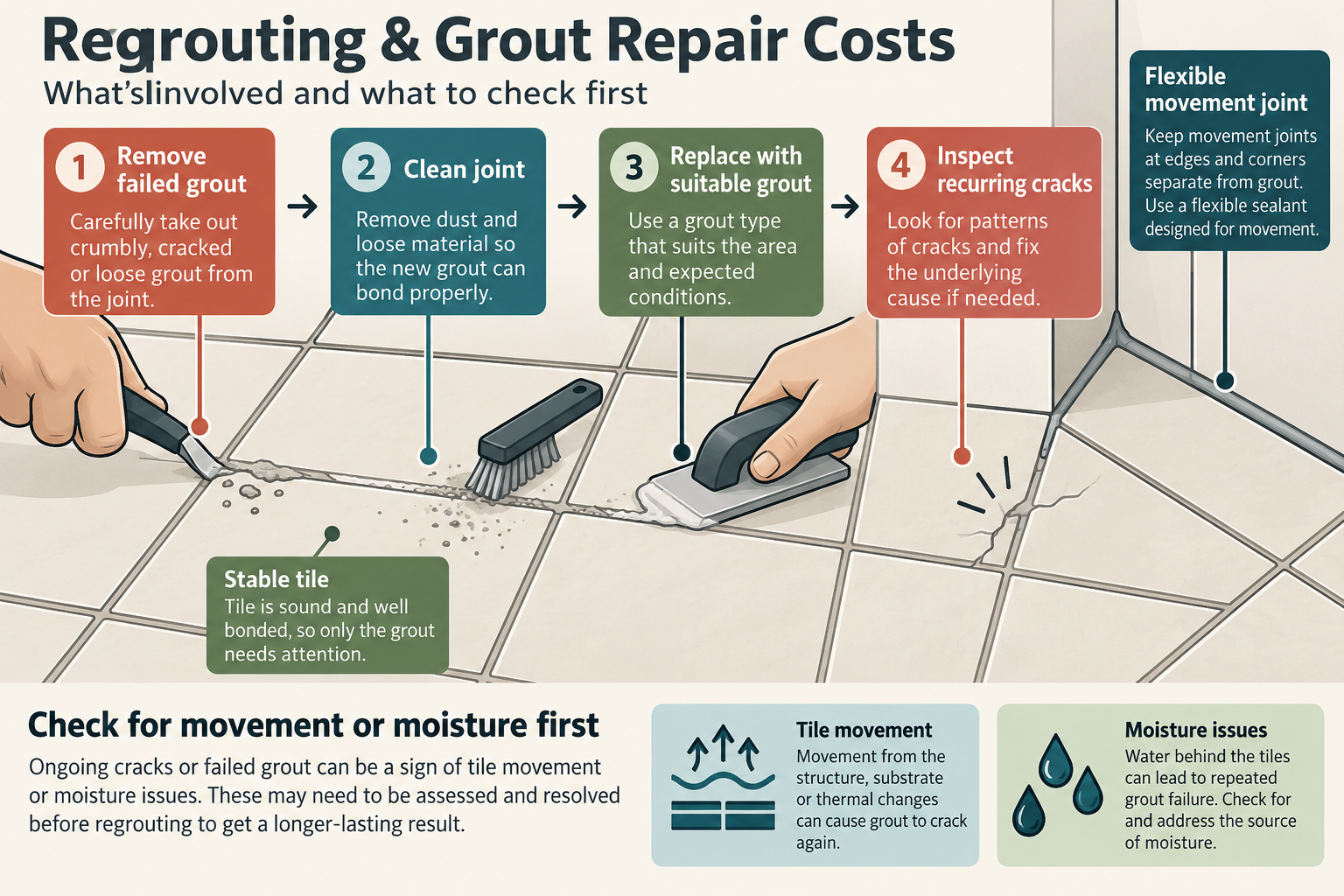
Regrouting is not simply spreading new grout over old joints. The project may include diagnosis, removal of failed material, cleaning, joint preparation, new grout, movement-joint treatment, and protection of the surrounding tile.
What changes the quote
Labor depends on the area, joint width and depth, tile layout, corners and transitions, floor or wall access, grout type and color, furniture, and the cause of failure. Cracked grout caused by substrate movement or moisture may return if the condition below the joint is not corrected.
TCNA states that grout cannot be successfully grouted over and recommends removing at least two-thirds of the old grout depth when repairing or replacing grout. The same guidance identifies substrate deflection, poor packing, excess water, and installation issues as possible causes. These are common examples, not a remote diagnosis of a particular floor.
Price expectations
Available sources do not establish a reliable current U.S. or Canadian regrouting range. Ask for the exact area, removal method, preparation, material, color-matching expectation, movement-joint treatment, and cleanup. Small sections may carry a service minimum.
When regrouting is not enough
Loose or cracked tile, widespread hollow areas, moving subfloors, water damage, or failed setting materials can require tile removal or substrate work. Ask the installer to explain whether the proposed work is cosmetic, functional, or intended to correct a system failure.
Local repair versus full regrouting
Localized grout repair may fit a small area when the tile is stable and the failure is limited. Full regrouting is a broader surface project that can involve removal of failed material, cleaning joints, protecting tile edges, installing new grout, matching color, and restoring the room. Neither scope should be selected solely because the grout looks dirty or cracked.
TCNA guidance identifies movement and installation conditions as possible reasons for grout failure. If cracks return, a larger pattern is present, or tile is loose, the underlying system may need assessment. New grout over an unsuitable or insufficiently prepared joint can make the surface look better without correcting the reason it failed.
What drives the labor
The largest drivers are joint width and depth, total area, tile size and pattern, access, furniture, grout type, color expectations, and the amount of material that must be removed. Narrow or irregular joints can take more careful labor. A floor with many corners, transitions, or fixtures takes longer than a clear room of the same area.
Ask how the existing grout will be removed and how much joint depth is required for the proposed material. The contractor should protect the tile and explain whether movement joints, caulked changes of plane, or other details are included. A regrout quote that treats every joint as interchangeable is difficult to evaluate.
Color and appearance expectations
Old grout may have changed through staining, cleaning, wear, and moisture. A new color can make repaired areas visible even when the installation is correct. Ask for a sample or defined color expectation, especially when only part of a room is being repaired. Sealing, if appropriate for the selected grout, should be listed separately from ordinary installation.
When grout is only the symptom
Cracked grout beside loose tile, hollow areas, recurring movement, or moisture can indicate a substrate or setting problem. A shower or other wet-area issue may involve waterproofing rather than an ordinary floor-finish repair. A moving floor, damaged framing, or active leak should be corrected before relying on regrouting.
Do not use a fresh grout line as proof that the assembly is dry, stable, or waterproof. The article’s cost boundary is finish-level grout work after the relevant cause has been assessed.
Cost scenarios
A simple repair covers a small, accessible area with stable tile, clear color expectations, and little preparation. A typical project includes broader removal, cleaning, furniture protection, color matching, and a return for cure or sealing where applicable. A complex project includes widespread failure, difficult access, loose tile, moisture, movement, or a transition into tile replacement or substrate work.
Quote checklist
Request the area, joint condition, removal depth, grout type, color, tile protection, movement-joint treatment, access, furniture, cleanup, sealing if applicable, and the condition that would trigger tile or substrate investigation. Compare the complete proposed repair rather than a per-square-foot number with unclear preparation.
Grout repair, movement joints, and tile work
A quote should distinguish cementitious grout joints from flexible joints or transitions and explain which material will be used in each location. Corners, changes of plane, and connections to tubs or other materials may need a different treatment from a field joint; the appropriate detail depends on the assembly and current product instructions. Do not assume that replacing every visible line with the same grout is the correct repair.
Color is part of the scope. Existing grout can be stained, faded, or affected by previous cleaning, so a new section may stand out even when the repair is sound. Ask whether the contractor will make a sample, how much of the room will be treated, and what variation is expected. If the purpose is appearance, compare the cost of cleaning or color treatment with removal and replacement, where those options are appropriate for the installed material.
Define the endpoint and change-order boundary
Specify whether the work ends with failed grout removed and replaced, a wider area regrouted, tile reset, or an investigation of the underlying assembly. Ask who protects tile edges during removal and what happens if a tile breaks or moves. If removal exposes loose setting material, moisture, or movement, agree in advance whether the installer stops for approval or proceeds under a defined allowance.
These details make a small repair easier to compare with full-room work. A very low price may cover only fresh material at the surface, while another quote may include removal depth, cleaning, corners, protection, and cleanup. Compare the same area and endpoint before treating the difference as savings.