
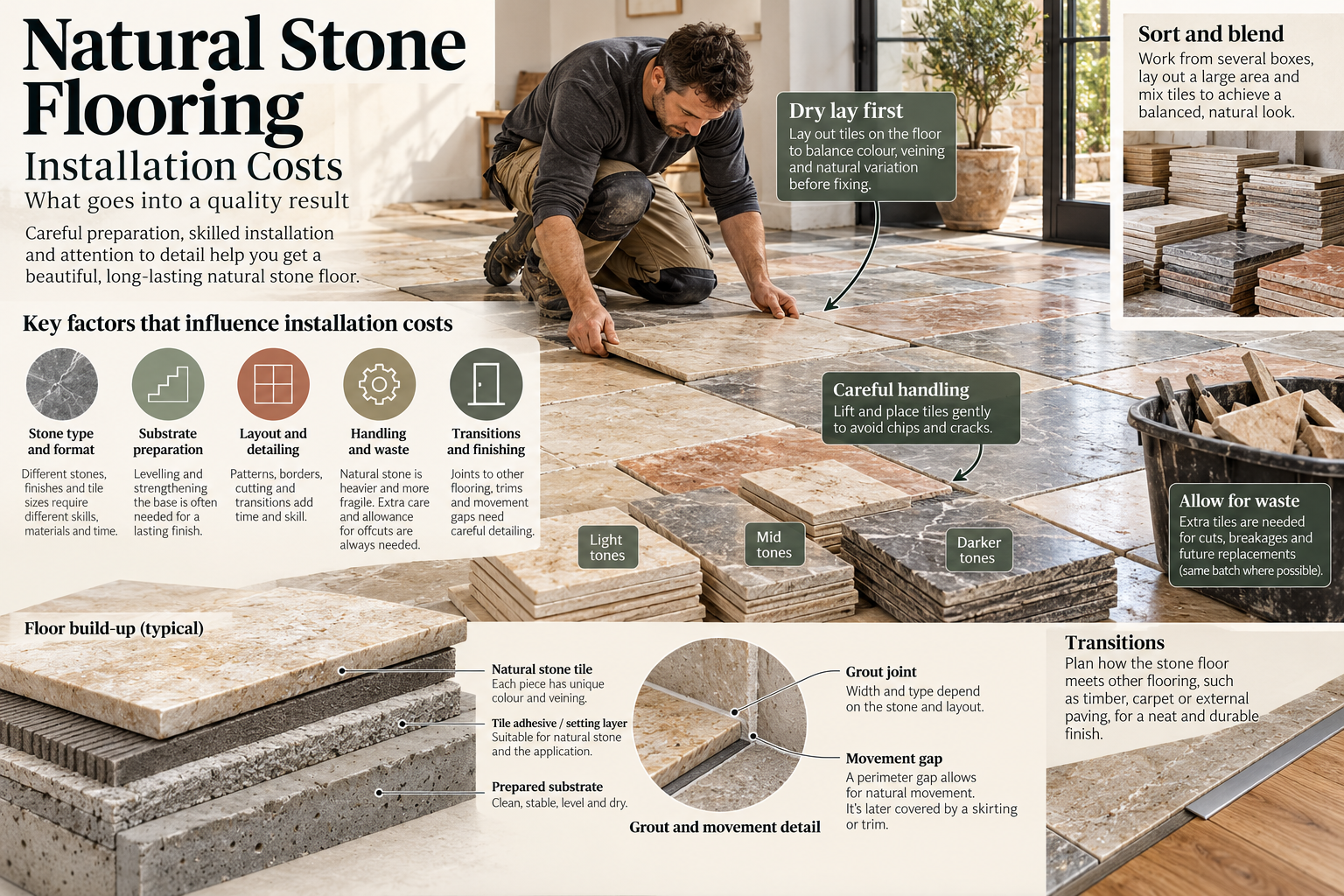
Natural stone flooring is a material and installation decision. Stone selection, thickness, finish, variation, handling, layout, substrate preparation, setting materials, grout, and final treatment can all change the quote.
Why stone needs its own budget
Stone can involve more sorting, cutting, layout planning, and substrate attention than a basic ceramic-tile installation. Room geometry, stairs, thresholds, pattern, slab or tile format, and the desired visual continuity affect labor. The installer should specify the stone and installation system instead of using a generic tile allowance.
TCNA guidance supports matching materials and installation methods to the tile, substrate, and location. It does not supply a universal natural-stone price or a universal substrate prescription for every stone.
Canadian example
A Canadian flooring guide reports about $2,392 for natural stone in a 550-square-foot example. This is a source-specific sample total, not a national installed range. Do not rank it directly against a U.S. estimate or convert the figure between currencies.
What the quote should show
Ask about material, waste, delivery and handling, removal, disposal, leveling, underlayment, setting materials, grout, layout, edge or transition work, sealing if specified for the product, furniture, tax, and cleanup. Confirm who will assess a floor that moves, slopes, or has moisture concerns.
If the stone is part of a bathroom or shower waterproofing system, the wet-area assembly may become the dominant project and should be priced accordingly. For an ordinary interior floor, compare the complete stone system with the complete alternatives.
Why stone has a different cost structure
Natural stone is not one uniform product. Slabs, tiles, mosaics, and different stone families vary in thickness, porosity, finish, edge treatment, fabrication, handling, and maintenance. Those differences affect material waste, cutting, substrate preparation, installation, sealing, and repair. The exact selected product should be part of the quote.
Stone may require more careful handling than an ordinary ceramic or porcelain floor. Weight, breakage risk, layout, matching, and the condition of the substrate can affect labor. A room with a simple shape can still be detail-heavy when the product has veining, directional grain, a pattern, or a fragile edge.
Material, fabrication, and waste
Ask whether the allowance includes the selected stone, waste, delivery, handling, cuts, edge details, and any fabrication or finishing. Natural variation is part of the material, so “matching” may mean selecting pieces for a balanced layout rather than producing identical tiles. If the homeowner expects a specific visual pattern, put that expectation in writing.
Material availability and future repair also matter. Keep spare pieces and record the quarry or product, size, finish, lot, and installation layout. A replacement years later may differ in color or thickness even when the name appears unchanged.
Substrate and installation
Stone should not be used to conceal a moving, wet, uneven, or structurally inadequate base. Preparation may include removal, leveling, subfloor repair, underlayment, setting materials, grout, movement accommodation, and transitions. The appropriate base depends on the product and location. In wet areas, waterproofing and the room assembly may control the scope.
The contractor should explain what happens if demolition finds deflection, moisture, cracked underlayment, or damaged framing. A stone installation quote that omits this question is difficult to compare with one that includes inspection and correction.
Sealing and ownership cost
Some stone products need initial sealing or other finishing steps; the exact requirement depends on the material and selected products. Do not assume that one maintenance schedule applies to every stone. Ask what the installer includes, what the homeowner must maintain, and whether the finish affects stain resistance or appearance.
Compare stone with porcelain on the complete ownership decision. Stone may offer a particular appearance but can carry different material, handling, sealing, repair, and replacement considerations. A higher initial cost can be reasonable when the visual or functional objective is specific, but it should not be justified by an assumed universal lifespan or resale return.
Cost scenarios and quote questions
A simple project has a uniform tile, ready substrate, open layout, and limited cuts. A typical project includes preparation, several corners and transitions, delivery, handling, grout, and sealing where appropriate. A complex project includes a detailed pattern, irregular rooms, stairs, extensive removal, substrate correction, fragile material, or wet-area coordination.
Ask for material, waste, delivery, removal, disposal, substrate and moisture assumptions, leveling, underlayment, setting materials, grout, layout, edge work, sealing, furniture, tax, and cleanup. Confirm who assesses movement, slope, or moisture and how concealed conditions are priced.
Compare the selected stone, not a generic allowance
Before pricing, identify the stone family, finish, dimensions, thickness, pattern direction, and whether the design expects deliberate variation or close visual matching. Two estimates for “stone tile” can describe different material grades, sorting effort, edge treatment, and waste. Ask how many boxes or pieces are included and who bears the cost if a shipment contains breakage or the selected lot cannot complete the layout.
A sample is useful for color and finish, but it does not show every variation across a full floor. If veining or directional pattern matters, ask how pieces will be dry-laid or selected and whether that layout service is included. Put the appearance expectation in practical terms: consistent direction, balanced variation, or a particular focal area. Avoid promising identical replacement stone years later; availability and lots can change.
Budget the full ownership path
Compare stone with porcelain by the outcome you want, not by assuming one material is universally more durable or economical. Include the selected material, installation system, preparation, sealing or other specified treatment, routine care, repairability, and the consequence of a damaged piece. Ask which maintenance products are compatible with the installed finish and whether any care is part of the installer’s warranty conditions.
For bids, give each installer the same product and layout information. Request separate lines for removal, base inspection, preparation, setting, grout, edge work, finishing, protection, and disposal. Ask what happens if the base moves or is not ready. This makes the material premium visible without confusing it with access, substrate, or finish work.