
Renovation in an older home should be planned around the possibility that painted components contain lead and that dust can travel beyond the work area. The safe sequence is to define the surfaces, choose a qualified contractor, isolate the work, control dust, clean deliberately, and verify the area before normal use. The exact legal program depends on the country, jurisdiction, building, contractor, and work type.
Start before the estimate
Tell every bidder the building age, prior reports, painted components to be disturbed, occupancy, and whether a child or pregnant person may be present. Ask whether an inspection or risk assessment is needed. A lead-paint inventory and a risk assessment answer different questions; neither silently covers inaccessible or concealed surfaces.
Define the disturbance area, including windows, doors, trim, floors, stairs, porches, siding, and utility penetrations. A small repair can disturb more layers than the visible patch suggests. Put the area and exclusions in the bid so the contractor does not price ordinary demolition under a lead-safe assumption.
The US RRP boundary
For many renovation, repair, and painting projects that disturb painted surfaces in pre-1978 housing and child-occupied facilities, EPA’s RRP program requires covered firms to use lead-safe work practices. The program includes scope, firm certification, worker training, and exemptions; verify the current rule rather than treating “built before 1978” as the only test.
Ask a US contractor for the firm’s EPA certification and the renovator’s qualifications when the work is covered. RRP is not the same as a lead abatement project, an inspection, or a risk assessment. A certified firm still needs a project-specific plan, and a report does not make an uncertified contractor eligible for covered work.
Canadian requirements and terminology vary by province and territory. Confirm local worker-protection, waste, notification, and clearance expectations before signing. Do not copy the US RRP sequence into a Canadian contract as if it were a universal law.
A seven-part planning sequence
The following sequence is a practical homeowner review based on EPA’s current lead-safe renovation guidance. A qualified contractor must adapt it to the actual work and jurisdiction.
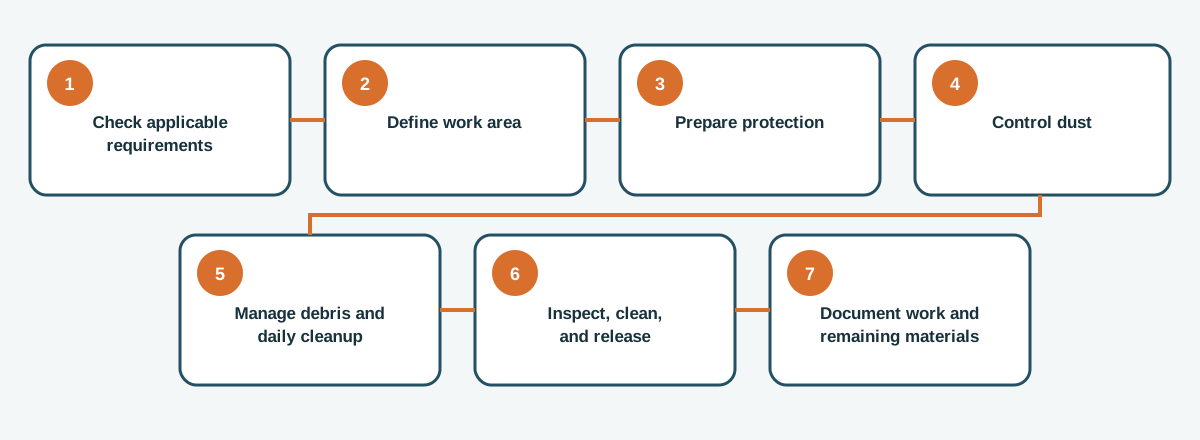
- Determine whether lead-related requirements apply. Define building age, occupancy, painted surfaces, and exemptions or local rules before demolition.
- Plan the work area. Decide what is being disturbed, how occupants and belongings are protected, how access is controlled, and how dust will be kept from clean areas.
- Prepare containment and protection. Use the barriers, floor and furniture protection, warning controls, and worker practices required for the project. Do not let ordinary traffic pass through the work zone.
- Control dust during disturbance. Select methods that minimize dust and avoid dry sanding, uncontrolled scraping, or power-tool use without the required controls. Keep debris contained.
- Manage waste and daily cleanup. Bag or otherwise handle debris according to the applicable rule, clean the work zone with the specified equipment and method, and prevent tracked dust.
- Inspect and clean before release. Complete the contractor’s visual and cleaning checks, address failed checks, and obtain any required dust sampling or clearance before occupants return.
- Document the project. Keep the report, contractor information, work area, methods, cleaning and clearance records, repairs, and remaining lead-painted components for future work.
This sequence does not tell a homeowner how to perform abatement. It is a way to check whether a contractor’s scope has a beginning, controlled work phase, closeout, and record handoff.
Protect occupants and adjacent work
Decide where residents, pets, belongings, HVAC pathways, and clean tools will be during the work. A closed door is not automatically a dust barrier. The contractor should explain access, ventilation, daily cleanup, and the release condition. Coordinate other trades so plumbing, electrical, flooring, and painting do not cross the controlled boundary.
Fix the building cause that is damaging paint. A leaking window, roof, plumbing connection, or condensation problem can defeat a new finish. Separate lead-safe setup and cleanup from ordinary repair and reconstruction in the contract.
Compare bids by control, not paint price
Ask each contractor to identify containment, surface preparation, method, component replacement, cleanup, waste handling, temporary occupancy, verification, and exclusions. Ask who performs clearance and what happens if the area fails. If the proposal only says “scrape and repaint,” it does not define how dust is controlled or how the result is released.
For the post-work decision, read lead clearance testing. For an earlier choice between repair, encapsulation, enclosure, and replacement, see lead paint encapsulation versus removal and lead paint abatement cost.
Before the crew arrives
Remove or protect belongings according to the contractor’s plan, arrange a clean route, and decide where residents and pets will be. Do not move dusty items through clean rooms. Turn off or isolate HVAC pathways only as directed by the qualified contractor; an improvised shutdown can create other building or combustion problems.
Ask for the work boundary, daily cleanup, access controls, waste route, and expected schedule in writing. Confirm that the contractor will tell you when the area is not safe to enter and what condition allows return. If the renovation is phased, identify where the lead-safe boundary moves and how each phase will be released.
While work is underway
A homeowner should not supervise the technical work by checking whether a worker is wearing a particular item. Instead, monitor the agreed project controls: unauthorized people are kept out, barriers remain intact, debris is not tracked through the home, and the contractor communicates changes. Stop and ask questions if the crew proposes unplanned sanding, dry scraping, or demolition outside the priced boundary.
If concealed paint, deteriorated substrate, dust outside containment, or a new component is discovered, pause that portion and request a written decision. The contractor may need a qualified assessment, a revised method, additional cleaning, or a change order. Do not let a verbal “it is probably fine” become the permanent record.
Coordinate related work
Plumbing, electrical, window, flooring, cabinet, and HVAC trades can each disturb painted surfaces. Put the lead-safe boundary and release condition in the master schedule. A room should not be declared complete while another trade still needs to drill, cut, or remove a surface inside it.
The final package should identify work areas, methods, cleaning, waste, verification, repairs, and lead-painted components that remain. Give the records to the person responsible for future maintenance. The next renovation should start from that record, not from a guess based on the new paint color.
Price a phased project without losing the boundary
A phased renovation may reduce the amount of the home unavailable at once, but each phase still needs a clear lead-safe boundary and release condition. Ask contractors whether containment, setup, cleaning, and verification repeat with each room or component. Compare that with one coordinated scope that controls several connected surfaces during the same mobilization.
| Quote line | Why to separate it |
|---|---|
| Assessment or work-plan update | A new component may be outside the original report. |
| Protection and containment | The occupied status and route through the home change setup. |
| Component control or replacement | Treatment, enclosure, and removal create different trade and finish costs. |
| Cleanup and waste | These are not the same as ordinary construction debris or painting cleanup. |
| Verification and release | The person who checks the work and the release scope should be named. |
| Ordinary reconstruction | Carpentry, paint, flooring, and moisture repair may be separate contracts. |
A bid should say what happens if hidden damage, additional paint layers, or a connected component is found. Ask whether that work is priced as a unit allowance or requires a new assessment. A large general contingency without a decision rule gives the owner little control over change orders.
Before accepting the schedule, confirm that the next trade will not disturb surfaces that have not been released. This coordination prevents one crew’s finish work from covering a condition the next phase still needs to address.
Set decision points for concealed conditions
A renovation contract should say what happens when a crew finds a painted component or condition outside the assessment. Ask whether work stops only in the affected area, who contacts the assessor, how a revised method is approved, and whether the owner must approve a change order before work resumes. This keeps the safety decision separate from the schedule pressure of an arriving trade.
Price the likely stages rather than one undefined lead allowance: assessment update, containment and occupant controls, component work, cleaning, waste, verification, and ordinary reconstruction. If the job is phased, identify who releases each room and how the clean route changes when barriers move. Make sure the trade completing the finish work receives the same boundary and release information.
If a contract includes a unit price for an added window or linear foot of trim, confirm that the price covers the same preparation, cleanup, disposal, and verification as the base scope. A unit price for painting alone may not reflect the work controls needed for lead-safe renovation.