
“Complete” should be defined before mold remediation starts. It is not automatically the same as a low air-sample result, a fresh coat of paint, or the absence of an odor on one day. Verification should compare the finished work with the original problem: source correction, affected materials, cleaning or removal, drying, containment, documentation, and the reconstruction decision.
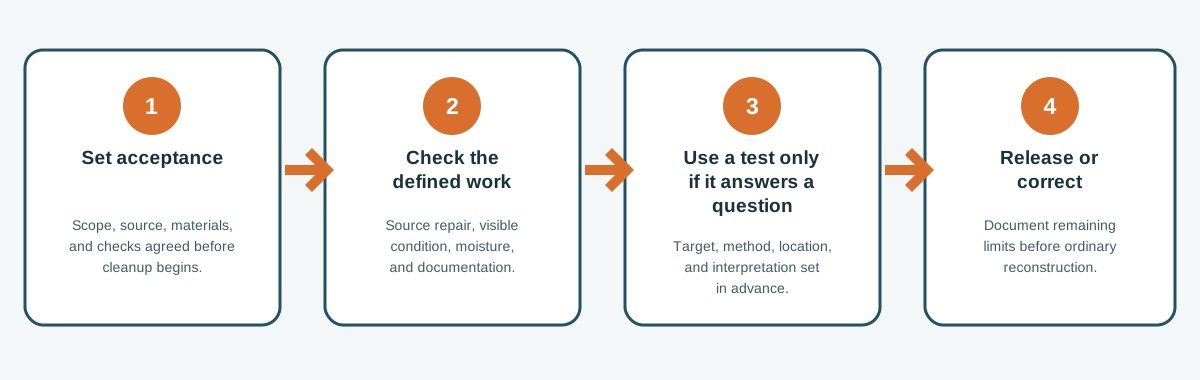
Define acceptance before the crew starts
Ask the contractor or independent verifier to write down:
- the areas and materials included in the remediation;
- the moisture source and the person responsible for correcting it;
- what will be removed, cleaned, dried, protected, or left in place;
- what condition permits containment teardown;
- what observations or measurements will be recorded;
- whether sampling is planned and what decision it will support;
- what documentation is delivered before reconstruction or reoccupancy.
Without a pre-work scope, a final inspection can become an argument about whether a visible result “looks good” rather than a comparison with a defined obligation.
Confirm the source was corrected
Look for evidence that the condition supporting growth has been addressed. That could be a repaired roof or pipe, corrected seepage, controlled crawl-space moisture, improved exhaust, resolved condensation, or another building-system action. The source may be outside the remediation contractor’s contract, so request the invoice, report, or professional statement from the responsible trade.
Do not close a wall or replace flooring only because the visible surface is clean. If the source is intermittent, verification may require reviewing weather, plumbing use, HVAC operation, or moisture observations over time. A single dry reading is useful evidence but may not settle a complex assembly.
Visual and material checks
The verifier can compare the finished area with the original photographs, scope, and material list. Questions include:
| Check | What it helps establish |
|---|---|
| Visible condition | Whether the defined area is free of visible growth and residue consistent with the scope |
| Removed material | Whether listed porous or damaged materials were actually removed and handled as agreed |
| Cleaned surfaces | Whether the selected surfaces were cleaned and are ready for the next phase |
| Edges and adjacent areas | Whether the boundary and nearby surfaces were considered rather than ignored |
| Moisture observations | Whether wet or damp conditions remain in the affected assembly |
| Containment and debris | Whether work-zone materials, equipment, and debris were removed without leaving the area unfinished |
These checks do not establish a universal health result. They establish whether the defined building work appears complete and whether unresolved conditions should stop reconstruction.
When sampling may add value
EPA says routine mold sampling is often unnecessary when visible mold already establishes the cleanup decision. Sampling may add value when it answers a specific comparison, dispute, source, material, or verification question. It should be designed before collection, with locations, method, timing, laboratory, interpretation, and decision use identified.
There is no universal federal residential airborne-mold clearance number. A sample from one room or surface does not prove that every untested cavity is clean. A result close to a threshold used by a particular program or professional should be interpreted within that program’s scope, not presented as a universal standard.
The verifier should not select a sample merely to produce a reassuring number. If the moisture source is still active or the defined removal is incomplete, another test does not make the project complete.
Independent verification
An independent verifier may be useful when the project is large, disputed, insurance-related, medically sensitive, or likely to be followed by substantial reconstruction. Independence can reduce the pressure to approve a scope that is incomplete, though the verifier’s credentials and role should still be checked locally.
If the remediation contractor performs its own final check, ask what was inspected, what limitations apply, and whether the contractor is also responsible for reconstruction. The aim is not to require a separate professional for every small project. It is to match independence and documentation to the consequence of releasing the area.
What the final package should contain
Keep:
- the original assessment and work scope;
- photographs or drawings of affected and excluded areas;
- source-correction records;
- material removal, cleaning, and disposal documentation;
- drying or moisture observations;
- containment and equipment records where relevant;
- sampling reports and limitations, if sampling was used;
- the final verification report;
- reconstruction releases, exclusions, and outstanding work.
The package helps a future contractor understand what was done and prevents ordinary reconstruction from being mistaken for remediation. It also makes a recurring problem easier to investigate because the next professional can compare conditions with the original baseline.
When verification fails
If visible growth remains, moisture is present, the source repair is incomplete, debris or affected material remains, or the report does not match the scope, pause the reconstruction handoff and ask for a written explanation. The next step may be additional source correction, cleaning, removal, drying, investigation, or a revised boundary.
Do not respond to a failed visual or moisture check by ordering an unrelated broad air panel. Resolve the specific failure first. If the failure is a disagreement about the scope, ask the assessor, contractor, and verifier to state the evidence and the decision each person is applying.
Reoccupancy and reconstruction
Reoccupancy depends on the work area, occupants, source condition, local practice, and professional assessment. Verification of building work is not medical clearance. If an occupant has symptoms or a health concern, seek appropriate healthcare advice.
Reconstruction can begin only when the defined remediation and moisture conditions support closing the assembly. Drywall, flooring, insulation, paint, cabinets, and trim may be separate scopes. The release document should identify what is ready and what remains open.
Cost and quote questions
Verification cost varies with travel, inspection time, area, moisture measurements, documentation, sampling, laboratory analysis, and independence. Request a quote that separates a visual and moisture review from optional sampling. Ask whether a return visit after corrective work is included and what happens if the original scope is not met.
Use mold remediation process to compare the work being verified and mold remediation cost to understand why verification, drying, source repair, and reconstruction may be separate. Mold inspection versus testing explains why a test is not automatically the best completion tool.
Write the verification plan before cleanup begins
Verification is most useful when the homeowner and contractor agree in advance what completion means for the defined project. The plan should connect the work area, source correction, material disposition, visual condition, moisture observations, documentation, and any sampling that has a stated purpose. This avoids adding an unexplained test at the end or arguing about a result that no one agreed would control release.
Ask who will verify the work and whether that person is independent of the remediation contractor. The answer may depend on local practice and the project. If sampling is included, establish the method, locations, timing, laboratory, and interpretation before the work starts. A sample cannot repair a failed source correction or substitute for an omitted area.
The contract should state what happens when verification does not meet the agreed condition. Possible next steps can include additional drying, cleaning, material removal, source correction, a revised boundary, or an explanation of why the result is not representative. Price the return visit and any added work method where possible; avoid an open-ended promise that “testing is included” without saying what happens next.
The closeout record should identify what was checked and what remains outside the project. That distinction is important if a later owner sees a stain in another room or plans to open a nearby wall. A report for one remediation boundary is not a whole-home certification.
Keep verification proportional to the original project
The verification plan should answer whether the work described in the contract is complete. It should not silently expand into a guarantee for every room, cavity, or future moisture event. Identify the affected area, the source repair, materials removed or retained, observable condition, moisture checks, and any sampling agreed for that scope.
If an independent verifier is hired, provide the original assessment and the final work record so the visit can compare like with like. A verifier who sees only a finished room may not know which wall was opened, which material remained, or which source repair was completed. If no sample is needed, the closeout should still explain the basis for release.
A failed check should be matched to a corrective step. The contract can state whether the remediator returns, whether the owner pays for a new assessment, and how a new source or excluded area is handled. This avoids treating every disagreement as a whole-home failure while preserving a route to address a real unresolved condition.
Keep the final release, photographs, moisture records, work-area map, and exclusions together. A later owner can then understand what was verified and what still needs attention.