
Mold-remediation cost is driven more by the scope of the building problem than by a simple area calculation. Access, affected materials, containment, demolition, contents, drying, disposal, source correction, verification, occupancy, and reconstruction can all change the quote. Two projects described as “mold cleanup” may contain very different work.
A market observation is not a project budget
Angi’s 2026 US market observations report a common mold-remediation range of about $1,223 to $3,757. This is an attributed US market observation, not an official price, guaranteed quote, Canadian estimate, or universal per-square-foot rate. It may combine different project scopes, and inspection, moisture repair, testing, disposal, and rebuilding may be extra.
Use the range as context for quote questions. A small, accessible area with cleanable hard surfaces is not comparable to hidden growth behind a wall, contaminated contents, a wet crawl space, or a project that needs demolition and reconstruction.
Separate the cost layers
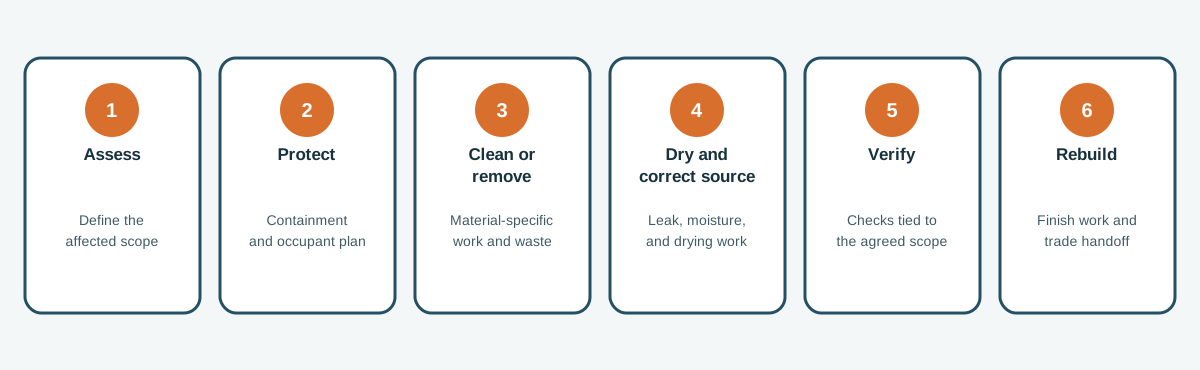
A complete budget may contain these layers:
| Cost layer | What can be included |
|---|---|
| Assessment | History, visual inspection, moisture investigation, sampling when justified, and a written scope |
| Protection and containment | Work-zone isolation, pressure control where used, temporary protection, and occupant logistics |
| Removal or cleaning | Labor and equipment for affected porous materials, cleanable surfaces, dust and debris control |
| Drying and source correction | Dehumidification, moisture repair, leak correction, ventilation or enclosure work |
| Waste and contents | Bagging or disposal arrangements, moving contents, cleaning or replacing furnishings |
| Verification | Visual, moisture, documentation, and targeted sampling where it answers a defined question |
| Reconstruction | Drywall, flooring, insulation, painting, trim, or other finish work after remediation |
The remediation quote should say which layers are included. A low number may cover only labor to remove visible material while excluding the moisture source, contents, disposal, or finished-room restoration.
Affected area and hidden extent
Visible growth is not always the full project boundary. Water can move through cavities, under flooring, behind cabinets, into insulation, or along framing. A report should explain how the affected area was established and what uncertainty remains. Unnecessary demolition raises cost, but stopping exactly at the visible edge can leave the source or affected assembly unresolved.
The quote should distinguish confirmed areas, areas that need selective opening, and areas being monitored or excluded. Ask what would trigger a change order if more material is found. The answer is more useful than a claim that a fixed area price covers an unknown assembly.
Accessibility and containment
Attics, crawl spaces, tight utility areas, high ceilings, finished rooms, occupied homes, and areas with limited entry cost more to work in because movement, protection, equipment, and cleanup take longer. Contents may need to be moved, cleaned, wrapped, or replaced. Travel and mobilization can matter when qualified providers are scarce.
Containment is selected for the contamination, work, building, and occupants. EPA’s technical course uses limited containment as a general example for 10 to 100 square feet and full containment as a general example for more than 100 square feet or where spread is likely, while emphasizing professional judgment. These examples are not universal residential thresholds or a fixed pricing table. A smaller area with intense growth or difficult spread pathways can require more control than area alone suggests.
Materials: clean, remove, or replace
Hard, non-porous surfaces may sometimes be cleaned, while porous materials can be difficult or impossible to restore when growth has penetrated them. The decision depends on material, condition, extent, moisture history, and the remediation plan. A contractor should identify which materials are being cleaned, which are being removed, and why.
Do not let a proposal use “treatment” as a substitute for a scope. Spraying, fogging, painting, or applying a product may not correct the moisture source or remove affected porous material. Ask what the product is intended to do, what evidence supports its use for the material, and what cleaning or removal still occurs.
Drying and source correction
Remediation is not durable if water or moisture remains. The source may be a roof, plumbing line, foundation, crawl space, enclosure, bathroom exhaust system, HVAC condition, or condensation pathway. The physical correction may belong to another building-system category and may not be included in a mold contractor’s price.
The budget should identify who repairs the source, whether remediation can proceed before that repair, how the area will dry, and whether finishes are being closed only after the condition is verified. If the source is not yet known, carry an investigation allowance rather than promising a final remediation price.
Occupancy and contents
The home may remain partially occupied, require temporary relocation, or need separate handling for children, older adults, people with respiratory sensitivities, pets, or valuable contents. The proposal should explain access rules, work hours, temporary shutdowns, storage, cleaning, and whether the contractor is responsible for contents.
Occupancy decisions are not a substitute for medical advice. A homeowner should obtain appropriate health guidance for a personal concern while the building professional addresses moisture and affected materials. The contract should not imply that a visual cleanup guarantees a health outcome.
Verification and reconstruction
Verification should be tied to the original scope: source correction, visual condition, affected materials, moisture, cleanup, removed waste, documentation, and any targeted sampling that has a defined purpose. There is no universal residential airborne-mold clearance number. Testing cannot prove that every untested space is free of growth.
Reconstruction is often a separate contract or line. It may include drying confirmation, drywall, flooring, insulation, cabinetry, painting, trim, and HVAC or finish coordination. Make sure the quote states whether containment teardown, temporary barriers, final cleaning, and reconstruction release are included.
Questions for comparing quotes
Ask each contractor to state:
- What areas and materials are included, excluded, or still uncertain?
- How was the moisture source identified, and who will correct it?
- What is cleaned, removed, or replaced, and why?
- What containment and occupant-protection measures are included?
- Are contents, equipment, disposal, travel, and repeat visits included?
- What does drying mean in this proposal, and how is completion documented?
- Is verification included, and is it visual, moisture-based, sampled, or another defined check?
- Who reconstructs the finishes and what happens if concealed damage is found?
Compare scope and assumptions rather than picking the lowest total. A realistic quote makes uncertainty visible and identifies the work needed to prevent recurrence.
US and Canada
The available market observation is US-only. No comparable Canadian range is established here, and a USD amount must not be converted mechanically into CAD. Labor, travel, insurance scope, professional practice, and local requirements vary by region. Credentials, clearance expectations, and any regulated work should be verified locally.
Use mold remediation process to understand the project anatomy and post-remediation verification to define completion. If the source or affected boundary is unclear, start with hidden mold investigation before accepting an all-in price.
Compare contained and multi-stage projects
A contained room with a known leak and accessible finishes is a different estimate from a multi-room project involving concealed materials, contents, or unresolved source correction. In the first case, the major cost may be a defined area, protection, material disposition, drying, and finish repair. In the second, more investigation, multiple trades, sequencing, temporary accommodation, or repeat mobilization may drive the total.
Ask each contractor to show whether the quote assumes:
- one mobilization or separate visits;
- a fixed boundary or additional work if concealed damage is found;
- contents moving and storage;
- source correction by this contractor or another trade;
- drying documentation and verification;
- reconstruction at the same finish level as before.
If two bids differ sharply, map each line back to the assessment. One may include only cleanup while another includes removal, drying, independent verification, and restoration. A lower total is not necessarily a saving if essential source correction or reconstruction is excluded.
When a project needs several trades, ask who controls the sequence and what record transfers responsibility from source repair to remediation and then to reconstruction. That handoff can prevent both delays and duplicate site visits.
Use allowances for hidden conditions carefully
An allowance is useful when an assembly cannot be fully assessed before work begins, but it should still name the assumptions behind it. Ask what additional moisture, damaged material, or concealed growth would trigger extra labor, disposal, or reconstruction and who approves that change.
A large project can require a sequence of selective openings rather than a single fixed boundary. In that case, request the base price for the known work, the cost basis for additional areas, and the point at which the contractor will stop for owner review. This gives the homeowner a way to control expansion without requiring a final wall-by-wall quantity before the assembly is open.
Keep source correction separate from removal and cleaning when different contractors own those tasks. If the plumber’s work is delayed, ask whether the remediation crew will remobilize and what that costs. A quote that includes containment but excludes the leak repair may still be reasonable if the dependency and schedule are clear.