
When mold or a musty odor returns, the building condition that supported it may still be present, the original work may not have reached the full affected area, or the odor may be residual rather than evidence of new growth. Repeating the same cleaning without testing the source can spend money without resolving the project.
First distinguish residual from new
Record what changed after the earlier work. Did the odor disappear and return after rain, a plumbing event, a heating or cooling season, a bathroom renovation, or a change in occupancy? Is there new staining, dampness, visible growth, damaged material, or only an odor? Which rooms and surfaces are involved?
Review the original scope, photographs, moisture records, removed materials, drying information, source repair, and verification. A small difference between the old and new condition can determine whether a contractor is investigating incomplete work, a new leak, an intermittent source, or a different building problem.
Do not assume that a new odor proves a new colony or that a clean-looking finish proves the assembly is dry. Those conclusions require a building assessment.
Common moisture pathways
| Possible source | Clues and likely project owner |
|---|---|
| Roof, flashing, or exterior weathering | Changes after rain, snow, wind, or ice; roofing or exterior specialist |
| Plumbing or appliance leak | Appears after use or near a supply, drain, or fixture; plumbing specialist |
| Foundation seepage or crawl-space moisture | Seasonal dampness, wet masonry, standing water, or humid crawl space; below-grade water or site-water specialist |
| Condensation and air leakage | Cold surfaces, seasonal patterns, insulation gaps, or humid indoor air; building-envelope specialist |
| Bathroom or kitchen exhaust | Odor or staining after showers, cooking, or poor exhaust operation; ventilation or wet-area specialist |
| HVAC or duct condition | Moisture or contamination associated with equipment or distribution; qualified HVAC assessment |
Category 028 owns the environmental assessment and remediation decision. The physical source repair remains with the category or trade that owns the roof, plumbing, foundation, enclosure, wet area, or HVAC system. A mold contractor may coordinate the sequence without performing every repair.
Fix the source before closing assemblies
Source correction should be part of the plan, not an optional upgrade. A replacement finish can hide moisture and make later investigation more expensive. The project should explain who will stop water entry, reduce condensation, repair ventilation, dry the assembly, and document that the condition is ready for closure.
The sequence may look like:
- protect occupants and limit additional disturbance;
- investigate the source and define the affected materials;
- correct the roof, plumbing, below-grade, enclosure, ventilation, or other source;
- remove or clean affected materials and dry the assembly;
- verify the defined remediation scope;
- reconstruct only the materials that are ready to be closed.
The exact order can vary. The principle is that cleaning or replacing a finish is not a substitute for correcting the condition that made it wet.
Humidity is a clue, not the whole diagnosis
Indoor humidity, condensation, and crawl-space conditions can influence mold, but one humidity reading does not identify the source or establish a universal safe boundary. Readings change with weather, ventilation, occupancy, and location. A professional may need to compare conditions over time and relate them to the assembly.
Do not treat a dehumidifier, fan, or air cleaner as proof that the building problem is fixed. Supplemental equipment can reduce conditions temporarily or support drying, but it may not correct a roof leak, plumbing failure, enclosure defect, or ventilation design.
Hidden reservoirs and incomplete scope
Growth or moisture can remain behind drywall, under flooring, in insulation, around penetrations, inside cabinets, or in another connected assembly. The presence of a hidden reservoir is not established by a smell alone. A focused investigation can decide whether selective opening, targeted sampling, or a broader source review is justified.
Ask the professional to show what was investigated and what remains unknown. A quote that expands the entire house without defining the evidence is hard to evaluate; a quote that limits itself to a visible patch without considering water movement may be incomplete.
When repeat remediation is appropriate
Repeat remediation may be reasonable when the source is corrected but the original scope did not include all affected materials, when a new event created new damage, or when verification identifies a remaining condition. It is less defensible when the same moisture source is still active and the proposed work only repeats surface cleaning.
Sampling should be considered only if it will change the decision. Visible growth and an unresolved source often call for correction and remediation rather than a new species report. There is no universal federal residential airborne-mold clearance number that can settle recurrence by itself.
Budget the complete cycle
Recurring mold costs can include investigation, selective openings, roof or plumbing repair, drainage or enclosure work, ventilation, drying, containment, removal or cleaning, disposal, verification, finish reconstruction, and temporary occupancy changes. The cheapest first cleanup can become the most expensive route if it leaves the source unresolved.
Ask for separate quote lines and a change-order rule for concealed conditions. Decide which contractor owns each dependency and what document allows the next trade to begin. Keep reports and photographs together so the second visit begins with the actual history rather than a new generic inspection.
Avoid the “spray and seal” shortcut
Products, coatings, fogging, or odor treatments may have a limited role in a specific scope, but they do not automatically remove affected porous material or correct moisture. A proposal should explain what is being cleaned or removed, how the source is corrected, how the area is dried, and how completion is verified.
Likewise, a negative air sample or a low-cost sensor reading cannot prove that every hidden cavity is sound. Use measurements as part of a defined investigation, not as a substitute for building reasoning.
Next decision
If you cannot identify whether the condition is new or residual, begin with hidden mold investigation. If a new remediation scope is being quoted, compare the work in what professional mold remediation includes and the cost layers in mold remediation cost. If the work is complete, post-remediation verification explains how to define the release decision.
Recurring mold is a source-control problem before it is a repeat-cleaning problem. The useful goal is a documented path from moisture cause to correction, affected material, drying, verification, and durable reconstruction.
Separate residual work from a new moisture event
The right next project depends on why the condition returned. Similar-looking growth can mean the original source was not corrected, the affected boundary was incomplete, drying or reconstruction occurred too soon, or a new leak or condensation pattern developed later. Those cases can require different contractors and budgets.
| Evidence pattern | Scope question |
|---|---|
| The same area becomes damp again after the original cleanup | Was the water, humidity, or enclosure source fully corrected and documented? |
| Growth appears next to the original boundary | Did the assessment include connected materials or a concealed pathway? |
| A different room is affected after a new leak | Is this a new event with a separate repair and remediation scope? |
| Odor remains but no visible growth or moisture is found | Would a focused building investigation answer more than repeating a generic air test? |
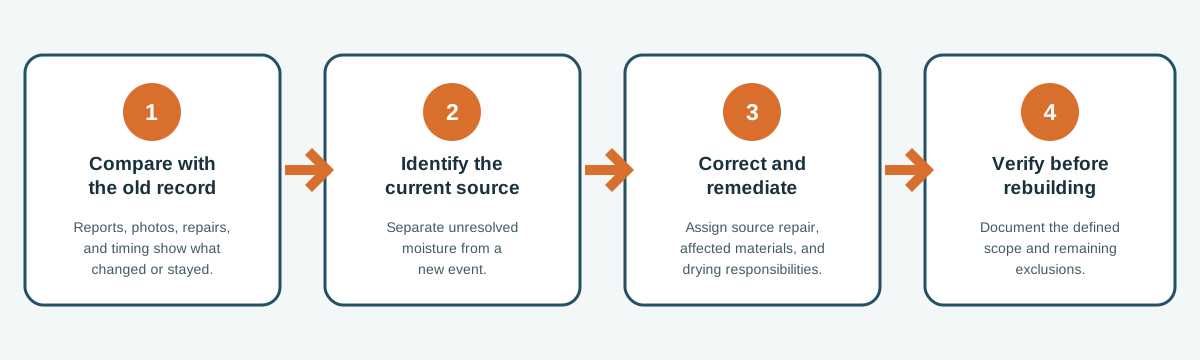
A recurrence assessment should compare the current condition with the original report, photographs, moisture history, source-repair records, and final verification. Ask the professional to identify what is new, what remains open, and what evidence supports that conclusion. A second cleanup without this comparison may repeat the original cost without changing the cause.
When the original contractor offers warranty work, clarify what the warranty covers: workmanship, the defined area, a source they repaired, or only a limited return visit. It may not cover a new leak, an excluded cavity, or ordinary reconstruction. Keep that boundary in writing before deciding whether to use the same contractor or obtain an independent assessment.
Make recurrence work a documented comparison
When the problem returns, compare the present condition with the original diagnosis instead of treating the second visit as a new blank-slate project. The homeowner can provide the prior moisture report, repair invoice, photographs, remediation boundary, drying or verification record, and the date when growth or odor reappeared.
Ask the professional to label each item as resolved, newly observed, or still uncertain. If the original water source is still active, price source correction before another cleanup. If the source was corrected and the affected area was not part of the old scope, a focused extension may be more appropriate than repeating the full project. If a new leak occurred, keep that event separate from the earlier one for pricing and any warranty discussion.
The comparison should end with a clear decision: repair the moisture pathway, investigate an unexamined area, remediate a defined boundary, or monitor a documented condition. A quote that skips the comparison may repeat work without addressing why it failed.