
A mercury-containing household item can break in a way that calls for a different response from an unknown liquid, a larger elemental-mercury release, or contamination that may have spread into furnishings or building materials. The first decision is to identify the source as safely as possible and get direction from the appropriate emergency, poison-control, public-health, or environmental authority. The second is to define whether a qualified assessment, specialized cleanup, disposal, or replacement work is needed.
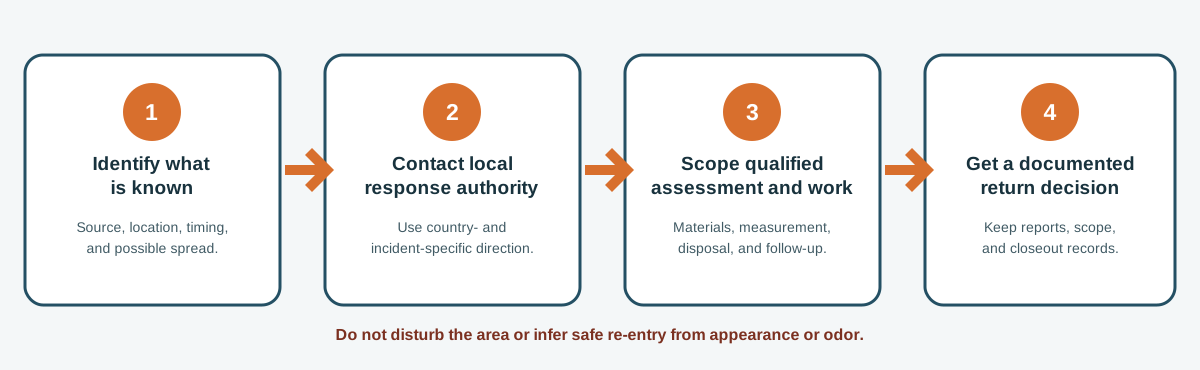
This article is a project-scope guide, not a cleanup tutorial. Do not use a general procedure for a bulb as a rule for a thermometer or an uncertain spill. Do not judge exposure, re-entry, or clearance from odor, appearance, or a consumer device.
Treat the source and amount as assessment questions
Tell the responding authority what item broke, where it happened, when it happened, what surfaces or contents may have been affected, and whether anyone may have had contact. If the substance or item is uncertain, say so. Avoid disturbing the area to collect more information. A photograph of the intact product label or a receipt may help if it is already available without entering or handling the affected area.
EPA publishes separate guidance for broken mercury-containing bulbs, thermometers, and larger elemental-mercury spills because the source and circumstances change the response. Those documents are U.S. guidance and are not interchangeable with Canadian authority instructions. An unfamiliar item, an uncertain quantity, contamination in a crack or porous material, or a concern about spread calls for local professional direction rather than improvising from a different scenario.
If anyone has symptoms or immediate medical concern, use emergency services or poison control. In the United States, contact the appropriate state or local poison-control and public-health services. In Canada, Health Canada directs people toward local public-health or poison-centre advice; CANUTEC provides a technical dangerous-goods response route. Follow the direction of local responders for the incident at hand.
Why a small item and a larger release are not the same project
The item can affect how much material may have been released, the surfaces involved, and the authority’s recommended next step. A bulb guide is limited to its stated source and conditions. It should not be used to make a decision about free liquid mercury from a thermometer, an unknown container, multiple items, or contamination in a floor joint or carpet.
The area and material also matter. A smooth, accessible surface is not equivalent to a porous furnishing, a deep crack, a heating or ventilation component, or an area where people or pets may have tracked material. These are questions for the assessor or response professional. They do not justify a homeowner-directed cleaning plan or a guess about how long an area should remain unused.
No universal amount, household test result, or fixed period establishes that every room is ready for use. The relevant authority can determine whether the incident requires evacuation, a specialist, a defined cleanup, measurement, disposal, or follow-up. A lack of visible droplets or a normal smell does not answer those questions.
What a qualified response may include
Depending on the source and affected materials, a professional scope may include incident history, a site assessment, measurement by a qualified specialist, controlled removal or cleaning, waste handling, replacement of affected materials, and a documented return decision. Not every incident requires every service. The authority’s source-specific guidance and an assessment of the actual home determine the need.
Ask the provider to identify the material and locations included, the reason for any proposed measurement, the method’s limits, who makes the return decision, and what happens if results are inconclusive. Ask whether the service includes only an immediate response or also building restoration and records. An air or surface result is meaningful only within the chosen method, location, timing, and comparison criteria.
Keep the response focused on the mercury incident. Do not let an isolated event automatically expand into a broad indoor-air panel or a general health diagnosis. If a separate odor, moisture, or renovation concern exists, scope it as its own question. See indoor-air-quality testing for why tests need a defined decision.
Read the estimate by stage
The available evidence does not establish a representative residential mercury-cleanup price for the United States or Canada. A routine household-waste fee is not a building-decontamination price, and an online cost for a different item or region is not a reliable allowance for an uncertain release. Ask for distinct line items for:
- emergency or authority-directed assessment;
- specialist travel, diagnostic time, and measurement if needed;
- controlled cleanup or removal of affected material;
- packaging, regulated transport, and disposal;
- replacement of carpet, furnishings, flooring, or other materials if specified;
- follow-up evaluation or documentation; and
- ordinary finish restoration, temporary accommodation, and access work.
The estimate should name the scenario and boundaries it assumes. Ask what additional facts would trigger a larger scope and how those changes are priced. A quote that only says “mercury cleanup” does not tell you whether it includes assessment, waste, building materials, verification, or reconstruction.
When comparing providers, verify that their qualifications and methods are accepted for the location and incident. Ask whether an authority has to approve the work, whether the provider coordinates with that authority, and what records you will receive. A general cleaning company may not be equipped or authorized for a specialized hazardous-material response.
Keep country and local direction attached to the decision
EPA’s household spill pages apply to U.S. consumers and distinguish their own scenarios. They should not be copied as a Canadian procedure. Canadian homeowners should follow local public-health or environmental instructions. Transport Canada’s CANUTEC material provides technical emergency-response information about mercury thermometer incidents; it does not replace local direction about building cleanup or occupancy.
Ask who determines whether the area can be used again and what documentation supports that conclusion. The answer may involve a local health or environmental authority and the qualified response provider. Do not assume that the person who performs cleanup also controls the official return decision.
Records and future work
Keep the incident date, source information, authority contacts, assessment and measurement reports, contractor scope, waste records, affected materials, invoices, and any return or closeout statement. If flooring, a wall, or a mechanical component was removed, preserve the rebuild details as well. This helps a later contractor understand what happened and prevents the incident from being reduced to an unsupported note that the room was “cleaned.”
Before approving reconstruction, confirm that the environmental work is complete under the applicable local direction and that the repair quote begins at the agreed boundary. Replacement flooring or paint is not itself proof of environmental clearance. For a different defined post-treatment concern, use indoor pesticide contamination assessment; normal pest treatment remains a separate service decision.
What changes the professional project scope
Several incident facts can change who should respond and what may be included in a proposal. They should be established by the authority or qualified professional, not used as homeowner clearance rules.
| Scope factor | Why it changes the decision |
|---|---|
| Item and substance identification | Guidance for a mercury-containing bulb does not automatically apply to elemental mercury from a thermometer or an unidentified product. |
| Amount and release history | An uncertain or larger release may require a different response than the specific small-item scenario covered by a public guide. |
| Surface and material | A smooth hard surface, porous furnishing, floor joint, and mechanical area create different assessment, removal, and restoration questions. |
| Occupancy and movement | Whether people or pets were present, and whether material may have moved beyond the visible area, can affect the assessor’s scope and the authority’s return decision. |
| Jurisdiction and disposal route | Local waste and response rules determine who can accept removed material and what documentation is needed. |
These are quote-defining facts. Ask the provider to show which are known, which are assumptions, and which could trigger a change order. If material identity or spread remains uncertain, a staged assessment may be more responsible than a fixed cleanup bid that hides those unknowns.
Ask the professional to distinguish the immediate incident response from later repair work. An authority-directed assessment may identify a limited affected area, while removal of a floor covering or furnishing can create a separate replacement project. Keep those boundaries visible so a reconstruction quote does not imply that it performed the environmental assessment or return decision.
Questions for the responder or assessor
- What item or material is believed to have released mercury, and how certain is that identification?
- Which authority should direct this incident in this country and locality?
- What locations and materials are included in the professional assessment?
- What will measurement or cleanup establish, and what can it not establish?
- Who decides whether the area may be used again?
- Does the estimate include disposal, removed materials, follow-up, and restoration?
- What records should be kept for future occupants and contractors?
The right budget begins only after the incident is defined. Until then, treating every mercury source as the same problem can lead to the wrong scope, unnecessary work, or unsafe assumptions about return.