
A pesticide spill, reported misuse, official concern, or unresolved post-treatment incident can leave a homeowner unsure whether the issue is medical, environmental, or part of the ordinary pest-service contract. These are different questions. The immediate response follows medical and emergency guidance; a qualified assessment then defines whether building work or verification is needed and who can authorize return.
This article covers a defined indoor incident. Correct application of a pest product and the normal clearance that may accompany a professional fumigation belong to the pest-service and product-label process. An isolated case report or symptom allegation does not establish that a treatment caused an illness or that every treated home needs environmental cleanup.
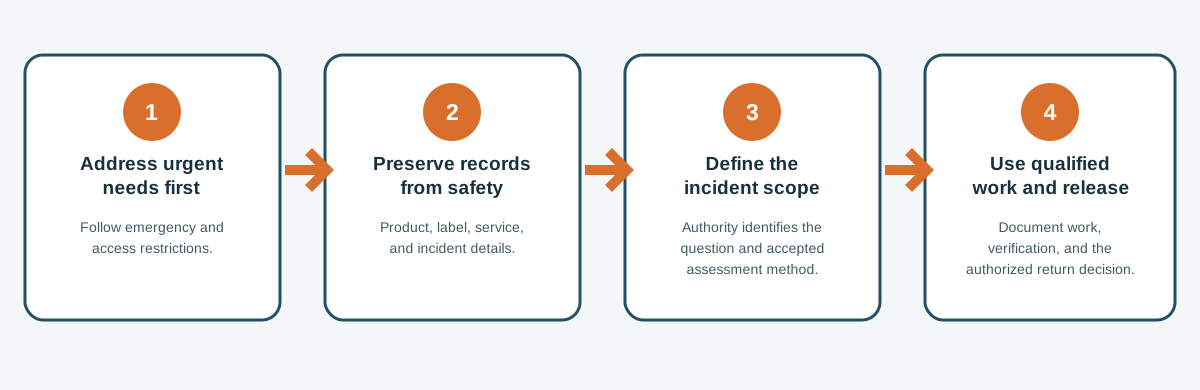
Put immediate health and access decisions first
If someone needs urgent medical attention, call emergency services. If symptoms are present, follow the product-label first-aid information and contact a healthcare provider or poison-control centre. Do not enter or re-enter an area that an emergency responder, applicator, or authority has restricted. Do not begin cleanup, run fans, move contents, or conduct a test to decide whether the home is safe.
For a Canadian incident, Health Canada advises calling 911 for immediate medical attention, contacting a healthcare provider or Poison Control Centre when symptoms occur, and reaching local authorities for environmental emergencies. The agency accepts public pesticide-incident reports even when the reporter cannot establish that the product caused the effect. A report records a concern; it is not a medical diagnosis or a finding that a company or treatment was at fault.
An incident report is useful for tracking what was reported, but it does not automatically commission a home investigation, determine compensation, direct a cleanup, or authorize re-entry. Keep any separate instructions from the local environmental or public-health authority and the licensed applicator with the report confirmation.
In the United States, use emergency services and the relevant poison-control, environmental, or pesticide authority for the incident and location. If a registered applicator or company performed the work, contact the company through the service record, while keeping any independent authority contact available. Local reporting and response routes differ.
Record the event without increasing exposure
From a safe location, gather information already available: product or active ingredient, label, application or fumigation invoice, date and time, rooms treated, written re-entry instructions, reported event, and any notice from an authority. Do not enter a restricted space to find a label or photograph a surface. Record which occupants or pets may have been present and when symptoms or observations began, without treating timing as proof of cause.
Ask the applicator or property manager for the treatment record, product and label information, clearance documents, and the person responsible for authorizing re-entry. Preserve original paperwork and communications. If the product is unknown, say so; a qualified responder may need to identify it before selecting an assessment method.
Separate normal fumigation clearance from incident assessment
Some professional structural fumigation products have a required clearance process in their current label and applicable rules. For example, U.S. sulfuryl-fluoride fumigation uses a label-specific clearance limit of no more than 1 ppm, assessed by the authorized professional operator with an effective instrument before re-entry. This is a narrow U.S. treatment rule. It is not a homeowner measurement target, a general pesticide cleanup standard, or a Canadian requirement.
When an incident occurs after a treatment, first ask whether the normal label-required process was completed and documented. A separate investigation may be warranted if the event includes a suspected misuse, release, unexpected condition, authority referral, or unresolved concern. The incident assessor should define what question differs from the routine service clearance and what evidence is needed to answer it.
Do not assume every treated mattress, room, or household requires a post-service wipe test. Also do not use a routine clearance report to answer a different question it was not designed to assess. Keep the product, treatment, and incident-specific scopes distinct.
What a qualified investigation should define
Pesticides differ in chemical properties, use, label directions, and interaction with building materials. An assessment should identify the product or plausible active ingredient, reported event, affected locations, surfaces and contents, and the decision the work is meant to support. Ask why a chosen sample or measurement fits that material and chemical, who will analyze it, and which authority or professional will interpret the result.
A surface wipe evaluates the sampled surface and analyte under its method. It cannot by itself establish the condition of every room, an air concentration, an occupant’s exposure, or whole-home clearance. EPA research describes procedures developed for selected chemicals and surfaces; it does not provide one universal household wipe method for all pesticides. A broad commercial panel may also be unhelpful if the incident and intended decision are not defined.
EPA’s response-site collection of pesticide decontamination documents expressly describes them as untested and non-standard. Treating a posted document as an approved cleanup recipe could add risk or leave the concern unresolved. A qualified investigator should identify an applicable authority, method, and acceptance criterion before any cleaning or removal work is approved.
Interpret reports and case examples cautiously
The report should say where and when samples were collected, what methods and detection limits applied, which materials were assessed, and what conclusion the results support. A negative result has a defined scope; it does not prove that every possible chemical is absent. A positive result needs interpretation in light of the product, surface, method, and relevant comparison basis.
One published sulfuryl-fluoride case report described delayed detection from a mattress after an exposure event. The report is a specific case, and the causal role of the mattress was unresolved. It does not establish how often residues occur, a general clearance rule, or that normal label-based fumigation is unsafe. It is a reason to keep the incident’s actual facts and the authority’s method in view, not to generalize from one case.
Symptoms may have causes unrelated to a pesticide or may require medical evaluation regardless of the building findings. Environmental testing does not diagnose an individual illness. Keep healthcare decisions with clinicians and building decisions with the responsible environmental or pesticide authority and qualified assessors.
Price the project in separate stages
The available evidence does not establish a representative home pesticide-contamination cleanup price or a universal need for remediation. A lab charge from a research study or one incident response is not a contractor estimate. Ask for separate costs and responsibility for:
- emergency response or authority-directed inspection;
- product identification and records review;
- professional assessment, sampling, laboratory analysis, and reporting;
- contents evaluation, cleaning or removal, and waste handling;
- any material-specific building work;
- follow-up measurement or verification and who accepts it;
- restoration, temporary accommodation, and service-provider return visits.
Ask what result triggers each later stage, who approves the change, and whether a failed or inconclusive check is included. A quote should identify the exact chemical or scenario assumed, locations and materials covered, test method and limits, work exclusions, and the party responsible for deciding that the area may be used again. Do not assume insurance coverage, legal liability, or a payment source from the existence of an incident report.
Use the right decision maker for release
Before accepting a cleanup proposal, identify who has authority to approve the assessment, select the method, review results, and authorize return. Depending on the location and event, that may involve a pesticide regulator, environmental or public-health authority, licensed applicator, incident-response specialist, landlord, or insurer. A contractor can describe work performed but may not control every official or medical decision.
For ordinary professional fumigation without a defined incident, ask the pest provider for the product label, required clearance record, operator identity, and service warranty. Category 036 covers normal treatment and professional fumigation clearance. This article is for a separate, documented concern requiring environmental assessment.
Keep a usable record
Save the product label, service invoice, treatment and clearance records, incident report, authority contacts, assessment plan, sampling results, cleanup work order, waste records, and any written release decision. Note which materials were examined or replaced and which were outside the scope. Give the records to future owners or contractors if building work could disturb affected areas.
The next project decision becomes clearer once the event, chemical, assessment method, and release authority are named. Until those are established, odor, symptoms, one wipe, or a general online cleanup document cannot tell a homeowner what to clean or when to re-enter.
Questions before approving investigation or cleanup
- What pesticide or treatment is believed to be involved, and how certain is that information?
- Is the concern an emergency, normal service clearance, or a separate incident?
- Which authority or qualified professional determines the assessment scope?
- What question does each test answer, and what are its limits?
- Who approves cleanup, verifies the work, and decides on return?
- Are contents, waste, follow-up, and reconstruction included in the estimate?
- Which incident, clearance, and closeout records should be retained?