
Radon is a radioactive gas that comes from soil and can accumulate indoors. Levels can differ substantially between neighboring homes, so a regional radon-potential map cannot determine the concentration in one house. Testing is the practical way to decide whether a mitigation assessment is warranted.
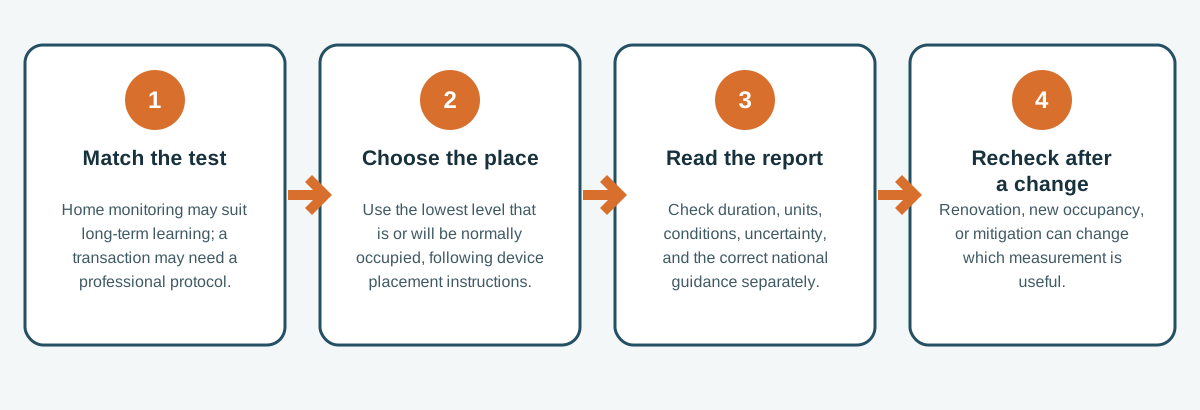
The important choices are not simply “digital versus kit” or “DIY versus professional.” The test location, duration, device or method, building conditions, laboratory or provider, units, and interpretation must fit the decision you are making.
Choose the test around the decision
A do-it-yourself kit can be a reasonable starting point for a homeowner who wants a long-term measurement and can follow the device instructions, send the detector to the stated laboratory, and retain the report. A professional measurement may be preferable for a purchase or sale, a disputed or unusual result, a building with several occupancy levels, or a situation where a formal protocol and interpretation are important.
Ask any provider or kit supplier:
- What device or method is being used, and what quality or performance program applies?
- Where should it be placed and for how long?
- How are start and end dates, interference, and unusual conditions recorded?
- Which units will appear on the report?
- Is the result intended as a short-term screening value or an estimate of longer-term average conditions?
- What is the next decision if the result is elevated or close to a guideline?
An electronic monitor can show changing readings, but more data points do not automatically make a result a better estimate of long-term exposure. Follow the instructions for the particular device rather than combining values from unrelated devices.
Short-term versus long-term measurement
Radon levels change with weather, season, ventilation, building pressure, construction, and household behavior. A short test can help meet a transaction deadline or identify a reason to investigate promptly, but it represents a limited period. A long-term test usually gives a better basis for understanding average conditions.
Health Canada recommends a long-term residential measurement of at least 91 days for decisions about its Canadian guideline. Its guide recommends enough time during the heating season and notes that a three-to-twelve-month measurement more accurately estimates an annual average. The current instructions for the device and the applicable national guidance control; do not call a short result an annual average merely because it is reported in Bq/m³.
During a long-term test, maintain normal household use. Do not deliberately open windows, close doors, move the device, or change ventilation to influence the number. Record dates and unusual events such as a major renovation, extended vacancy, or equipment failure so the provider can interpret the result.
Place the device where people live
The measurement should represent the lowest level that is or will be normally occupied. Health Canada’s guide defines a normal occupancy area as a space where a person is likely to spend more than four hours per day. A finished basement family room, bedroom, office, or future living space can qualify. A crawl space, unfinished basement, furnace room, storage room, or infrequently used area does not represent the same exposure question.
For the Canadian long-term placement guidance, do not use a kitchen, bathroom, laundry room, closet, or an unfinished area that is not the normal-occupancy area for the decision as the test location. Place the detector in a typical breathing zone, away from exterior walls, windows, doors, vents, heat sources, direct sunlight, electronics, and objects that restrict airflow. Keep it where people and pets will not move it. The device’s current instructions may add placement requirements.
If a basement is being converted into a bedroom or office, test the future normal-occupancy area even if it is not yet used every day. A change in occupancy can make an older result less relevant.
US and Canadian guidance are separate
The US EPA uses 4.0 picocuries per liter, or 150 becquerels per cubic meter, as its action framework and notes that lower levels still carry risk. Health Canada uses 200 Bq/m³ for the average annual level in a normal occupancy area and recommends corrective action above that Canadian guideline, with faster action at higher concentrations. These are separate national frameworks, not one threshold to average or mechanically convert.
For Canada, Health Canada recommends a device that meets the current C-NRPP performance requirements for the applicable measurement route. For the United States, follow the current EPA and state radon-program guidance and use a qualified provider where the project or transaction requires one. State, provincial, and territorial programs can add advice or requirements.
Interpreting the result
Check the report before reacting to the number. Confirm the test location, dates, duration, device, units, building conditions, and any note about invalidation or interference. A result close to a guideline should not be treated as an exact boundary because measurement uncertainty and natural variation matter.
In Canada, Health Canada’s measurement guidance says a result below 200 Bq/m³ may need another test when the heating-season coverage was inadequate. A result above 200 Bq/m³ should lead to corrective action rather than waiting for a short confirmatory test simply to make the number feel more certain. In the United States, use the current EPA framework and state guidance for the result and follow-up.
A high result is not a mitigation design. A qualified mitigator evaluates the foundation, soil-gas pathways, occupancy, existing systems, and possible suction points. Do not try to solve an elevated result by sealing one visible crack or connecting an improvised fan. Compare the design questions in radon mitigation methods and the quote layers in radon mitigation cost.
Testing during a purchase or sale
Transaction schedules often favor a short test. Request the complete report rather than a single number: location, start and end time, device or provider, conditions, result units, and any mitigation history. A result from an infrequently occupied utility space may not represent the lowest lived-in level. Contract deadlines, disclosure rules, lender requirements, and negotiation options are local matters; public-health guidance does not by itself create a legal duty.
An existing mitigation system also needs evidence of operation and a follow-up measurement. Health Canada recommends retesting homes with active mitigation systems every five years. A major renovation or newly occupied basement may justify earlier testing because the building and the exposure question have changed.
What to keep
Save the kit instructions, laboratory or provider report, test location, dates, device information, unusual-condition notes, and any mitigation documents. These records help a future owner or professional understand what was measured. They do not replace a new test when the home, occupancy, transaction, or local requirement calls for current information.
Check whether an old test still fits the home
A previous radon result can be useful history, but a homeowner should ask whether it represents the current exposure question. Changes to a basement, a new bedroom or office, a foundation repair, major air-sealing work, ventilation changes, or a new mitigation system may affect the relevant measurement. A result from a room that was not normally occupied may not represent a space that is now used every day.
Before repeating the test, compare the old and proposed measurements:
- Are they in the same or a similarly relevant occupancy area?
- Do the test methods and durations answer the same question?
- Were the building and ventilation conditions comparable?
- Is the result being evaluated under the same country’s guidance?
- Did an installed system operate during both measurements?
If the answer is no, treat the results as different observations rather than a clean trend line. Ask a qualified provider how to establish a useful baseline for the current condition. Do not average unlike short- and long-term tests or compare devices without understanding their methods.
A retest can also be a commissioning step after mitigation or construction. In that case, define who arranges it, which level is tested, how soon after work it occurs, and whether a later long-term measurement is still recommended. The report should remain paired with the system record so a future owner can tell whether the measurement was before installation, after installation, or after a later building change.
Follow a high result through to a priced decision
When a result supports mitigation, keep the test report with the first professional estimate. Ask the mitigator to explain which readings and locations inform the proposed system and whether the home has mixed foundations, separate occupied levels, or an existing system. The test is evidence of concentration; it does not tell the contractor which pipe route, fan, or suction point will work.
Before authorizing installation, identify who will arrange the post-installation test, which room and level will be measured, and what the contract covers if the result remains elevated. A retest can require another device, provider visit, or laboratory fee. Those costs are distinct from fan operation or maintenance.
If the result is near a guideline, discuss the measurement uncertainty and follow-up with the relevant radon program or qualified professional. Do not turn small differences between tests into a precise ranking of rooms or homes. The useful outcome is a documented decision about whether to test again, mitigate, or gather more information—not a number detached from its method.