
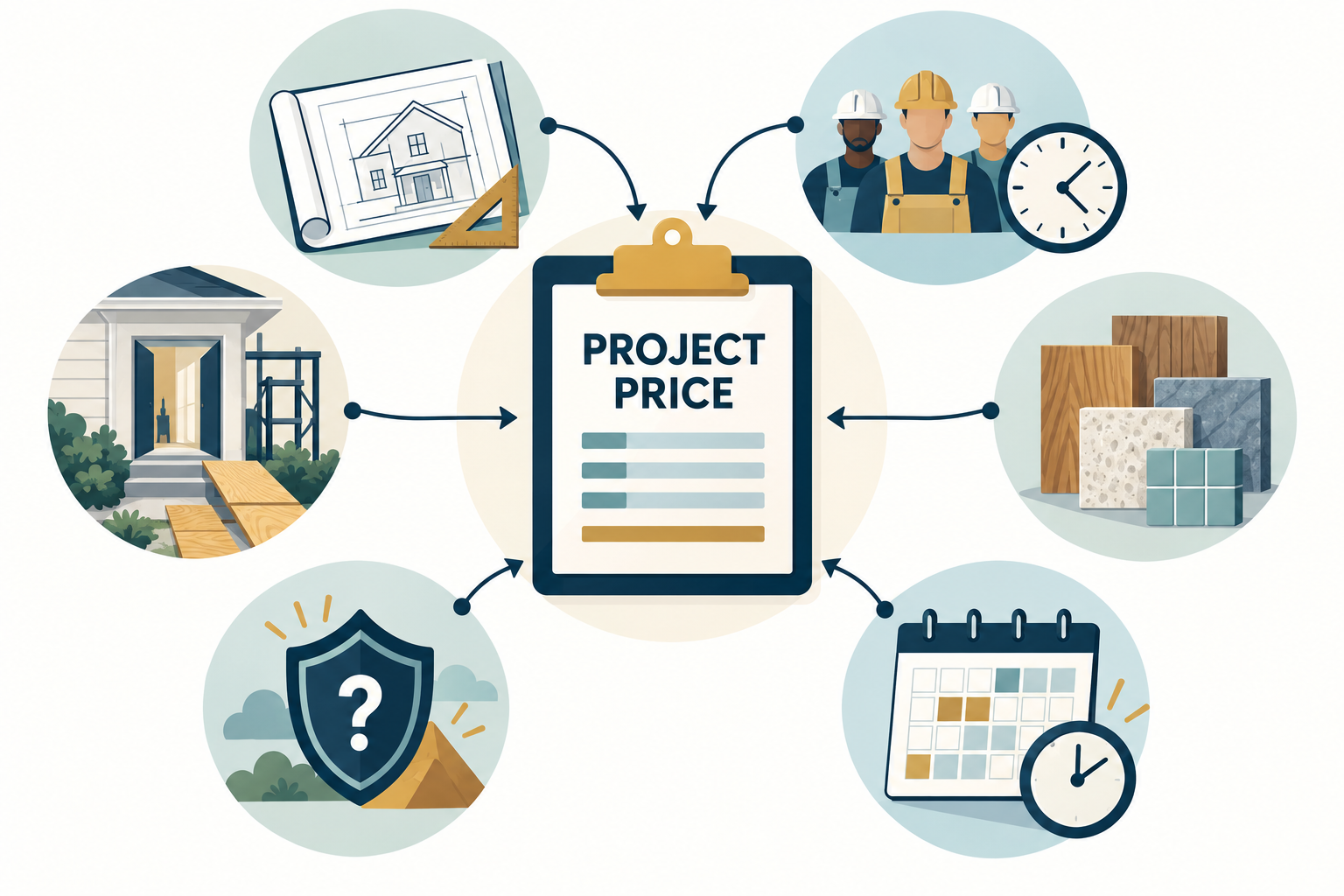
Two contractors can look at the same room, roof, pipe, or electrical problem and produce very different numbers without either quote being automatically dishonest. A quote is a price for a defined scope under a set of assumptions. If the scope, crew, materials, access, timing, risk, or follow-up service differs, the prices are not actually for the same job.
“The same job” often hides different scopes
One contractor may price a visible repair while another includes the work needed to reach it, protect the house, remove damaged material, test the result, and restore adjacent finishes. Compare whether each proposal states:
- what is being repaired, replaced, or left in place;
- how much work is included and how quantities will be measured;
- demolition, surface preparation, access, protection, and cleanup;
- permits, inspections, testing, design, engineering, or specialist reports;
- materials, equipment, grade, model, finish, and allowed substitutions;
- temporary work, follow-up visits, warranty service, and exclusions.
A low number can be a useful option when it meets the same outcome. It is not a useful comparison when it simply omits the difficult parts.
Labor is both time and a rate
Labor cost depends on the expected hours, the number and skill of workers, supervision, productivity, and the billed rate. A specialist may take fewer hours but charge more per hour. A general crew may quote a lower rate but need more preparation, coordination, or return visits. Some contractors quote a task or project price instead of exposing an hourly calculation at all.
Travel, setup, estimating, procurement, communication, cleanup, and warranty callbacks may be recovered through the labor price or through separate charges. Comparing a worker’s wage with a contractor’s selling rate therefore does not reveal the contractor’s profit by itself.
Materials and availability change the bid
Material descriptions such as “shingles,” “windows,” “flooring,” or “fixtures” are not specifications. Grade, thickness, performance, finish, quantity, waste, delivery, storage, special ordering, and availability can change the installed cost. A contractor who includes a named product and another who includes an allowance may be pricing different levels of certainty.
Substitutions can also shift the scope. Ask whether a product is an exact specification, an equivalent selected by the contractor, or a placeholder that will be finalized later. If a component is backordered, the labor and schedule assumptions may change as well.
Overhead and markup are part of the selling price
A contractor must recover more than the direct labor and materials placed in your house. Transportation, insurance, office administration, estimating, supervision, tools, vehicles, payroll burdens, warranty work, and the cost of running an available business are examples of indirect costs. Markup can recover those costs and leave an operating profit; it is not the same thing as net profit.
Public specialist discussions sometimes report illustrative U.S. markup ranges, but there is no universal percentage that proves a quote fair or unfair. A contractor who shows markup separately and one who embeds it in labor, material, or subcontractor lines may have similar total economics.
Access and occupied-home conditions matter
The same repair costs differently in an empty, open-access building and an occupied home with furniture, pets, children, finished surfaces, restricted parking, or limited working hours. Protection, dust control, temporary weatherproofing, staging, lifting, carrying, and daily cleanup can be real scope. Difficult access can also reduce productivity and increase the chance of return visits.
The quote should say what the homeowner must provide: clear rooms, water or power, parking, permits, temporary accommodation, or access to a crawl space. An assumption that is not written down can become a dispute later.
Risk is priced somewhere
An open wall, buried pipe, old roof, damp foundation, or incomplete design contains uncertainty. A contractor can include investigation and a risk allowance, use a pricing model that passes certain costs through, or exclude the unknown work and issue a change order when it appears. These are different ways of allocating risk, not merely different levels of contractor honesty.
Ask what the contractor believes is known, what is assumed, and what will happen if the assumption is wrong. A quote that clearly states an uncertainty can be more useful than one that appears firm because it is silent.
Timing and service commitments affect price
Emergency response, after-hours work, short deadlines, peak-season demand, difficult weather, material lead times, and limited crew availability can all affect the price. The contractor may need to rearrange other work, pay overtime, source a more expensive material, or accept schedule risk. Conversely, a flexible start date may allow better coordination, but an off-season discount is never guaranteed and must not override suitable installation conditions.
Warranty terms, response time, subcontractor coordination, documentation, and the contractor’s ability to return if something fails also have value. Do not compare a complete proposal with a bare labor number solely because both end in the same total line.
How to tell a meaningful difference
Put the proposals into a comparison table. Normalize scope, products, quantities, prep, protection, permits, taxes, disposal, schedule, payment, warranty, and exclusions before judging the totals. Ask the highest and lowest bidders to explain material differences in writing. The U.S. Federal Trade Commission cautions against automatically choosing the lowest bid. Canadian consumer guidance separately emphasizes written estimates, comparable specifications, contract detail, and clear cost and cleanup assumptions.
If a large difference remains after normalization, it may reflect a different solution, risk assumption, business model, or level of service. The U.S. Federal Trade Commission advises asking about large differences and not automatically choosing the lowest bidder. Canadian federal guidance separately emphasizes matching specifications, labor and extra charges, taxes, contract scope, warranties, and cleanup. Choose the option that fits the required outcome and your tolerance for uncertainty, not the number that is easiest to read.
A useful way to read a high or low quote
Start by asking which kind of number you received. A preliminary budget may be based on limited information. An estimate may describe a likely price but still depend on measurements or concealed conditions. A proposal may be more complete, but even a detailed proposal can reserve unknown work for later. The label matters less than the written scope and the assumptions behind it.
For each proposal, mark every major cost as included, excluded, allowance, unit price, owner responsibility, or unknown. “As required” is not a price. It is a prompt to ask what event will make the work required, who will decide, and how the amount will be calculated. A proposal that is higher because it includes a clearly described investigation may be easier to manage than a lower proposal that assumes the condition away.
Imagine two bids for repairing water damage. One includes finding the source, removing damaged material, drying the assembly, replacing the finish, and testing. The other includes only patching the visible surface. The second may be appropriate for a cosmetic defect after the source has already been corrected, but it is not a cheaper version of the same complete outcome. The comparison becomes useful only after the homeowner defines which outcome is wanted.
Compare scenarios, not just totals
When a project has meaningful uncertainty, ask each contractor to describe at least a straightforward case and a condition that would expand the scope. For example:
| Situation | Question to resolve |
|---|---|
| Defined work | What is included in the stated price and quantity? |
| Limited unknown | What inspection or unit price applies if one condition is different? |
| Larger condition | What work stops, changes, or requires written approval? |
| Closeout | What testing, cleanup, documentation, and restoration complete the job? |
This does not require a contractor to predict a concealed condition. It makes the next decision visible. It also helps you compare a firm price with a time-and-materials proposal without treating one as automatically safer.
Do the same for schedule. A contractor with an earlier start may charge more because the crew is rearranging other work or because materials must be expedited. A later start may be cheaper but could increase carrying costs, temporary accommodation, damage, or the chance of an emergency response. A quote is therefore a combination of money, time, risk, and service—not only a number.
Questions that expose the real difference
Ask each bidder to answer the same short set of questions in writing:
- What exact finished result is included?
- Which quantities, products, and performance assumptions drive the price?
- What is the largest excluded cost a homeowner should plan for?
- What condition would trigger a change order or a revised unit price?
- Who obtains permits, coordinates other trades, removes debris, and restores finishes?
- What is the expected schedule, and what happens if materials or inspections delay it?
- What labor, material, and callback warranty is provided?
If the answers make one quote materially more complete, compare the revised all-in scenarios. If the answers remain vague, paying for a better diagnosis, design, or scope may be more valuable than averaging the bids. Do not use the apparent size of a markup, a labor rate, or a discount as a substitute for understanding the work.