
Selling as-is can preserve cash and shorten the time before listing, but it may reduce the buyer pool or shift uncertainty into the offer. Completing repairs can improve function, marketability, or financing readiness, but the work can cost more than expected and delay the sale. The useful comparison is about net proceeds and risk, not the gross price of the house after renovation.
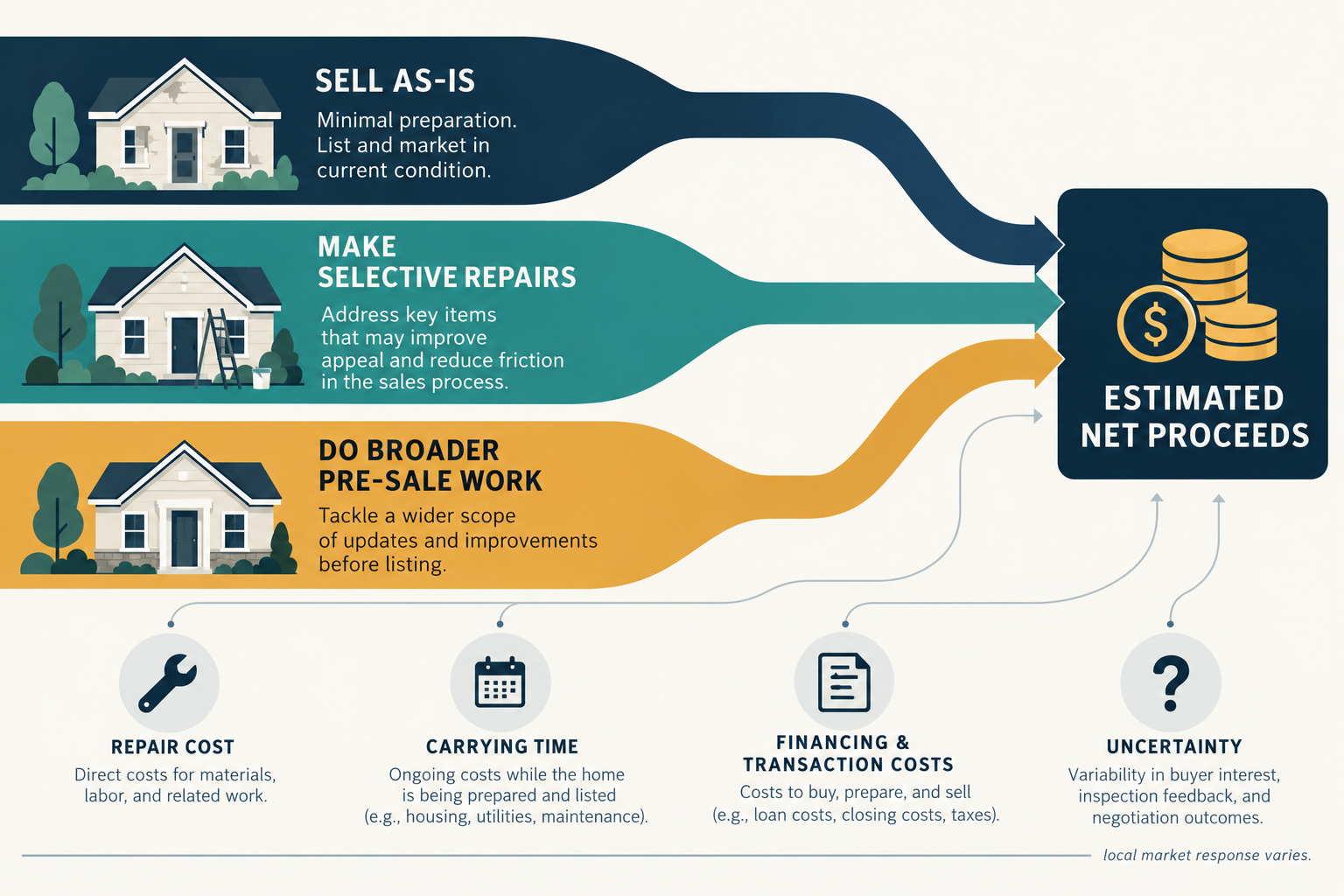
Compare three strategies
| Strategy | What it may suit | Costs and risks to include |
|---|---|---|
| Sell as-is | Limited cash, short timeline, or a property whose condition is not worth broad work | Lower offers, buyer inspection findings, disclosure duties, carrying time, and transaction concessions |
| Selective repairs | Active damage, safety, obvious function, or a few conditions that block a credible sale | Diagnosis, contractor coordination, schedule, hidden scope, and uncertain market response |
| Broader pre-sale work | A defined project with enough time, funding, and a clear buyer expectation | Construction cost, financing, delay, design changes, carrying cost, and risk of over-improvement |
The same strategy can be rational in one local market and poor in another. A specialist real-estate source can describe common tradeoffs, but it cannot guarantee that a particular repair returns its cost.
Use a net-proceeds calculation
For each strategy, estimate:
expected sale proceeds
- repair and project costs
- selling and financing costs
- carrying costs during the work or listing
- temporary housing, storage, and utility costs
- concessions or transaction adjustments
= estimated net proceeds
Use a range for the sale result and repair scope. Add the cost of a failed or delayed project, not just the contractor’s first number. If the work reveals additional damage, the sale date and carrying cost may change together.
Do not treat a higher list price as a guaranteed return. Buyer expectations, comparable homes, local inventory, financing conditions, execution quality, and the condition of the rest of the property all affect the result.
Fix risk before appearance
If you do work, start with active leaks, ongoing damage, unsafe conditions, and obvious functional failures that can worsen or undermine the transaction. Then consider repairs that improve a buyer’s ability to understand the property, followed by limited presentation work. Avoid spending the pre-sale budget on a broad remodel when the likely buyer will discount the project or choose different finishes.
The pre-sale repair-priority guide provides a more detailed sequence. For an uncertain condition, obtain a specialist scope before committing to the full project.
Include the obligations that do not disappear “as-is”
“As-is” is not a universal waiver of every disclosure, safety, contract, or lender issue. The meaning and required disclosures vary by state, province, territory, contract, property condition, and representation. Ask the appropriate local professional what must be disclosed and what documentation a buyer or lender may request.
An as-is sale can still require safe access, honest descriptions, insurance coordination, and attention to an active condition. Do not hide a known hazard or allow a rushed repair to create a new one.
Consider a pre-listing inspection carefully
A pre-listing inspection may reveal problems early enough to price, repair, disclose, or sell as-is deliberately. It also creates information that must be handled according to local transaction and disclosure rules. The value depends on the property, market, and seller’s ability to act on the findings.
If you obtain one, separate immediate conditions, specialist follow-up, maintenance, and cosmetic observations. Do not assume that every recommendation deserves a repair before listing.
The best pre-sale decision is the one that preserves the seller’s net outcome and options. Price the work, time, carrying cost, buyer response, disclosure context, and downside scenario before choosing between as-is, selective repair, and a broader project.
Identify the buyer and financing effect carefully
A condition can affect buyer interest, the time needed to close, the number of potential offers, or whether a lender or insurer asks for more information. Those effects vary by property, market, loan, buyer, and jurisdiction. Do not promise that a repair will create a particular return or that a buyer will reject a home as-is.
Ask local professionals what is common for the property and market, and separate that opinion from a legal or lender requirement. A contractor’s suggestion to replace an entire system is not automatically a disclosure rule, building-code rule, or financing condition. If a transaction depends on one of those distinctions, obtain the applicable authority before spending.
Treat time as a cost
During pre-sale work, the property may incur taxes, insurance, utilities, interest, travel, security, lawn or snow care, storage, and temporary accommodation. The listing date may move if a permit, material, inspection, or concealed condition is delayed. A project can also reduce flexibility if the market changes while cash is tied up in unfinished work.
Ask the contractor for a realistic duration and the events that could extend it. Price a downside scenario in which the work expands or the property is listed with part of the project incomplete. A selective repair may be economically stronger than a broad renovation because it limits schedule and scope risk, even when the broad renovation would look more attractive in photographs.
Run a three-case net-outcome test
For each of the three strategies, use a conservative and a more favorable sale outcome rather than a single predicted price. Then vary the assumptions most likely to change the choice: repair scope, completion date, carrying period, buyer response, and any lender or insurer condition. A specialist report or firm scope may narrow uncertainty; a broad estimate or online resale claim may not.
Stop when added work no longer improves the credible net outcome, when the deadline makes quality control unlikely, or when the remaining project is an optional upgrade with uncertain buyer value. Keep invoices, permits, warranties, and condition records for whichever path you choose.
Preserve flexibility until the scope is proven
Use staged authorization for work that may reveal more condition. The first stage can be inspection, temporary protection, or a narrowly defined source correction. Set the evidence and price needed before authorizing restoration or broader improvement. This keeps a seller from committing the entire repair budget before knowing whether the property will be listed, held, or sold with the condition disclosed.
Compare the remaining cash position in each strategy. A repair plan that consumes the reserve for carrying costs, closing expenses, taxes, insurance, or an urgent unrelated issue may be weaker than its apparent sale-price benefit. Include the possibility that the work finishes late, the market changes, or a buyer still requests a concession.
Whichever path is chosen, preserve the basis for it: reports, quotes, scope assumptions, completed work, known conditions, and disclosures. “As-is” is a strategy for setting expectations and allocating work; it is not a substitute for truthful information or applicable transaction advice.
Compare the decision at a fixed date
Set a date to refresh the three cases with current quotes, carrying costs, property condition, and listing assumptions. Without a date, a seller can keep defending an old repair plan after its price or schedule has changed. At the refresh, remove completed work, add new evidence, and stop if the limited repair case no longer beats its cash and delay exposure.