
The best pre-sale repair is not always the most visible one. When cash or time is limited, prioritize work that protects people and property, stops active damage, preserves essential function, or removes a documented obstacle to a credible transaction. Cosmetic work comes after the condition and economics are understood.
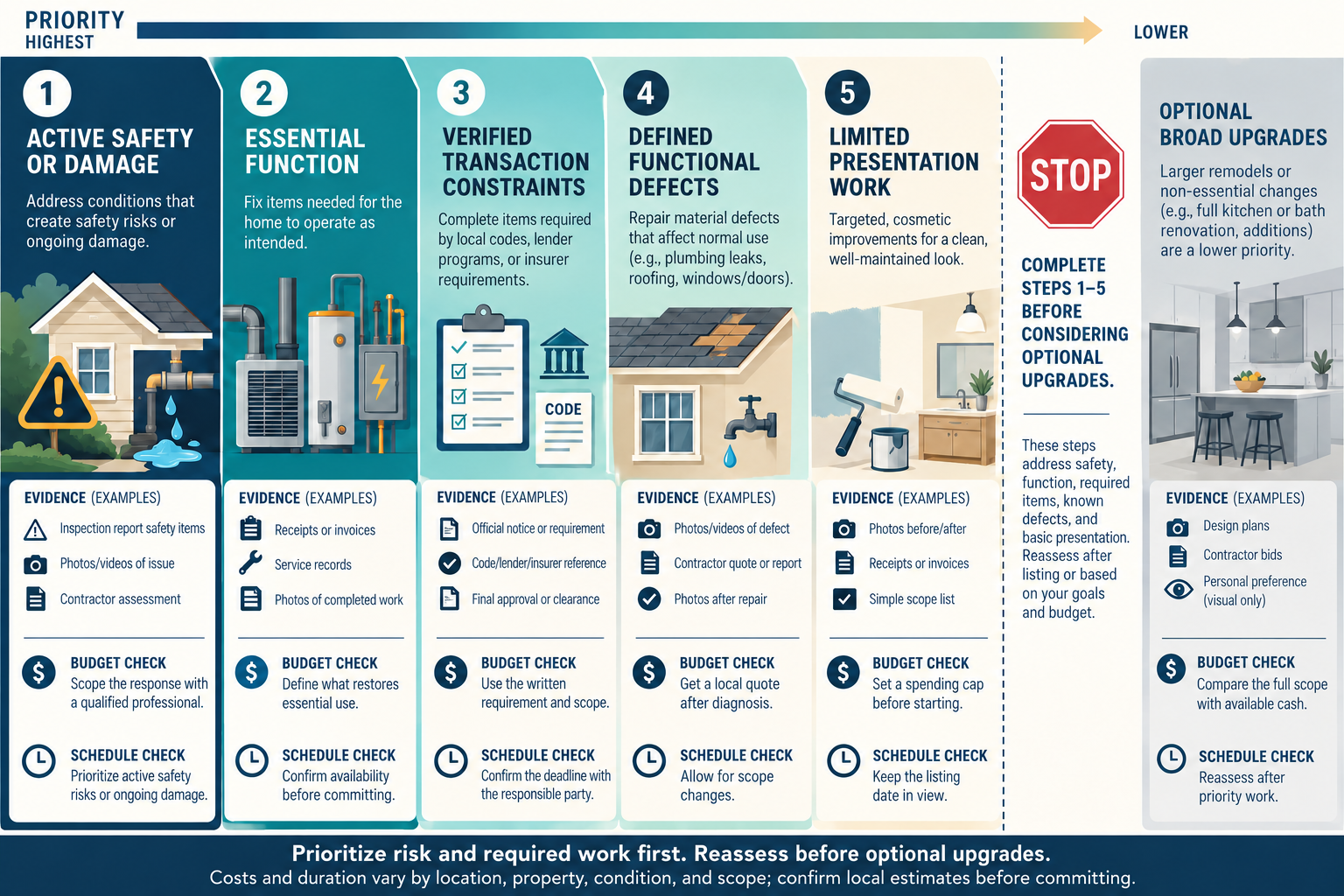
There is no universal list of “highest return” repairs. Local buyer expectations, property condition, market supply, financing, contractor availability, and execution quality change the result.
Use this sequence
1. Stop active damage and address safety
Deal with active water entry, unsafe electrical or gas conditions, structural concerns, fire or health hazards, sewage exposure, and other worsening conditions through appropriately qualified professionals. A sale deadline is not a reason to delay a necessary response or disguise a hazard.
2. Protect essential function
Consider failures that affect reliable heat, cooling, water, drainage, access, weather protection, or basic habitability. Obtain a scope before assuming that replacement is required. A temporary measure may be appropriate only when a qualified professional says it is safe and the remaining risk is visible.
3. Address conditions likely to block a transaction
If an inspection, lender, insurer, or local requirement has identified a condition, verify the exact requirement, deadline, documentation, and responsible party. Do not assume a contractor’s recommendation is a lender or insurer rule, or that a building-code requirement applies because a buyer is concerned.
4. Repair obvious functional defects
Broken fixtures, damaged surfaces that expose the building, unfinished work, and defects that make the property difficult to understand may deserve attention when their scope is defined and the cost is proportionate. Document what was done and keep invoices, permits, warranties, and reports. If you describe work as warranty-backed, verify the written coverage and any transfer process, fee, or deadline before representing that it will continue for a buyer; an invoice alone does not establish transferable coverage.
5. Consider limited presentation work
Cleaning, touch-ups, and small visible repairs may help a buyer assess the property, but a broad remodel can consume cash without producing a reliable return. Compare the work with the alternative of adjusting the price or selling as-is.
Create a limited-work budget
Set the available cash, the listing deadline, and the maximum disruption before choosing projects. Then put every candidate into a table:
| Candidate | Evidence | Full cost | Time | Likely consequence | Decision |
|---|---|---|---|---|---|
| Condition or repair | Inspection, diagnosis, or observation | Work plus related costs | Duration and delay risk | Safety, damage, function, transaction, or appearance | Do, define, defer, or sell as-is |
“Full cost” includes diagnosis, access, demolition, disposal, permits, temporary protection, finish repair, taxes, storage, accommodation, and carrying cost when applicable. A $500 visible repair can be less affordable than a larger defined repair if it blocks a sale schedule or opens a much larger project.
Resolve unknowns before committing cash
An inspection comment may be enough to rank a condition but not enough to specify the work. Pay for a specialist assessment when the choice involves structural movement, active water, gas, electrical, fire, environmental health, essential services, or a condition likely to expand. Ask the specialist to separate observed facts, suspected causes, recommended next steps, and optional improvements.
If a project may uncover hidden work, set a stop point and an approval rule. Do not let the listing deadline turn an unknown repair into an open-ended authorization. A qualified professional may recommend temporary protection or a staged repair; document what that does and does not solve.
Prioritize transaction constraints without overclaiming
A lender, insurer, buyer, inspector, or local authority may raise a concern. Ask for the requirement in writing, including the scope, deadline, qualification, inspection, and completion evidence. A contractor’s recommendation is not automatically a lender or insurer requirement, and a cosmetic preference is not automatically a building-code issue.
If a condition affects financing or insurance, verify it with the responsible party rather than assuming that a repair will produce approval. If a disclosure or contract question affects the decision, use the applicable real-estate or legal professional. “As-is” language does not erase every obligation, and a rushed repair can create a new documentation problem.
Score each candidate before authorizing it
For each proposed repair, record the evidence, its effect on safety, active damage, essential function, buyer understanding, and verified transaction requirements, plus full installed cost, schedule, contractor availability, carrying cost, and the chance of uncovering more work. Mark likely buyer or lender response as uncertain unless the responsible party has confirmed it. A small source-correction repair may outrank a larger cosmetic project when it protects an assembly or removes a material uncertainty; a costly improvement may be deferred when buyer response is speculative and the listing deadline is close.
If the cause is unclear, pay for diagnosis before a broad repair. If work may uncover structural, water, electrical, gas, environmental-health, or other high-consequence conditions, obtain specialist guidance before committing cash or setting a listing deadline.
Ask the contractor to separate repair, replacement, preparation, finish restoration, and optional upgrade. Obtain written scope and current pricing for the items that survive the first screen. If a project would consume the cash needed for closing, carrying costs, or a known essential repair, include that opportunity cost in the decision.
Use a stop rule: after the highest-consequence and best-defined work is complete, recheck the expected net outcome before authorizing another project. “More finished” is not the same as “more valuable,” and no general article can promise a particular resale return.
After safety, active damage, essential function, and verified transaction constraints are addressed, compare the next cosmetic or broad improvement with selling as-is. Consider the remaining time, contractor availability, scope uncertainty, likely buyer response, and cash that would no longer be available for closing or carrying costs.
Record the reason and stop point
Before authorizing a project, record what would justify proceeding and what result would complete it. “Improve buyer appeal” is too broad to control a budget; name the observable change or verified transaction need and the uncertainty it is meant to reduce.
| Decision record | What to capture |
|---|---|
| Condition or request | The observed issue or written requirement and its evidence |
| Scope and endpoint | The defined work, the result expected, and who must accept or verify it |
| Full cost and schedule | Current scope, related costs, duration, contractor availability, and carrying cost |
| Stop and approval rule | Cash and schedule limits, what triggers a pause, and who can authorize added work |
Keep optional work separate. If the essential package comes in over budget or behind schedule, remove optional work first rather than weakening protection or documentation. If new conditions expand the scope, pause at the agreed authorization boundary and compare the information with the remaining transaction benefit.
After completion, compare the result with the endpoint and keep invoices, permits, warranties, reports, photographs, and required inspection evidence with the listing records. If work did not resolve the source or transaction question, keep the item open for the next assessment. Records help explain what is known, what was corrected, and what remains unresolved; they do not erase disclosure obligations or guarantee a price increase.