
An inspection finding can lead to several economic choices: the seller completes the work, the buyer receives a credit or concession where permitted, the price changes, an escrow or holdback is arranged where available, or the buyer completes the work after closing. Each option changes who controls the scope, when money moves, and who carries the risk that the repair costs more than expected.
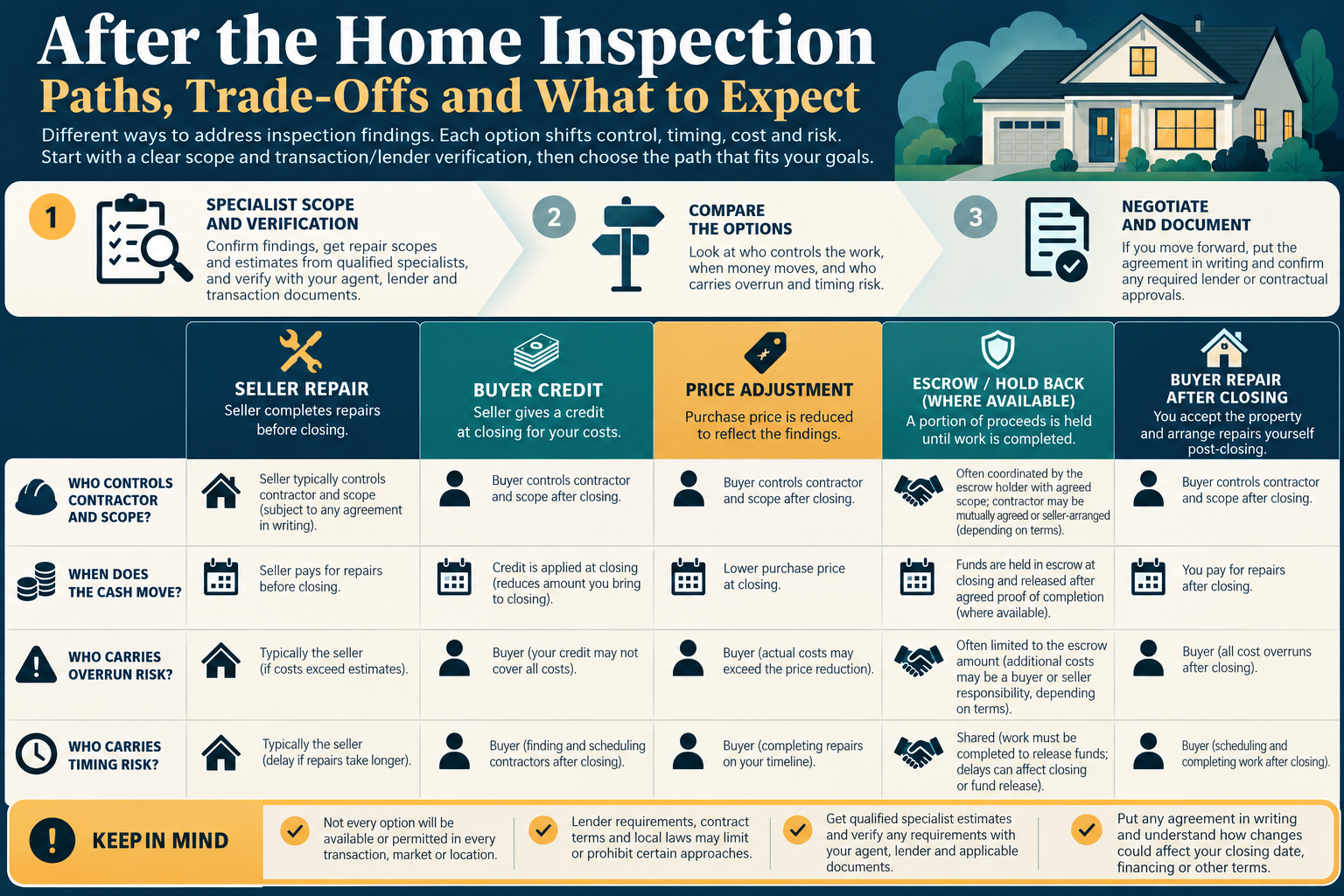
This is a comparison framework, not a negotiation or legal guide. The purchase contract, lender, loan program, jurisdiction, and transaction facts control what is allowed.
Compare the main options
| Option | Potential advantage | Main exposure |
|---|---|---|
| Seller completes repair | Work may be done before possession, with the seller carrying the immediate coordination burden | Quality, timing, documentation, and whether the chosen scope solves the cause |
| Buyer receives a credit or concession | Buyer may control the contractor and finished result after closing | The lender, contract, or program may limit treatment; cash may not be available as a dollar-for-dollar payment |
| Purchase-price adjustment | Reduces the agreed price rather than arranging construction before closing | The buyer still needs cash, financing capacity, and time to complete the repair |
| Escrow or holdback | Money may be reserved for defined post-closing work where the parties and lender permit it | Availability, release conditions, documentation, and deadlines are highly fact-specific |
| Buyer accepts and repairs later | May preserve the transaction when the condition is manageable and accurately budgeted | The buyer carries scope growth, delay, safety, and temporary-protection risk |
| Buyer declines or cancels under a contract condition | Avoids taking on an unacceptable unknown | Rights and deadlines depend on the contract and local law |
The cheapest-looking option is not automatically the least expensive. A seller repair can be valuable when the work is urgent and well-defined, while a credit can be more useful when the buyer needs control over diagnosis and contractor selection.
Price the condition before choosing the remedy
An inspection report is not a contractor quote. For a material finding, obtain a specialist scope and comparable proposals when time permits. Ask what the estimate includes, what remains concealed, whether temporary protection is required, and whether the work will expose related conditions.
Use a low, expected, and high scenario. Include diagnosis, permits, access, disposal, restoration, temporary accommodation, and the cost of delay. A credit based on a superficial repair price may leave the buyer funding the actual cause and related work.
For a seller repair, specify the outcome, materials, qualified provider, permit or inspection records, warranty documents, and acceptance process where the parties agree. If anyone describes a warranty as continuing after the sale, verify the actual transfer terms, required notice, fees, and remaining coverage rather than relying on the label. For a credit or price adjustment, verify that the amount and treatment match the contract and financing requirements.
Consider control and timing
Seller-performed work can avoid a post-closing disruption, but the buyer may have less control over contractor, product, and hidden-condition decisions. Buyer-controlled work can produce a better-matched result, but the buyer needs cash or financing and must accept the scheduling burden.
Ask:
- Who chooses the contractor and approves a scope change?
- What happens if the repair cannot be completed before closing?
- Who pays if the condition is larger than the inspection suggested?
- Is the property safe and insurable while waiting?
- What documents will the lender, insurer, municipality, or future buyer require?
- Does the remedy change the agreed possession date or other contract term?
Do not let a transaction deadline encourage unsafe work or waive a specialist assessment for a structural, electrical, gas, fire, health, active-water, or essential-service condition.
If repair funds will be released only after a condition is met, ask the lender or program who may draw them, which invoices or completion evidence are required, when release occurs, and what happens if the work or inspection is delayed. A stated credit, renovation-loan limit, or proposed holdback is not necessarily cash available on the contractor’s due date. For the homeowner’s separate choice among cash, borrowing, assistance, or staging, see paying for a home repair.
Check lender and local constraints
The Consumer Financial Protection Bureau notes that major repairs can complicate closing and that some loan programs may require repairs before closing or funds to be set aside for immediate post-closing work. That is mortgage guidance for the applicable programs, not a universal rule. Canadian treatment likewise depends on the transaction, lender, property, and local requirements.
Before agreeing, ask the lender, real-estate representative, inspector, and appropriate local professional how the proposed remedy affects financing, disclosure, insurance, and the contract. Do not assume that a credit is permitted, that an escrow is available, or that a price reduction creates enough repair cash.
Choose the option that leaves the condition, scope, control, deadline, and funding visible. If those facts are still uncertain, the next economic step may be better diagnosis or more time—not a rushed agreement based on the inspection’s most convenient number.
Compare who controls the work
The economic difference among a seller repair, buyer credit, price adjustment, and post-closing work is not only the amount on the page. Ask who chooses the contractor, defines the scope, controls quality, carries schedule risk, and pays if the repair expands.
| Option | Potential advantage | Main uncertainty |
|---|---|---|
| Seller completes repair | Buyer may receive a finished condition before closing | Scope, workmanship, documentation, and timing may be outside the buyer’s control |
| Buyer receives a credit or concession | Buyer may choose the contractor after closing | Contract, lender, program, and local limits may apply; cash may still be insufficient |
| Purchase-price adjustment | Reduces the transaction price rather than arranging work | The reduction may not provide cash for the repair and may affect financing differently |
| Buyer repairs after closing | Buyer controls diagnosis, scope, and contractor | Buyer carries cost, delay, condition, and temporary-occupancy risk |
These are economic patterns, not legal advice or an exhaustive set of transaction structures. The contract, lender, program, jurisdiction, and facts control what is available.
Price the risk of an incomplete repair
A seller’s promise to repair may sound equivalent to a buyer’s own project, but the scope can differ. Ask for the exact condition, method, product, qualification, permit, inspection, warranty, and closeout records. If the repair is concealed or safety-sensitive, an apparently complete fix may still leave the buyer unable to verify the source or quality before closing.
Conversely, a buyer may prefer control but underestimate the cost after possession. Add diagnosis, access, temporary protection, debris, finish restoration, carrying cost, and the chance that the inspection report understated the condition. A credit should be compared with a realistic repair range, not just the first contractor’s smallest number.
Match the option to the deadline
Make a schedule showing inspection response, specialist diagnosis, quote, approval, permit, work, testing, and closing. A seller repair that cannot be completed or inspected before closing may be less useful than a clearly documented post-closing arrangement. A post-closing project may be reasonable when the condition is safe to defer and the buyer has adequate liquidity, but it is risky when the home cannot be safely occupied or insured.
The Consumer Financial Protection Bureau notes that major repairs can affect a buyer’s decision or mortgage process and that a lender may impose repair or reserve conditions in some circumstances. That U.S. guidance does not establish the same treatment for every loan, lender, province, state, or transaction. Confirm the actual requirement with the responsible professional.
Compare the options by control and certainty
Use the same questions for each path:
| Question | Seller repair | Credit or price change | Buyer repairs after closing |
|---|---|---|---|
| Who controls the scope? | Seller or seller’s contractor | Usually the buyer after closing | Buyer |
| When is cost known? | Before closing only if the scope is defined | Depends on the agreed amount and repair uncertainty | Often after specialist pricing |
| Who carries an overrun? | Depends on the contract and completion terms | Often the buyer, unless the agreement says otherwise | Buyer |
| What must be verified? | Completion, quality, documents, and any required approval | Lender, contract, credit, and cash rules | Scope, funding, access, and post-closing responsibility |
The table is an economic comparison, not a statement of what a jurisdiction or lender permits. If a repair is safety-critical or the scope is unknown, obtain the appropriate specialist information before negotiating a number. If the deadline is close, include the cost of delay and the risk that an incomplete repair leaves the buyer with both the problem and less cash to address it.
Before agreeing, record the condition, evidence, repair scope, estimated cost range, deadline, who pays, who controls the work, required documentation, and what happens if the work is not complete. If the scope is uncertain, spend on the specialist information needed to negotiate intelligently. If the economic difference is small compared with the risk of an incomplete repair, control and verification may matter more than the nominal price.
Do not treat a credit, price reduction, or seller repair as a guarantee that the property’s issue is resolved. The sound option is the one that leaves the remaining risk visible and compatible with the buyer’s cash, financing, insurance, timing, and authority.