
An insurer or prospective insurer may ask for repairs, an inspection, a re-inspection, photographs, receipts, or other proof about a property’s condition. Treat the request as a high-consequence budgeting event. Verify what it means before authorizing work: a carrier’s underwriting condition is not automatically a building-code requirement, a contractor diagnosis is not automatically an insurance requirement, and a repair requested for underwriting is not necessarily covered as a claim.
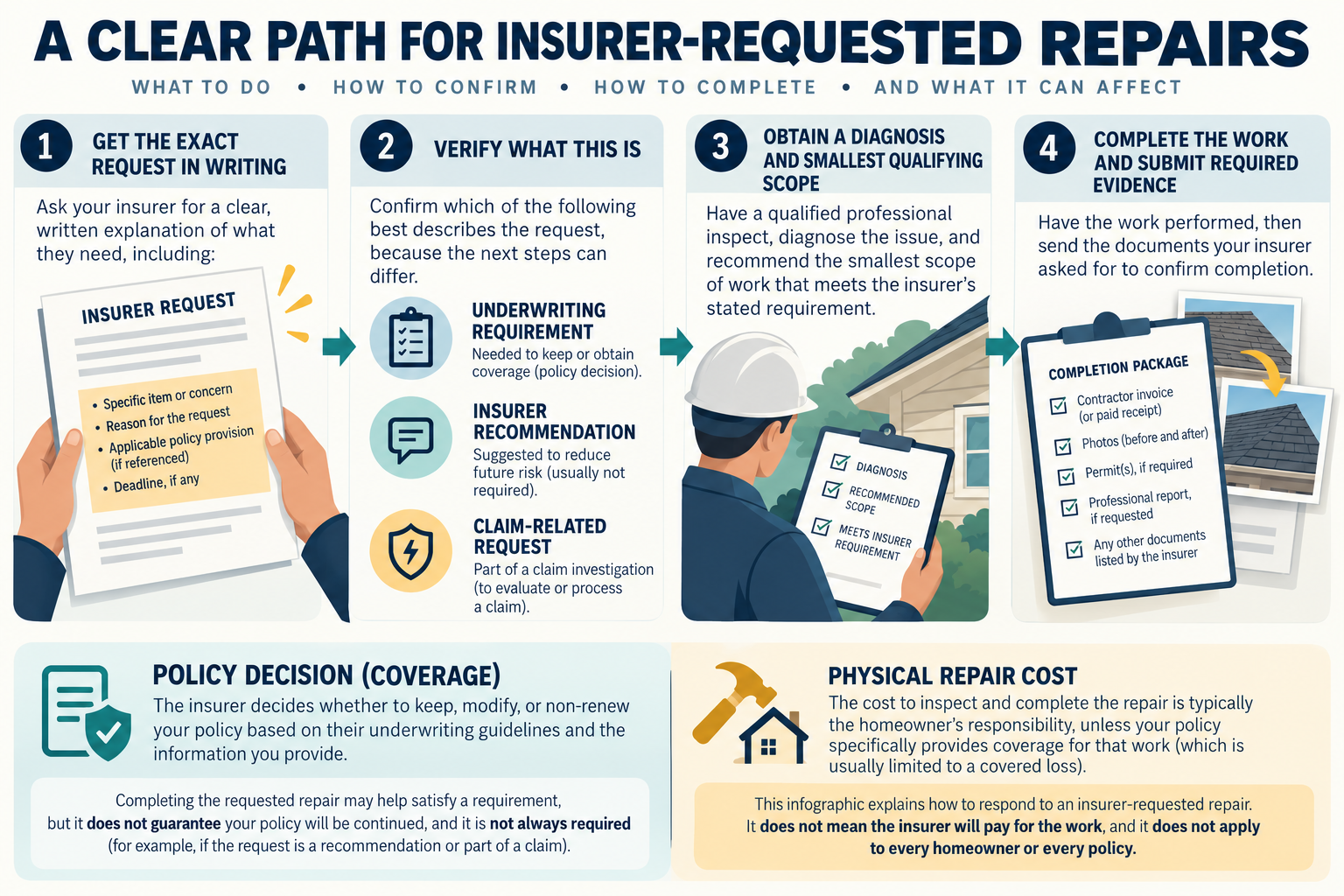
Identify the type of insurance event
Clarify whether the communication concerns:
- a new-policy application or underwriting review;
- a renewal, nonrenewal, or possible cancellation;
- a property inspection or re-inspection;
- a loss-prevention recommendation;
- a claim, covered loss, deductible, or settlement;
- documentation requested after work is complete.
These events can have different rights, deadlines, and financial effects. Do not assume that a request to correct a condition means the insurer will reimburse the repair. Coverage depends on the policy, cause of loss, exclusions, limits, deductible, settlement basis, and claims facts.
Get the request in writing
Ask the insurer or agent to state:
- the exact condition or property feature identified;
- whether the request is mandatory for a policy decision or a recommendation;
- the deadline and what happens if it is missed;
- the required scope, contractor qualification, permit, or documentation;
- whether photographs, invoices, inspection reports, or re-inspection are accepted;
- whether temporary protection is acceptable while a permanent scope is arranged;
- how the request relates to coverage, premium, renewal, cancellation, or a claim.
Keep the original message and ask questions before accepting a contractor’s broad replacement proposal. If the request is unclear, contact the insurer’s escalation channel and the applicable insurance regulator or consumer-assistance office.
Separate the four scopes
Create separate lines for:
- Insurance requirement: the condition the carrier says it needs addressed.
- Diagnosis: the professional work needed to verify the condition and define a remedy.
- Repair or replacement: the work that corrects the verified condition.
- Optional improvement: an upgrade, modernization, or broader project you choose for another reason.
An insurer may require correction of a condition without prescribing a particular product. A contractor may recommend a larger replacement than the minimum condition requires. Ask what evidence supports each scope and whether the carrier will accept an alternative.
Budget the response conservatively
Obtain a qualified assessment when the condition is unclear, especially for roof, electrical, plumbing, structural, water, fire, environmental-health, or other high-consequence work. Compare proposals using the same scope, assumptions, access, permits, disposal, restoration, warranty, and completion documentation.
Include diagnosis, re-inspection, temporary protection, deadline-related scheduling, and the possibility that concealed damage expands the work. Keep insurance deductibles and claim costs visible, but do not count expected coverage until the carrier confirms it under the policy and claim facts.
Understand jurisdictional limits
U.S. consumer guidance from the National Association of Insurance Commissioners discusses coverage, deductibles, exclusions, and settlement choices. Washington and Nevada provide state-specific examples involving property condition and inspections; those examples do not establish a national insurer practice. Canadian federal consumer guidance likewise describes policy factors and maintenance-related exclusions but does not determine a carrier’s underwriting request or provincial insurance law.
Do not publish or rely on a universal list of disqualifying roof ages, wiring, plumbing materials, tree distances, or other conditions. Requirements vary by carrier, policy, state, province, territory, property, market, and underwriting decision. Verify current rules and appeal or notice rights locally.
Document completion
Before work begins, save the request, scope, contractor qualifications, permits, approvals, and photos. During work, record changes. At completion, obtain invoices, reports, warranties, permits, inspection results, and the exact evidence the insurer requested. Send it through the carrier’s stated channel and retain confirmation.
If a request concerns an active hazard or worsening damage, protect people and property first. Do not wait for a cheaper season or a third bid when delay could increase harm. If it is an optional improvement presented as a condition, ask the insurer to clarify the requirement before spending.
The sound budget is the smallest verified scope that addresses the stated property-condition requirement safely, with enough allowance for diagnosis, documentation, and local uncertainty. It should not quietly become an unrelated renovation or be treated as a guaranteed insurance claim payment.
Check occupancy terms if the home will be empty
If you or other occupants will be away while an underwriting request is open, tell the insurer and ask in writing whether the policy’s occupancy or vacancy terms affect the deadline, required monitoring, visits, or acceptable proof of completion. Do not infer a universal day limit or assume that an absence itself creates a physical repair requirement. Texas Department of Insurance guidance and Insurance Bureau of Canada vacation guidance are examples for their own audiences; the actual policy and insurer instructions control. The unoccupied-home guide covers the separate care budget without setting a universal visit schedule.
Distinguish underwriting from a claim
An insurer can ask about condition when deciding whether to issue, renew, or continue a policy. A claim concerns a loss and the policy’s coverage for that event. A loss-prevention recommendation may be helpful without being a condition of coverage. These situations can overlap, but they should not be combined in the budget without written confirmation.
Ask whether the carrier is saying:
- the policy will not be issued unless a condition is corrected;
- coverage or renewal may change if the condition remains;
- a re-inspection or document is required;
- the request is a recommendation;
- a claim payment or deductible process is involved.
Coverage, exclusions, deductibles, settlement method, policy wording, and local rules control the claim question. A maintenance-related condition may be treated differently from sudden covered damage. Never assume that an underwriting repair will be reimbursed simply because the insurer requested it.
Verify the smallest qualifying scope
If the request is vague, ask the carrier to identify the observed condition rather than accepting a contractor’s broad replacement recommendation. Ask whether a qualified inspection, repair, maintenance record, photographs, invoice, permit, or re-inspection will satisfy the request. Ask whether an alternative material or repair is acceptable before ordering work.
Then obtain a scope from an appropriately qualified professional. The scope should distinguish the condition, cause, necessary correction, optional improvement, and work that may be exposed only after opening an assembly. If the carrier needs a particular credential or document, confirm that before paying for a report that cannot be accepted.
Price deadline and evidence risk
An insurance deadline can change the economics by limiting contractor availability, increasing expedited work, or forcing a temporary measure. Request an extension or clarification through the carrier’s documented channel when the scope cannot reasonably be completed on time. Do not rely on an informal promise that the deadline is flexible.
Keep a record of the original request, dates, conversations, approvals, contractor qualifications, scope changes, permits, photographs, invoices, and submission confirmation. If the carrier rejects the evidence, ask for the specific deficiency rather than repeating unrelated work. Contact the applicable regulator or consumer-assistance office when notice, cancellation, nonrenewal, inspection, or appeal rights are unclear.
Keep a requirement-to-evidence log
Create one row for each condition the carrier identifies:
| Field | Record |
|---|---|
| Source of request | Letter, inspection report, agent message, or policy notice |
| Exact condition | The wording used by the carrier, without broadening it |
| Decision affected | New policy, renewal, cancellation, nonrenewal, recommendation, or claim |
| Deadline | Date, extension request, and consequences stated in writing |
| Qualifying evidence | Report, invoice, photograph, permit, certificate, or re-inspection |
| Cost status | Diagnosis, required repair, optional improvement, deductible, or unknown |
Use the log to ask whether the carrier requires a repair, a condition assessment, or proof that a risk was addressed. If a contractor proposes replacing more than the request identifies, ask the carrier whether the broader scope is necessary for acceptance before ordering. If the request cannot be met on time, request an extension or specific interim requirement in writing.
U.S. and Canadian policy, regulatory, and carrier practices differ. The log does not determine coverage or legal rights; it gives the homeowner a reliable record for the carrier, agent, regulator, qualified contractor, and any local adviser who must answer those questions.
NAIC guidance describes U.S. policy choices, coverage, exclusions, deductibles, and insurer shopping. Washington and Nevada materials illustrate state-specific property-inspection or underwriting context. Canadian federal consumer guidance discusses coverage, exclusions, rating factors, and settlement concepts but does not determine a carrier’s requirement or provincial law. None establishes a universal list of unacceptable roof ages, wiring, plumbing, trees, or other conditions.
The same property condition may receive different treatment from different carriers. Ask the actual carrier or agent what is required, and verify legal rights locally. A contractor can describe the cost of correction; the insurer must clarify the underwriting consequence.
When the condition is dangerous or worsening, protect people and property first. When it is unclear or appears broader than the written request, buy the diagnosis before committing to an unrelated upgrade. A controlled scope, documented completion, and explicit coverage boundary produce a better budget than a rushed assumption that insurance will pay.
Track coverage and completion as separate records
Make one record for the policy question and another for the physical work. The policy record can include the request, date, claim or underwriting reference, coverage question, deductible, exclusions to verify, and the adjuster or broker contact. The work record can include the observed condition, temporary protection, written scope, permits or inspections where applicable, invoices, photographs, test results, warranty, and final sign-off. Keeping them separate makes it easier to see what remains unpaid or unverified.
Do not start with the assumption that the cheapest qualifying repair is automatically sufficient. Confirm the required endpoint: correction of a hazard, replacement of a component, proof of maintenance, a roof or electrical inspection, or another specific document. Ask whether temporary work is acceptable while a permanent scope is priced, and ask who must approve a change.
Coverage decisions belong to the policy, carrier, and applicable jurisdiction. The budget should show the homeowner’s cash exposure until coverage, reimbursement, or underwriting acceptance is actually confirmed.