
An empty home still has systems, weather exposure, upkeep, and a need for someone to respond when a problem is found. For an authorized owner planning an extended absence or a gap in occupancy, budget for assessment, suitable preparation, continuing care, monitoring, urgent response, policy confirmation, and the work needed before returning.
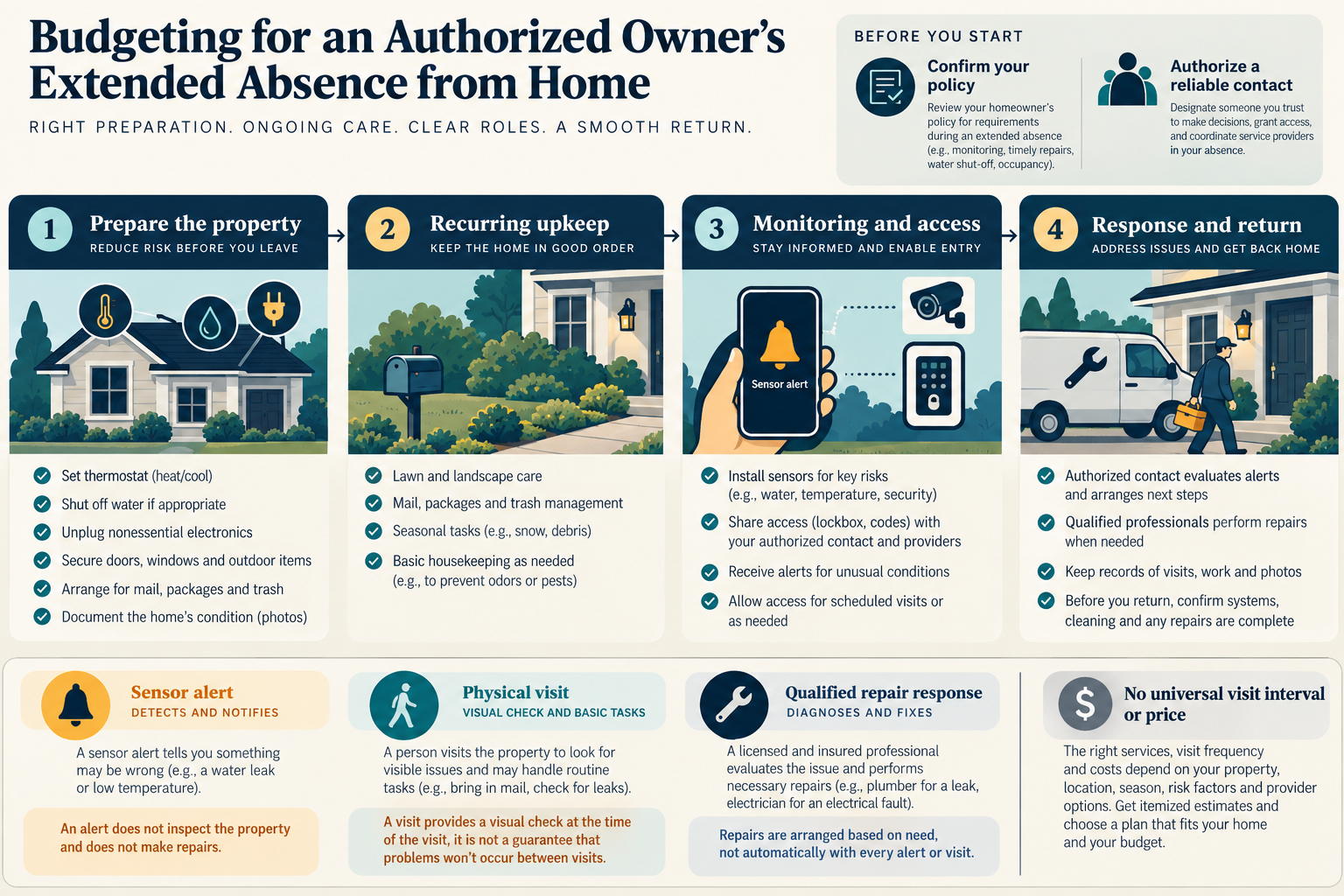
The right plan depends on the home’s condition, location, climate, length of absence, policy, and who can access and authorize work. This is not an insurance-shopping or do-it-yourself winterization guide. It does not set a universal visit interval or a price for every property.
Define the absence and who can act
Write down the expected departure and return dates, season, property condition, location, known risks, utility arrangements, and who is authorized to enter, make decisions, contact service providers, and approve spending. Include a backup contact if the first person cannot respond. Give the caretaker or service provider a current contact list and the owner’s escalation instructions.
If title, authority, or access is shared, confirm who may arrange inspections and pay for work before the absence. An inherited or estate-owned home can involve different authority questions; see the inherited-house stabilization guide.
Confirm the actual insurance terms
Before leaving, contact the insurer or broker through a verified channel. Ask for written guidance on how the policy treats the home during the planned absence or vacancy, what notification is required, whether any visit or monitoring conditions apply, what types of proof to keep, and how a change in duration affects coverage. Ask about any utility or property-preparation instruction that depends on the home’s systems; get technical advice from a qualified professional before acting on it.
Terms vary by policy and place. The Texas Department of Insurance provides Texas-specific consumer guidance about vacancy and home insurance. The Insurance Bureau of Canada gives vacation-related guidance for its Canadian audience. Neither establishes one North-American vacancy deadline, visit schedule, or coverage result. Do not assume that a sensor, a friend checking occasionally, or a paid home-watch plan satisfies your actual policy; ask the carrier what it accepts.
If the insurer sets a required repair or inspection, record the request, deadline, scope, and acceptable evidence. The insurance-required repair guide addresses that separate underwriting decision.
Build a care plan around the property’s condition
Start with a qualified assessment when the home has unresolved leaks, moisture, freeze exposure, unsafe equipment, pest activity, roof or drainage problems, or other conditions that could worsen. Ask the appropriate professional whether any preparation is needed and what services are safe to continue or suspend. Do not use a general checklist to change electrical, gas, plumbing, heating, or other systems without qualified guidance.
Separate the care plan into four jobs:
| Job | Budget questions |
|---|---|
| Preparation | Is an inspection, repair, service, securing, or weather-related task needed before departure? Who is qualified to do it? |
| Recurring care | What lawn, snow, cleaning, pest, mail, plumbing, or other service is actually needed for this home and season? |
| Monitoring and access | Who visits, what areas are checked, how are keys handled, and how are observations documented? |
| Response and return | Who can call a qualified repair provider, pay an agreed amount, arrange access, inspect after an incident, and prepare the home for return? |
Price each line as a one-time cost, scheduled service, quoted allowance, or unresolved question. Add travel, access, emergency callouts, supplies, and the time needed to restore regular use if those costs apply.
Compare people, home-watch visits, and devices
A trusted nearby person may be able to visit and respond, but agree on access, tasks, timing, emergency contacts, expenses, and what to do if they find damage. A paid home-watch service may provide scheduled physical checks and reports; ask exactly what the visit includes, how long it takes, whether interior areas are checked, how photos and incidents are recorded, how quickly the provider can return, and whether emergency repair or only notification is included.
Remote sensors can report temperature, moisture, power, or entry events if installed and connected. A notification does not confirm the cause, inspect all parts of the home, stop a leak, or authorize repairs. Budget for the device, connectivity, battery or power, alerts, maintenance, and a person who can respond. Do not treat a sensor as a substitute for policy-required physical care unless the insurer confirms that it is acceptable.
The service agreement should identify the visit scope, access procedure, report, escalation contact, response hours, travel zone, extra charges, liability boundaries, cancellation, and what the service does not do. A scheduled visit is not necessarily emergency response or a guarantee that damage will be prevented.
Use local prices as examples, not a market average
Public provider prices can help you understand what to request in a quote, but they are promotional, local, and tied to different scopes. When checked for this article in October 2026, a Regina provider, Permitto, listed monthly home-watch plans at C$179 for two visits and C$299 for four visits. An Arizona provider serving Surprise and the West Valley, Arizona House Watch, listed a plan starting at US$60 per month for one visit. These vendor-posted examples are not independently verified market averages, do not establish insurance acceptance, and are not directly comparable. Confirm current prices, tax, service area, visit scope, and extra charges with providers near the property.
Request quotes using the same questions: number and duration of visits, locations checked, photo or written report, access and travel fees, additional service price, emergency availability, and what happens after a concern is reported. A monthly fee for a brief visual check may not include repairs or follow-up visits.
Build the absence budget in scenarios
Use a short, extended, and delayed-return case. The delayed-return case matters when travel changes, an illness or transaction takes longer, or a repair prevents normal occupancy.
| Cost line | Short absence | Extended absence | Delayed return |
|---|---|---|---|
| Initial assessment and preparation | One-time quote | Add work identified for season or condition | Recheck condition and any lapsed preparation |
| Visits or home-watch service | Quoted count and rate | Added visits, travel, or seasonal work | Extend service until owner or authorized representative returns |
| Utilities and property upkeep | Confirmed services and consumption | Continuing service and upkeep | Additional months, inspection, or restoration |
| Monitoring | Device, connectivity, and contact | Ongoing fees and maintenance | Replace batteries, reconnect, or extend service where needed |
| Emergency response | Available contact and spending limit | Callout, access, temporary protection, and repair reserve | Follow-up visit, assessment, and permanent repair |
| Return to use | Basic inspection and restart | Recommissioning or cleaning if required | More extensive inspection and correction based on condition |
Keep recurring care costs separate from the repair reserve and from insurance payments that have not been confirmed. The emergency repair fund guide explains how to keep emergency cash distinct from planned maintenance.
Prepare a handoff and return record
Before leaving, save current photographs, service and repair records, policy contact instructions, utility contacts, access information, approved spending limits, and a list of known issues. Ask the caretaker or service provider to record the visit date, areas checked, observations, photos, action taken, and person notified. Keep any incident and repair documents with the home records.
Before returning, ask what was observed, whether any systems or services were changed by a qualified person, whether an incident occurred, and what needs inspection before normal use. A longer absence may call for professional assessment rather than a quick visual check. Do not assume that the home is ready for occupancy solely because no alert was received.
The budget is ready when the owner knows who may enter and authorize work, what the insurer actually requires, what care is included and excluded, how a concern will be escalated, and how costs change if the return date moves.