
When a piece of an old house is missing or beyond repair, replacement is not one simple category. The owner may reuse original material, find architectural salvage, buy new material that matches, commission a reproduction, or choose a modern substitute. The lowest material price is not necessarily the lowest project cost once lead time, fitting, approval, maintenance, and future repair are considered.
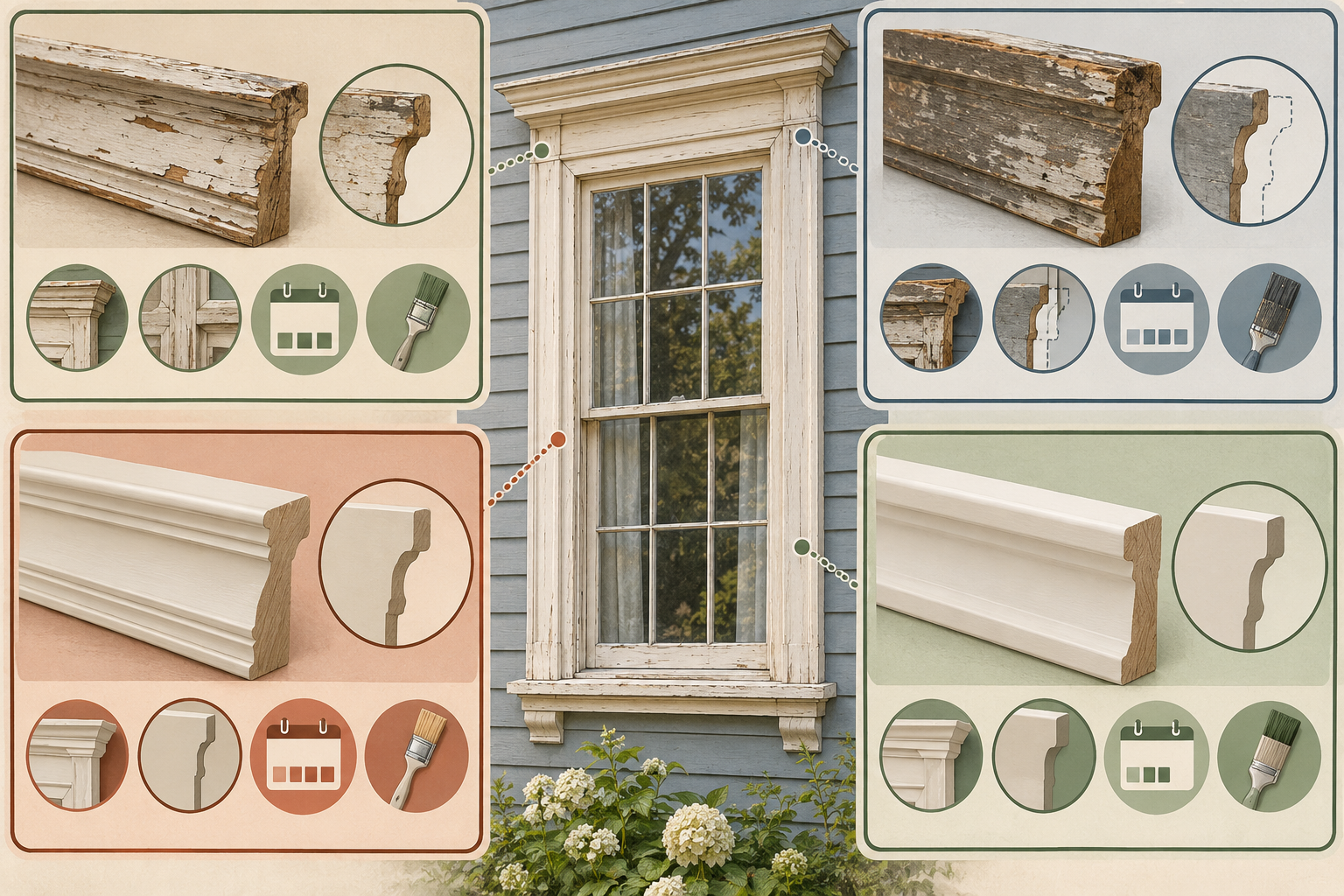
Decide how exact the match needs to be
First identify why the match matters. A visible front elevation, a stair, a repeated window profile, or a character-defining trim detail may justify more effort than a concealed repair. A designated property may have a formal review requirement, while an undesignated house may allow a broader choice. The project goal—preservation, rehabilitation, restoration, or selective modernization—also changes the answer.
Document the existing material with photographs, dimensions, profiles, species or masonry type where known, finish, location, and condition. Preserve a sample when safe and appropriate. A supplier cannot match an item reliably from a general description such as “old wood trim.”
Reuse what remains sound
Salvaging original pieces can preserve the best visual and material match. It may involve careful removal, labeling, storage, cleaning, repair, and reinstallation. The labor can exceed the value of a new commodity product, especially when access is difficult, but the result may avoid a reproduction problem and preserve material that cannot be purchased today.
Reuse is not automatically appropriate. A piece may have concealed rot, contamination, structural damage, or a coating that requires professional handling. Do not make a salvage decision without checking how the material will perform in its new location.
Architectural salvage
Salvage can fill a missing opening, repair a damaged floor, or provide a donor component. Its uncertainty is fit. Dimensions, grain, weathering, hardware, fastener holes, and profile may not match. Transport, storage, adaptation, and repair can erase the apparent material savings.
Ask a contractor to price the work needed to make the salvage functional. If the material is historic or has unknown coatings, include appropriate assessment before cutting, sanding, or refinishing.
New in-kind material
New material of the same general type can be the simplest choice when exact age is not required and a reliable supplier exists. It can be economical for repeated siding, flooring, slate, or trim, particularly when a standard profile is close enough. The comparison should include profile, dimensions, moisture behavior, fasteners, finish, and repairability—not only species or color.
“Same material” does not mean “same performance.” A new product may have different density, movement, surface treatment, thickness, or manufacturing tolerances. Confirm that the replacement is suitable for the assembly and exposure.
Custom reproduction
Custom milling, casting, glazing, carving, or fabrication is appropriate when the profile or size is important and no standard product fits. The cost depends on design time, sample or pattern preparation, setup, minimum quantities, shop work, finishing, and installation. A single replacement can have a high unit cost; a larger quantity may lower setup cost but increase cash exposure and storage.
Request a shop drawing or sample before authorizing the full run. For a visible feature, approval may be easier when the proposed material, profile, finish, and distinction from original fabric are documented.
Modern substitutes
A substitute can make sense when it improves durability, availability, code performance, maintenance, or cost without harming the building’s significant character. It must be evaluated for physical as well as visual compatibility. A hard, impermeable, or differently moving product may create a new problem in an assembly designed around softer or more permeable materials.
Use a substitute cautiously around historic masonry, windows, roof systems, traditional walls, and exterior wood. Ask what happens at joints, edges, fasteners, coatings, and future repairs. A product that looks right on installation day may age differently or make the adjacent original material fail sooner.
Compare the whole cost
For each option, record:
- material and fabrication price;
- pattern, sample, or design work;
- shipping, minimum order, and storage;
- removal and preparation;
- installation and finish matching;
- approval or documentation;
- expected maintenance and future repair;
- schedule risk if the material is unavailable.
Keep a record of the selected product and its source. Future repairs are easier when the owner knows the profile, finish, batch, and compatibility assumptions.
The best choice is the one that serves the treatment goal and the building’s physical needs at a transparent total cost. “Original,” “matching,” and “modern” are not quality rankings; they are options whose value depends on significance, condition, visibility, performance, and the consequences of getting the material relationship wrong.
Decide what “matching” means
A match can refer to more than color. Define the attributes that matter for the particular repair:
- dimensions, thickness, and profile;
- species, grain, texture, or masonry type;
- color, sheen, weathering, and finish;
- movement, permeability, drainage, and fastening behavior;
- visibility from the public way or from important interior rooms;
- how the material can be repaired or sourced in the future.
The priority may be visual continuity on a prominent elevation, physical compatibility in a traditional wall, or simple availability for a concealed repair. A material that matches one attribute and conflicts with another is not automatically a successful match. Tell the designer or contractor which attributes are essential and which can vary.
Price samples and failure before the full order
Samples, test panels, and mockups are decision costs. They can reveal that a salvaged piece does not fit, that a substitute ages differently, or that a finish is visually close but physically unsuitable. They can also prevent an owner from buying a large quantity before a local review or the treatment goal is confirmed.
Ask for a written acceptance criterion: who approves the sample, what is being compared, how the sample will be documented, and whether the test area will be retained or removed. Include the cost of pattern-making, shipping, storage, waste, and a second option if the first material fails. A small sample charge is easier to evaluate when it is tied to a decision rather than described as an unexplained shop fee.
Consider future repairability
The most economical choice at installation may be difficult to maintain. Record the supplier, profile, finish, dimensions, and any compatible repair material. Ask whether future replacement can be obtained in small quantities and whether the material requires a specialized craftsperson. If a substitute changes the way water moves, fasteners hold, or adjacent material expands, include those consequences in the lifecycle comparison.
For designated properties, document why the selected option is appropriate to the treatment goal and local review. For an undesignated property, the same record can help future owners understand what is original, what is reproduced, and what is intentionally new. Clear documentation protects the next repair decision without turning the project into a claim that every new piece is historically original.
Record the accepted material
Keep the approved sample or test panel, photographs, measurements, supplier and availability notes, and rejected alternatives with the project record. State whether the result is in-kind, salvaged, reproduced, compatible but differentiated, or a modern substitute, and identify the visual and physical differences the owner accepted.
At handoff, record what was installed and where, the source and finish, maintenance needs, and whether future material can be ordered in small quantities. This lets a later repair distinguish a true match from a similar substitute and budget for specialist work or lead time.
Build a material-selection estimate
There is no reliable national USD or CAD range for matching historic materials. Request a dated local comparison that separates documentation, salvage search, shipping and storage, minimum orders, custom setup, preparation, installation, finish matching, approval, and future maintenance. Record whether the material is confirmed available or only an allowance.
Compare the complete installed path in the market where the work will occur. A cheaper substitute is not comparable if it changes preparation, adjacent repairs, appearance, durability, or later repairability.