
An old window is not automatically a failed window. The repair decision depends on the condition of the sash and frame, the glazing, air leakage, water management, operation, significance, quantity, and the performance the homeowner needs. Replacement can be appropriate, but it should be compared with repair and weatherization rather than assumed to be the first or cheapest answer.
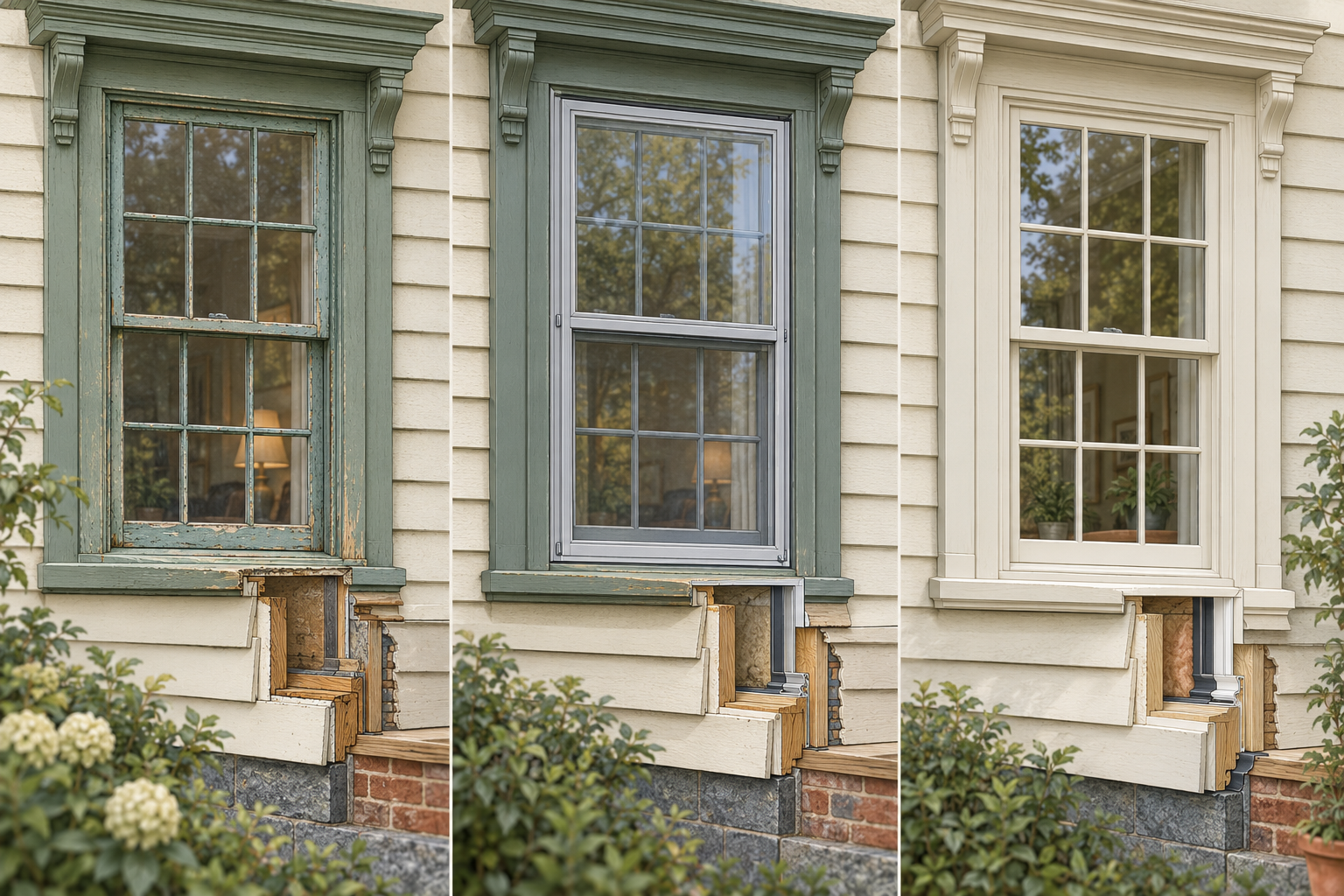
Identify what is actually failing
Ask the contractor to inspect the frame, sash, glazing, putty or glazing compound, joints, sill, hardware, paint layers, weatherstripping, and surrounding opening. Separate a loose pane or air leak from rot, structural distortion, water entry, or a failed wall detail. A window that sticks may have a repairable hardware or paint issue, or it may reflect settlement or frame damage.
Record which windows are original, which are later replacements, and which elevations receive the most weather. Grouping every opening into one replacement scope can hide useful differences. A repair plan may be appropriate for most windows while a few require custom rebuilding or replacement.
Repair and weatherization options
Repair may include localized wood work, glazing repair, sash rehabilitation, hardware work, and repainting. Weatherization may include air-seal improvements, compatible weatherstripping, interior or exterior storm windows, and adjustments to the surrounding opening. These interventions can improve comfort while retaining the original frame and sightlines.
The cost is driven by condition and labor. Careful removal, transport to a shop, lead-safe preparation, paint stabilization, glazing, drying time, and reinstallation can matter more than the replacement unit price. Ask whether the quote includes protection, temporary closure, screens, hardware, and finish work.
The National Park Service’s window-by-window guidance groups needed work into routine maintenance, structural stabilization, and parts replacement. When most work is maintenance or stabilization, it favors repair; when many new parts are needed, a matching replacement may be worth evaluating. This is a condition-based guide, not a fixed replacement threshold. A specific Lawrence Berkeley National Laboratory winter test found similar thermal performance among the tested historic-window and storm-window combinations and a tested low-E replacement unit. Its north-facing test-facility setup does not predict current prices, a household bill, or every window’s performance. For some programs, repairable original windows and their replacement have different eligibility; check the assistance guide before changing a scope for funding.
When replacement may make sense
Replacement deserves comparison when the existing assembly is extensively deteriorated, cannot provide the required function after responsible repair, has been repeatedly altered, or is incompatible with the owner’s treatment goal. A custom replacement may be needed to preserve dimensions, muntin patterns, profiles, and operation. A standard unit may fit neither the opening nor the visual relationship of the façade.
Replacement also creates secondary work. The opening may need reframing, flashing, trim adaptation, masonry repair, interior patching, paint, disposal, and heritage review. If the existing window is in a designated property or a visible historic elevation, confirm the approval path before ordering.
Do not promise an energy payback
Energy performance depends on the whole building. Air leakage at the window, wall, attic, foundation, HVAC system, and doors may interact. A replacement window can be useful, but it is not automatically the best first investment, and a historic window is not necessarily an energy failure merely because it is old.
Compare the expected improvement with the cost of repair, storms, shading, air sealing, insulation that is appropriate for the assembly, and mechanical upgrades. Keep any payback estimate specific to the climate, utility rates, window condition, occupancy, and modeled assumptions. There is no universal historic-window payback period.
Compare three quote paths
Request separate pricing for:
- Repair and weatherize: condition assessment, shop or field work, glazing, weatherstripping, storms, finish, and reinstallation.
- Selective replacement: which openings are beyond repair, how the replacements will match, and what adjacent restoration is included.
- Full replacement: product, installation, disposal, opening work, trim, approvals, and future maintenance.
Make sure every bidder states quantity, access, hardware, screens, paint, interior and exterior finish, and warranty. “Window replacement” without opening and restoration scope is not comparable to a complete conservation quote.
Lifecycle matters
Repair retains original material but may require ongoing maintenance. Replacement may offer new components but can introduce different profiles, coatings, seals, hardware, or future parts. A custom unit can be expensive to reproduce if damaged later. Ask how each option will be maintained, repaired, and matched in ten or twenty years.
The right choice is usually the one that meets the functional need with the least unnecessary loss and a clear total cost. Repair is not automatically virtuous, and replacement is not automatically efficient. Decide from condition, significance, performance, access, approval, and lifecycle—not from a single comparison price.
Treat the window and opening as one system
A window quote should describe the opening around it. Water may enter at the sill, trim, flashing, masonry, or adjacent cladding rather than through the sash. If the opening is out of square, a replacement can require reframing or trim changes. If the wall is damp, a new unit may conceal a building-envelope problem. Ask the contractor to separate window condition from opening and wall condition so a replacement does not become a way to hide unresolved work.
Quantity also changes the economics. A shop-based repair may have setup and transport costs that make one window expensive but improve the unit cost for a group. A small number of highly visible or severely damaged openings may justify custom work while less significant windows take a simpler path. Price the windows by condition group and elevation rather than assuming that every opening needs the same treatment.
Make the performance target specific
“More efficient” is not a sufficient specification. State whether the goal is fewer drafts, better operation, less exterior noise, lower condensation risk, improved comfort, reduced maintenance, or measured energy reduction. Each goal may change the choice of repair, storm unit, glazing, air sealing, or replacement. A performance target also makes it easier to judge a quote without promising that one intervention will solve whole-house comfort.
Ask how the work will affect ventilation, interior humidity, egress, cleaning, screens, hardware, and future service. A tightly sealed window can change air movement in a room; a new profile can change trim and hardware; a storm unit can improve performance while adding seasonal maintenance. These are not reasons to reject an option, but they belong in the comparison.
Plan a window-by-window decision
Create a schedule with the opening, condition, significance, proposed path, finish scope, and unresolved question. Include photos of representative windows and record any pattern or profile that must be retained. The schedule lets the owner approve repair for one group, custom rebuilding for another, and replacement only where the condition or function warrants it. It also gives the contractor a basis for a realistic allowance instead of an average price for an unknown mix of openings.
Include hardware, glazing, and weather details
Ask the proposal to identify the frame, sash, glazing, putty or seal relationships, hardware, weatherstripping, screens or storms, exterior trim, and surrounding opening. A window may appear to need replacement when the problem is a failed component, poor operation, water detail, or a surrounding wall condition. Conversely, a replacement unit may not solve leakage if the opening or adjacent cladding remains damaged.
Record what visible variation is acceptable between retained and new openings. Include removal, storage, protection, sill and trim repair, interior finish, exterior finish, disposal, and final adjustment. This makes a window-by-window decision comparable and protects the owner from a whole-house allowance that ignores different conditions.
Plan the future maintenance handoff
Keep photographs, measurements, repair decisions, samples, hardware information, and the maintenance requirements for each opening. Note which windows were deferred and why. A future storm-window, paint, glazing, or sash repair should be able to use that record without reopening a sound wall or discarding a repairable component.
Check the opening, not only the window
At completion, review the sill, trim, surrounding finish, water detail, operation, and accepted visual difference for each opening. A repaired sash or new unit does not close out the project if the opening still leaks or the adjacent historic material remains damaged. Record deferred conditions for the next phase.
Make each opening’s decision traceable
Keep the window schedule, photographs, measurements, repair or replacement choice, accepted finish, weather details, and deferred condition. A house-wide label hides important differences between openings; a window-by-window record keeps future maintenance and later quotes specific.
Keep the window schedule current
Record the choice, accepted appearance, weather details, repair area, and deferred condition for each opening. A window-by-window schedule is more useful than a whole-house promise that every opening was treated the same way.
Build a window comparison
No reliable national USD or CAD range applies to historic window work. Ask for dated local options that separate assessment, repair, weatherization, glazing or storm units, custom replacement, hardware, access, disposal, trim, paint, approvals, and future maintenance. State the number and condition of openings covered by each option.
Compare the complete installed scope in the local market rather than converting a foreign price. A useful bid explains what remains original, what is replaced, and how the opening will be protected and restored.