
Contingency is the money reserved for scope that cannot be responsibly priced before enough of the building is visible. In an old or historic house, the uncertainty is not limited to ordinary concealed construction. Past alterations may be undocumented, a material may need custom matching, access may be unusually careful, and a hazard or preservation review may change the sequence.
There is no universal historic-home contingency percentage. A fixed number can be a useful internal planning test, but it is not a substitute for identifying the risks that make the number move.
Why older projects have different uncertainty
An opening may reveal a second layer of framing, an abandoned pipe, a prior repair, rot, incompatible mortar, damaged wiring, or a finish that cannot be replaced from a standard catalog. A contractor may also discover that the planned access route passes through original plaster, flooring, trim, or masonry.
The project can expand in several directions at once. A leak damages a finish, the repair requires system access, the access exposes a hazard, and the finish must then be restored by a specialist. Price each link rather than treating the entire chain as an unexplained “old-house premium.”
Main contingency drivers
Concealed conditions
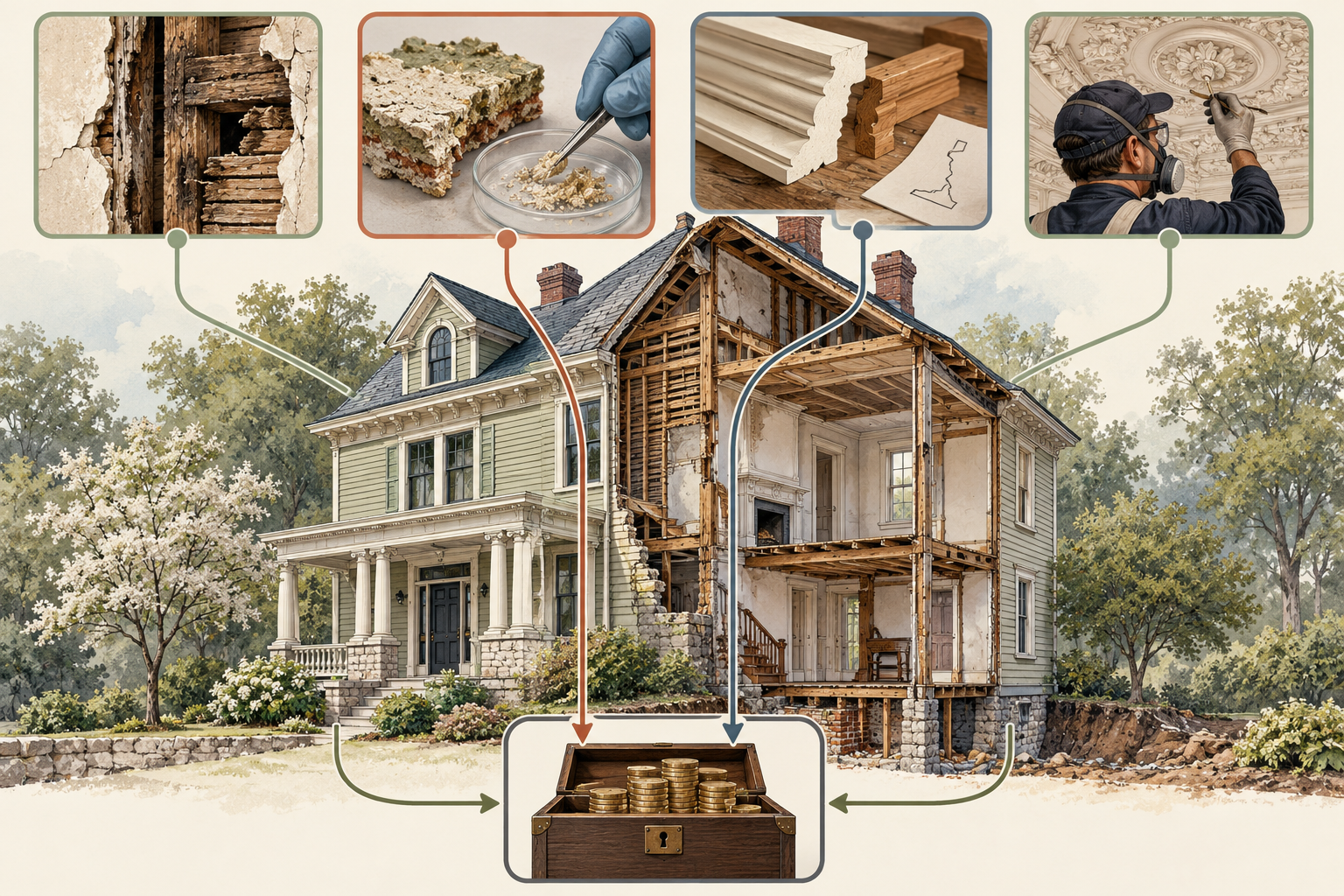
Inaccessible framing, foundation bearing, roof decking, pipe routes, and prior alterations cannot always be confirmed without selective investigation. Ask what has been observed, what has been inferred, and what opening or test would resolve the uncertainty. A meaningful allowance names the condition it covers.
Hazards
Lead paint, asbestos-containing materials, suspect insulation, and other hazards can affect containment, testing, labor, disposal, and schedule. The age of a house is not proof that a material is hazardous. Planned disturbance matters. If the project will sand, cut, demolish, or remove older material, budget for qualified screening before work and for a separate abatement scope if needed.
Matching and custom work
Replacement may require salvage searches, custom milling, reproduction profiles, specialty glazing, matching masonry, or compatible mortar. Lead time and minimum orders can be as important as the material price. A short contingency may not cover a design decision that changes the product entirely.
Specialist labor and access
A small repair may require a craftsperson who is not available on the same schedule as a general contractor. Roof height, tight rooms, occupied spaces, scaffolding, temporary protection, labeling and storage, or careful removal can multiply labor hours. Ask whether mobilization, travel, protection, and return visits are included.
Testing and mockups
Material analysis, sample panels, paint testing, moisture investigation, engineering, and trial repairs can prevent a larger failure. They may also prove that a proposed treatment is unsuitable. Budget them as decision costs, not as wasted money or hidden contractor overhead.
Structure the budget in layers
Use separate lines for:
- Known base scope: work visible and specified now.
- Allowances: a defined item whose quantity, access, or final selection is not known.
- Investigation: testing, openings, engineering, or conservation advice needed before a decision.
- Contingency: a reserve for a defined class of uncertain condition.
- Owner choices: optional restoration, custom reproduction, energy upgrades, or finish level.
This structure makes a bid easier to compare. A contractor should explain what causes an allowance to be used, who approves it, how unused money is handled, and whether the amount includes overhead, tax, disposal, or restoration.
Use phased discovery when the whole project is not visible
For a whole-house modernization, it may be sensible to complete documentation, hazard screening, moisture investigation, and selective openings before committing to finish restoration. The first phase can reduce later uncertainty, although it adds mobilization and may not eliminate every concealed condition.
Do not use contingency as permission to begin demolition without a plan. Stop when a discovery affects safety, structure, hazardous materials, heritage attributes, or the intended treatment. Obtain the appropriate professional evaluation and revise the scope in writing.
Avoid inflated or empty allowances
An old house can justify uncertainty, but “historic” should not be a blank check. Ask for photographs, assumptions, unit prices where practical, and a description of the trigger for additional work. Compare bids by what each includes: protection, testing, custom materials, specialist subcontractors, restoration, inspection, cleanup, and warranty.
The right contingency is large enough to keep a known uncertainty from becoming a crisis and specific enough that the owner can make decisions as conditions are uncovered. It should not hide an incomplete design, an unresearched hazard, or a contractor’s refusal to explain the scope.
Rank uncertainty by how it changes the project
Not every unknown deserves the same reserve. A missing trim profile may create a sourcing delay or a custom-fabrication choice. A concealed foundation defect, hazardous material, unstable masonry, or failed service route can change safety, sequence, occupancy, and the work of several trades. Describe the consequence as well as the unknown:
- Cost-only uncertainty: quantity, finish level, waste, or a small amount of extra labor.
- Scope uncertainty: a hidden condition may add a repair, access route, or restoration package.
- Sequence uncertainty: testing, approval, or drying may postpone work that was planned next.
- Decision uncertainty: investigation may show that repair, replacement, or a compatible substitute is the better path.
This ranking helps keep a contingency from being used as a substitute for design. If the owner knows that a structural assessment or hazard test is needed, price that investigation directly. Reserve contingency for the conditions that remain uncertain after a reasonable level of investigation.
Use change triggers and approvals
A useful allowance states what was observed, what was assumed, the unit or scope covered, and what will activate more work. An opening allowance can identify the area to be exposed and the restoration included if the framing is sound. A material allowance can identify the profile, quantity, lead time, and decision if a match cannot be sourced. A hazard allowance can identify testing, containment, disposal, and the separate professional scope if a suspect material is confirmed.
Set a process for change decisions before construction begins. Ask who documents the discovery, who evaluates its significance or safety, who prices the response, and who approves the change. This is especially important when an owner is living in the house or when a small discovery affects several connected trades.
Separate a contingency from an owner reserve
Contractor contingency, owner reserve, allowance, and optional upgrade are not interchangeable. A contractor may carry a reserve for defined construction uncertainty. The owner may also keep cash available for an elective change, a schedule delay, temporary accommodation, or a finish decision made after seeing the opened work. Show those items separately so an owner reserve is not mistaken for money already included in the contract.
Review the reserve as information improves. Investigation may reduce one risk while revealing another. Do not shrink it simply because the first opening was uneventful, and do not keep it opaque when the contract has become sufficiently defined. The goal is not to predict a percentage; it is to keep the remaining uncertainty visible and financially manageable.
Keep conditional assistance out of the base budget
Price the full work and keep owner cash, contingency, eligible costs, and any possible assistance on separate lines. A grant ceiling or tax-credit percentage does not fund the contractor invoice when the contract is signed; the program may require a particular scope, advance approval, owner contribution, closeout evidence, or later tax filing. Until eligibility, start-work terms, and payment timing are confirmed in writing, do not reduce the gross project budget or use contingency to cover a benefit that may be delayed or unavailable. See heritage assistance and cash flow.
Review contingency as the project learns
Set a point at which the owner and project team revisit each allowance. When an opening, test, or inspection resolves the condition, remove or revise the allowance rather than spending it by habit. When a new discovery changes the scope, document the evidence, the technical or preservation decision, the added work, and the effect on schedule and restoration.
Keep a contingency for existing conditions separate from an owner reserve for a preference change. The first belongs to a defined project uncertainty; the second is a cash-flow choice. Both may be prudent, but they answer different questions and should not be blended into a misleading “old-house percentage.”
The owner should receive a closeout showing which allowances were used, which were released, and which conditions remain unresolved. That record makes the next phase easier to price and keeps uncertainty visible after the contract is closed.
Make the unknowns priceable
No reliable national USD or CAD contingency percentage applies to historic renovation. Build a dated local allowance for each unresolved driver—concealed structure, hazard discovery, access, material matching, specialist labor, or finish restoration—and state the observation or decision that would activate it.
Compare bids by inclusions and assumptions, not by the contingency label alone. Keep confirmed work, allowances, and owner-selected upgrades separate so an unknown condition does not become an unexplained markup.