
Slate can have a long service life, but the roof system is more than the slates. Broken or missing pieces, fasteners, flashing, valleys, underlayment, sheathing, roof geometry, and prior repairs can produce different scopes. The National Park Service recommends repair rather than replacement where possible while recognizing that deterioration may eventually require replacement.
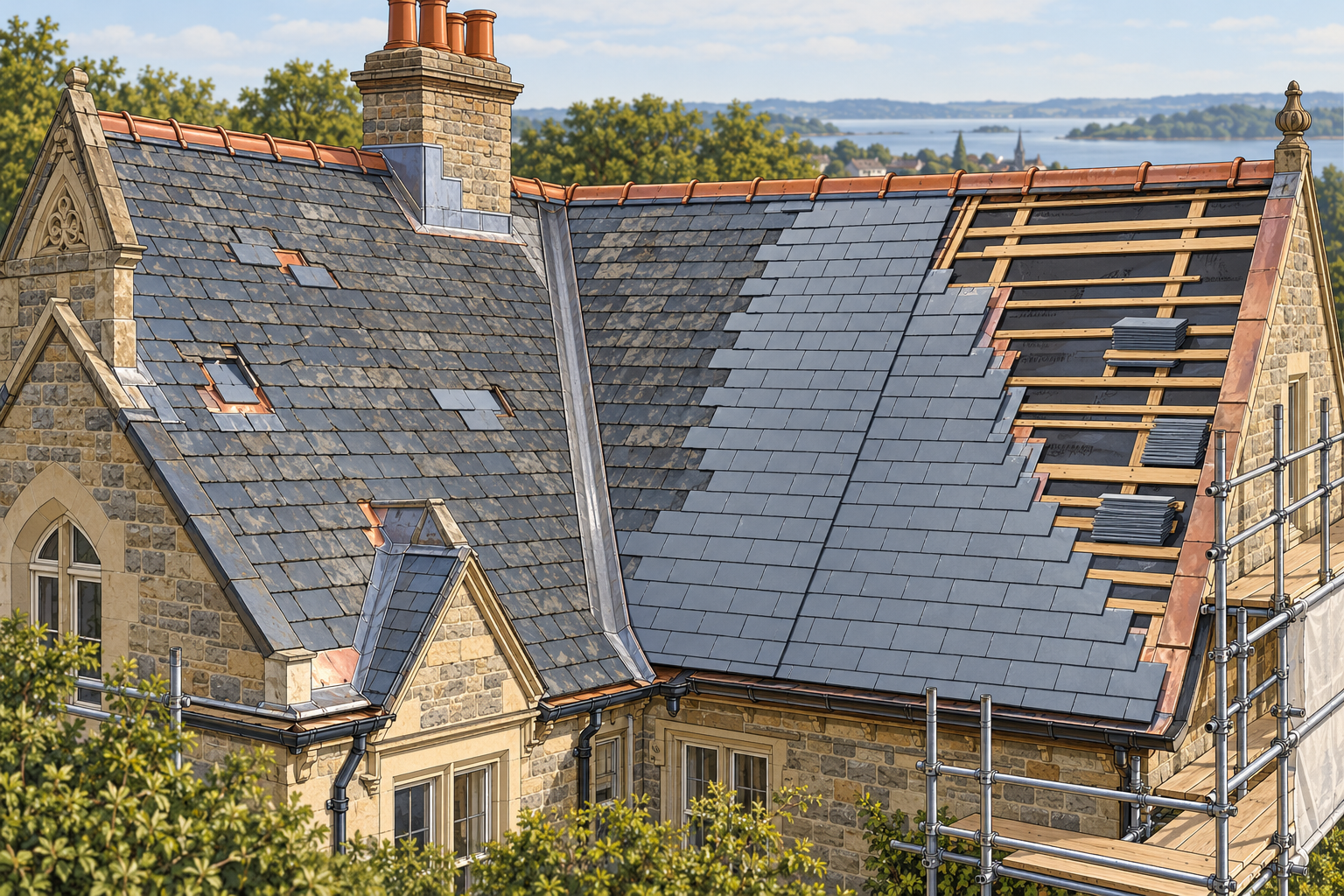
Diagnose the roof as a system
Document slate size, color, thickness, exposure, coursing, patterns, ridge and hip details, flashing, valleys, gutters, and evidence of water entry. Separate individual slate failure from widespread delamination, fastener problems, failing substrate, and a roof that has already lost its water-shedding details. A roof inspection should be performed by a qualified slate-roof professional who can work safely at height.
Compare the pathways
- Localized repair may replace individual slates or address flashing and fasteners while retaining most of the roof.
- Partial replacement may suit a defined slope or area with broad deterioration, but matching and transitions need careful detailing.
- Full re-slating involves removal, sorting or salvage, substrate and underlayment decisions, new material, detailing, access, and significant labor.
- Alternative roofing may reduce availability or installation constraints but can change the building’s character, future maintenance, and any applicable review.
The source’s commonly cited slate life range—roughly 60 to 125 years or longer, with some slate reported over 200 years—is not a guarantee for a particular roof. Slate type, exposure, installation quality, fasteners, water management, and maintenance matter more than age alone.
Compare quotes by detail, not area alone
Ask whether each bid includes documentation, access or scaffolding, temporary protection, slate sorting, matching or salvage sourcing, flashing, valleys, underlayment, sheathing, gutters, disposal, and finish restoration. If solar or another roof-mounted system is planned, confirm roof condition and future access before installing it.
Preserve original patterns and significant details where the chosen treatment permits. A lower replacement price may conceal a change in material, detail, or future service life that affects the property’s character and maintenance cost.
Compare repair, partial replacement, and re-slating
Localized repair may involve replacing slates, correcting fasteners, repairing flashing, or addressing a detail. It can preserve the field roof and avoid unnecessary removal, but matching material and access may be difficult. Partial replacement can make sense when one slope or exposure has a distinct failure pattern. Confirm how new work will transition to the retained roof and whether salvaged slates are available.
Full re-slating may be appropriate when the roof system is broadly compromised or the retained material cannot provide a reliable result. Price sorting, salvage, underlayment, flashing, sheathing, fasteners, valleys, ridge details, disposal, scaffolding, and interior protection. A substitute roof can reduce sourcing or maintenance difficulty but changes appearance, detailing, weight, service life, and any approval path.
Do not decide from area alone. Roof pitch, height, dormers, chimneys, valleys, tight property lines, weather, and public-way protection can dominate labor and access.
Include future projects in the decision
If solar, insulation, attic work, chimney repair, or other roof penetrations are planned, coordinate them before final slating. Installing one system on a roof that soon needs major work can create removal and reinstallation cost. Conversely, delaying a necessary roof repair for a future project can increase interior damage. Ask for a sequence that makes dependencies clear.
Compare qualified proposals
Request a condition report, photographs, repair map, sample or matching plan, access method, temporary protection, and warranty or maintenance assumptions. Ask whether the contractor has experience with the material and whether the estimate includes weather delays, sorting, waste, flashing, gutters, and finish restoration. Roof work and fall protection require qualified professionals.
The economical option is the one that matches the actual failure pattern, preserves sound material where that is the goal, and does not hide the access, substrate, sourcing, or future-maintenance consequences behind a single replacement price.
Read the roof condition by component
Ask for a roof map that separates field slates, ridges and hips, valleys, flashings, penetrations, fasteners, underlayment, deck or sheathing, gutters, and interior evidence of leakage. A roof can have a large number of broken slates but a repairable system, or a visually intact field with failing fasteners, flashing, or substrate. Age alone does not select the intervention.
The source-backed lifespan figures describe what some slate roofs have achieved, not a remaining-life guarantee. Exposure, slate quality, installation, fasteners, water management, weather, and maintenance all matter. A condition report should explain what is observed and what still requires opening or specialist assessment.
Price the access and sourcing risk
Slate work can require scaffolding, roof protection, sorting, careful handling, public-way controls, weather delays, and a specialist crew. Matching material may be available from salvage, a quarry, a supplier, or a custom source, each with different lead times and waste. Include the cost of storing reusable slate and the plan for pieces that cannot be reused.
If the roof is near a chimney, dormer, solar array, or other penetration, coordinate those interfaces before the final treatment. A partial repair should show how new slates and flashing meet retained work. A full re-slating proposal should explain what happens to sound slate and whether the new system changes the roof’s appearance, weight, detailing, or future repair path.
National Park Service roofing guidance notes that replacing flashing can require lifting surrounding slate, and that sound slates may be reused when the underlying support is repaired. It also warns that repeated repair labor can approach broader replacement without setting a price threshold. Ask bidders to separate flashing and substrate work, slate retained or salvaged, setup and mobilization, access, and future maintenance. If local assistance could affect the scope, check its eligibility and start-work conditions in the heritage assistance guide before ordering material or scheduling work.
Decide what “saved” means
Saving a roof may mean retaining most of the field, preserving a visible pattern, repairing a slope while replacing an underlying component, or postponing full replacement until a defined threshold is reached. State the threshold. For example, an owner may accept visible repairs but not recurring water entry, or may prefer a compatible substitute when matching slate becomes impractical.
Ask for inspection and maintenance requirements after the work. A repair that cannot be accessed or monitored may have a different lifecycle value from a higher-priced treatment with clear future service. Roof safety and fall protection remain the responsibility of qualified professionals.
Set a repair threshold and review date
If the owner chooses localized or partial repair, define the condition that would trigger another assessment or broader work. The qualified roofer should identify the relevant technical observation, such as repeated leakage, failed flashing, inaccessible fasteners, loss of matching slate, or a substrate condition found during opening, and state its budget consequence.
Set a roof inspection and maintenance interval suited to the roof and local exposure. Record repaired areas, salvaged material, matching limits, flashing work, and deferred conditions so a temporary repair is not treated as a whole-roof guarantee.
Record the roof handoff
Keep the roof map, inspection, slate source, flashing and substrate assumptions, photographs, access plan, and maintenance instructions together. Include any interior water damage and restoration, what was saved or replaced, what remains uncertain, and which deferred condition should trigger another review. Note how later roof or solar work could affect the repair.
Build a local estimate
There is no reliable national USD or CAD price range for historic slate work. Ask for a dated site-specific proposal that separates inspection, access, slate sorting, salvage or matching material, fasteners, underlayment, flashing, sheathing, disposal, and finish protection. Price localized repair, partial replacement, and full re-slating as separate options, and record which roof areas each option covers.
Use the proposal to calculate the decision rather than comparing a single area price: retained material, access days, replacement quantity, hidden substrate allowance, and future maintenance should each be visible. Keep U.S. and Canadian bids in their own market; do not convert one to the other by exchange rate.