
State what happens in difficult conditions
Ask how the proposal handles low outdoor temperatures, backup or supplemental heat, defrost, outages, retained equipment, and rooms with deficient ducts. Include electrical, condensate, controls, removal, access, commissioning, and future service. These conditions often matter more than the equipment line.
Compare simple replacement, typical retrofit, and difficult distribution or access scenarios. Use local electricity, fuel, climate, runtime, and ownership assumptions. Do not subtract unverified incentives or promise savings that the evidence does not establish.
Use three budgets, not one
Prepare a low-complexity budget for compatible equipment and accessible connections, an expected budget for removal, controls, electrical, condensate, duct or line-set work, and commissioning, and a difficult budget for access, distribution correction, backup, or future envelope coordination. These are scenarios, not promises. The quote should identify which one it assumes.
Then compare ownership: electricity, retained or removed equipment, maintenance, service, backup, and future replacement. A heat pump is a system investment whose value depends on design and use. A product price or rating cannot resolve the decision by itself.
If the heat pump replaces an AC, state whether the furnace or air handler remains. If it replaces a furnace, state the backup strategy, fuel equipment retained, and electrical scope. If it is new, show distribution and access rather than using an equipment-only price.
Tell the designer about planned envelope work and request commissioning, capacity, airflow, controls, condensate, low-temperature or backup operation, and homeowner documentation. A product rating cannot compensate for an incomplete installation.
A U.S. specialist guide reports professional heat-pump installation around $4,237–$7,943. Canadian specialist examples put a ducted air-source heat pump around CAD $4,500–$10,000 with existing ducts and a standard air-source system around CAD $5,000–$10,000. These are broad examples with different assumptions, not local bids or a universal range. Capacity, duct condition, climate, backup heat, controls, electrical infrastructure, access, and installation quality can move the project well outside them.
Define the configuration
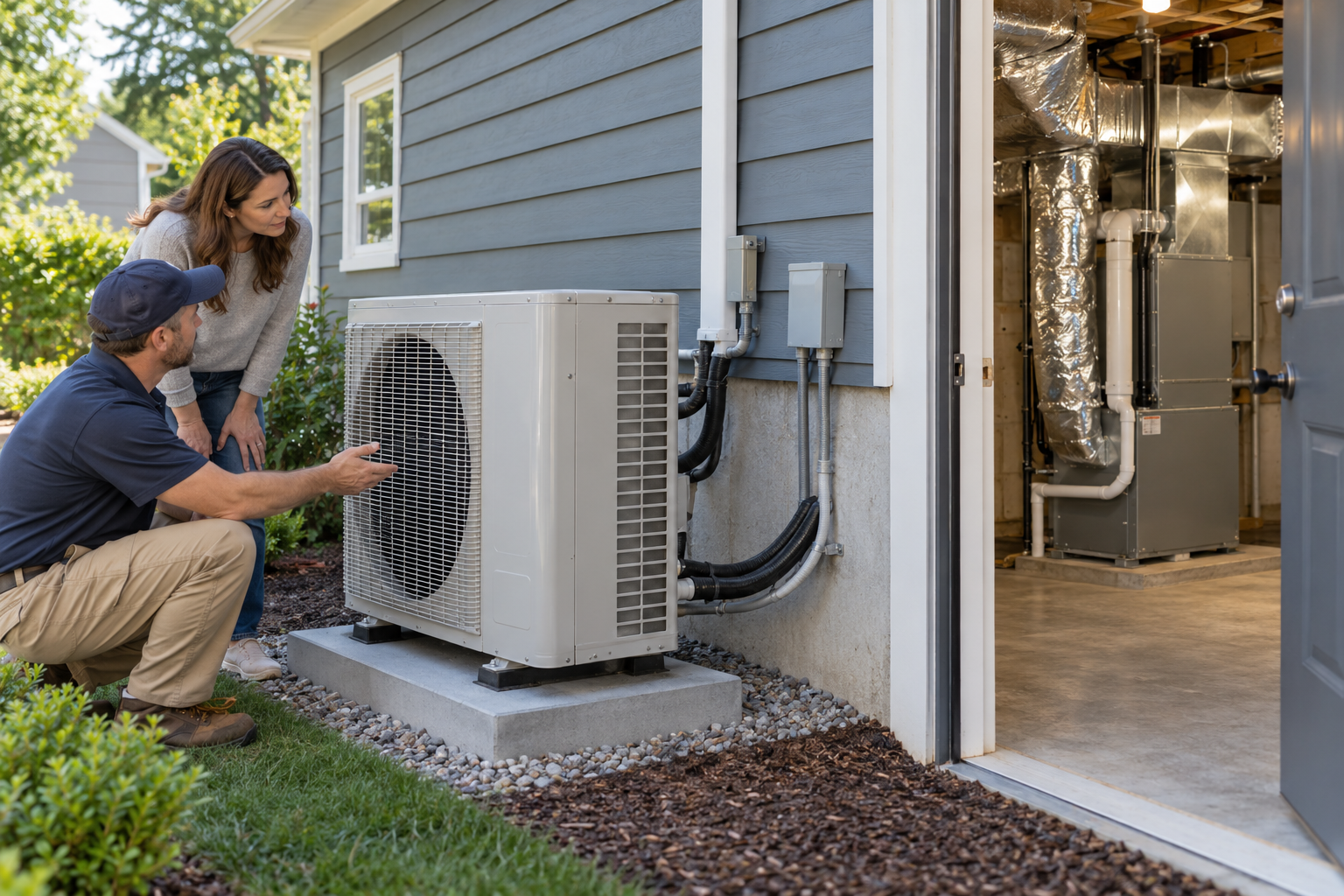
State whether the system is ducted or ductless, heating-only or heating and cooling, replacing a furnace or AC, retaining a furnace as backup, and using existing ducts or new distribution. Equipment match, indoor unit, outdoor unit, thermostat, line set, condensate, electrical work, removal, and commissioning should be explicit.
Sizing and climate
Do not choose capacity from floor area or the old nameplate alone. ENERGY STAR’s criteria distinguish ducted and non-ducted systems and use SEER2, EER2, and HSPF2. Its cold-climate designation includes low-temperature testing, but qualification is not a sizing method or a promise of field performance.
NRCan states that proper selection, sizing, and installation are critical and that both undersizing and oversizing can increase cost and reduce efficiency. It also says planned insulation, window, or air-sealing work should be considered in system design. Tell the designer about envelope work before equipment is selected.
Cost layers
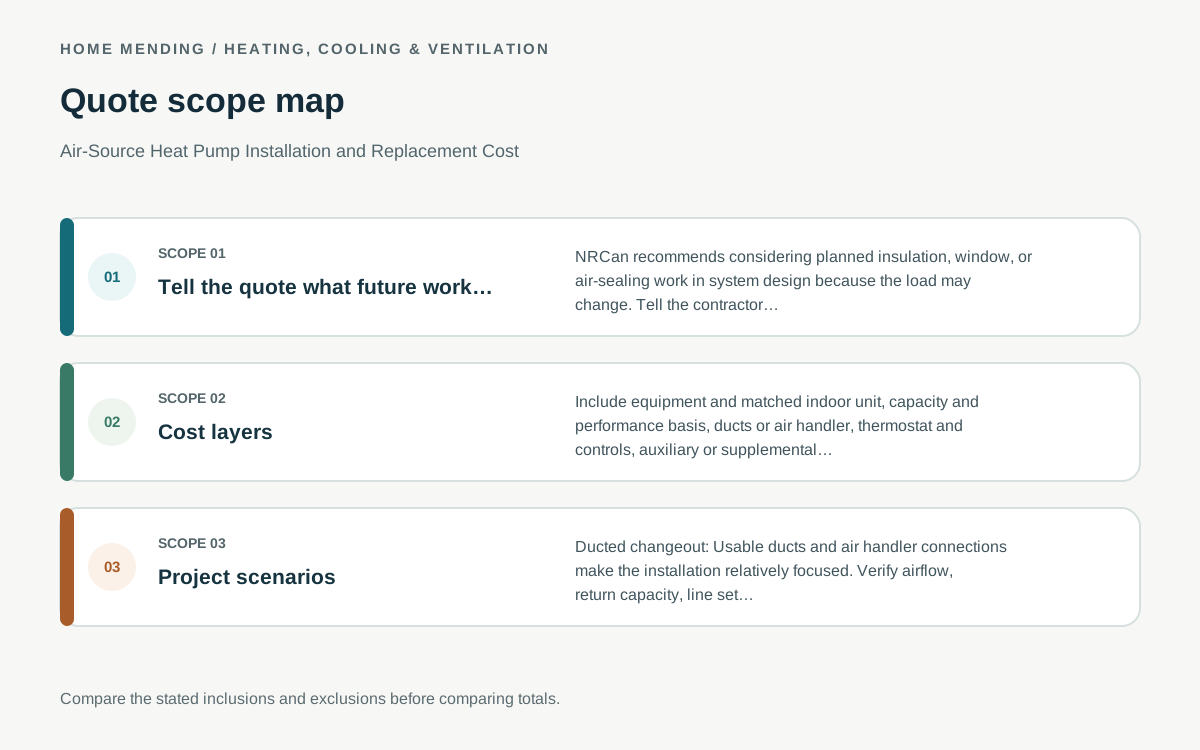
Include equipment and matched indoor unit, capacity and performance basis, ducts or air handler, thermostat and controls, auxiliary or supplemental heat, line set, condensate, electrical circuit or service assessment, pad and penetrations, removal, disposal, access, testing, balancing, commissioning, permits where applicable, and warranty.
Do not assume a panel upgrade is part of ordinary installation. If electrical capacity or whole-home electrification dominates, keep that project in the appropriate electrical or energy-retrofit scope.
Project scenarios
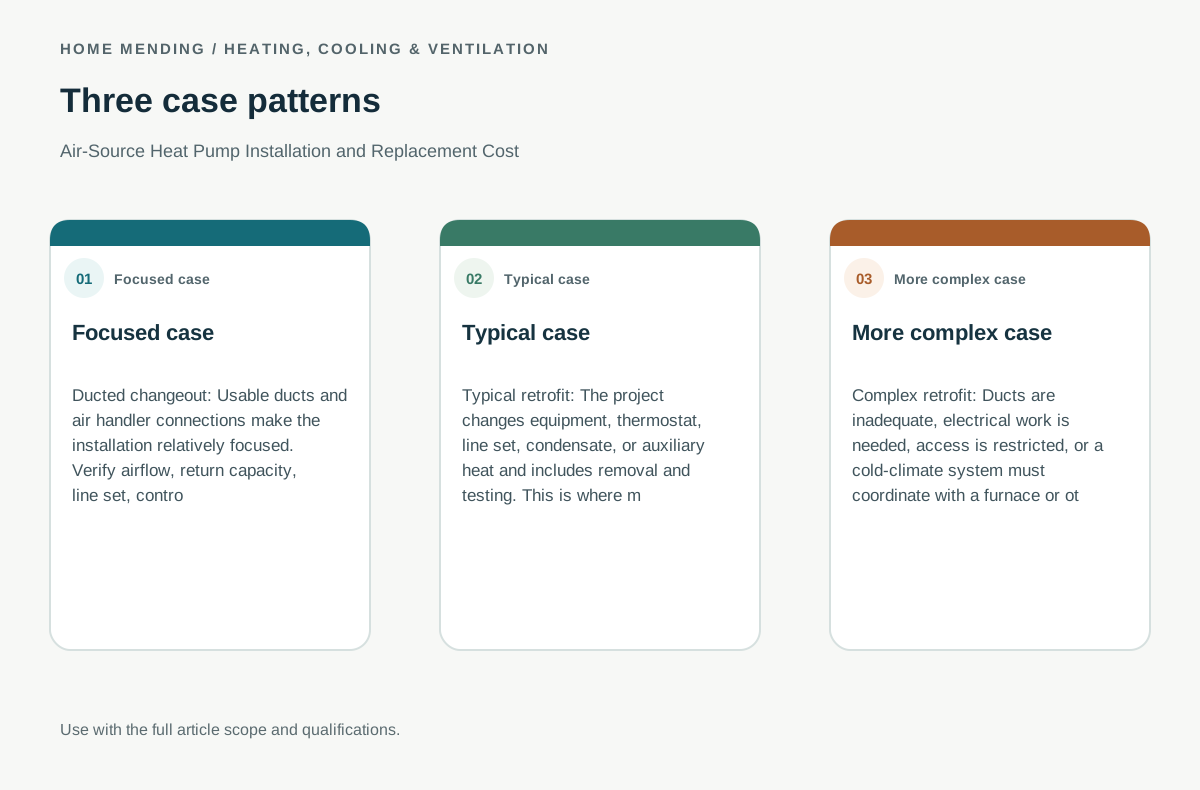
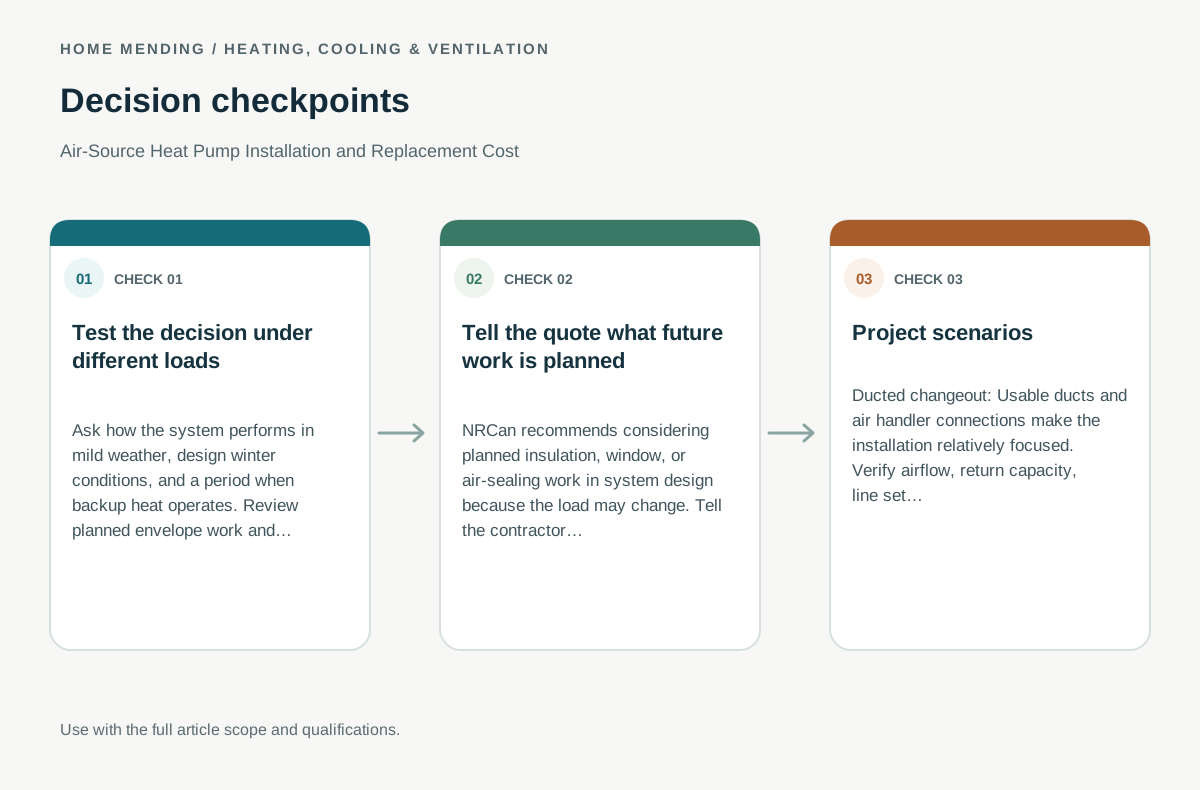
Ducted changeout: Usable ducts and air handler connections make the installation relatively focused. Verify airflow, return capacity, line set, controls, and backup heat.
Typical retrofit: The project changes equipment, thermostat, line set, condensate, or auxiliary heat and includes removal and testing. This is where many homeowner quotes should be normalized.
Complex retrofit: Ducts are inadequate, electrical work is needed, access is restricted, or a cold-climate system must coordinate with a furnace or other backup. Price each layer and state the low-temperature capacity basis.
Operating economics
NRCan notes that outcomes depend on electricity and competing fuel prices and the system being replaced. Model local rates, heating demand, backup-heat use, cooling value, maintenance, and ownership period. Do not promise that every heat pump will lower bills or that every cold climate requires the same configuration.
Compare quotes
Ask for the load and capacity basis, equipment identifiers, performance at relevant conditions, indoor/outdoor match, ducts and airflow, backup heat, thermostat, electrical, line set, condensate, removal, commissioning, warranty, and exclusions. Separate optional zoning, smart controls, and premium equipment from work required for a compatible installation.
The best heat-pump budget makes the climate, distribution, backup, and infrastructure assumptions as clear as the equipment price.
Tell the quote what future work is planned
NRCan recommends considering planned insulation, window, or air-sealing work in system design because the load may change. Tell the contractor whether those projects are funded, hypothetical, or out of scope. An equipment choice based on today’s leaky condition may be oversized after envelope work; a choice based on future work may leave the home under-served if the work never happens.
Compare the complete alternative
If the baseline is a furnace plus AC, include both replacement paths, paired equipment, future service, and cooling value. If ducts are poor, price sealing, repair, replacement, balancing, or ductless zones. If a panel upgrade is proposed, request its electrical basis and separate total. A heat-pump price is not meaningful until the distribution and backup assumptions match the alternative.
Commissioning and handoff
Ask what capacity and airflow checks, controls setup, condensate verification, low-temperature or backup operation, and homeowner documentation are included. Installation quality affects performance and life; a product rating cannot compensate for an incomplete installation.
Make the replacement boundary explicit
If the heat pump replaces an AC, state whether the furnace or air handler remains. If it replaces a furnace, state the backup strategy, venting or fuel equipment retained, and any electrical work. If it is a new installation, show distribution and access rather than using an equipment-only price.
Test the decision under different loads
Ask how the system performs in mild weather, design winter conditions, and a period when backup heat operates. Review planned envelope work and duct corrections before final sizing. A suitable heat pump is a whole-system choice; the lowest quoted capacity or highest rating is not automatically the best value.
Keep incentives, local permitting, and utility claims verified for the actual jurisdiction. They can change the budget but should not be treated as guaranteed national benefits.
Compare the project under three conditions
In a straightforward replacement, existing ducts, electrical service, controls, and equipment location are compatible. A typical retrofit adds duct correction, electrical or control work, condensate, removal, and commissioning. A difficult project includes concealed access, inadequate returns, low-temperature backup, a new distribution strategy, or a future envelope change that may alter sizing. Ask which condition the proposal assumes.
For the ownership comparison, include the retained or removed heating system, auxiliary heat, maintenance, service access, electricity and competing-fuel assumptions, and future replacement. A heat pump can be a strong choice when its climate and distribution fit are credible. Its equipment price alone does not establish savings or suitability.