
A siding warranty can change who contributes to a repair, but it does not automatically pay the contractor’s entire invoice. The physical repair still has a scope, and the remedy may cover only a product or finish. To estimate your outlay, keep three figures separate: the full repair quote, the remedy the manufacturer has approved in writing, and the amount you will pay after applying only the confirmed credit or payment.

Start with the actual product and warranty
Find the siding label, purchase or installation paperwork, product invoice, and any record showing when it was manufactured. A similar-looking panel is not enough to identify the product or the warranty version. Check the document that applies to that product, date, territory, and owner. Transfer rules may differ from the original buyer’s coverage, and a warranty for the siding product may be separate from coverage for a factory finish or for the installer’s workmanship.
The cause matters too. A manufacturer’s limited warranty may address a defined manufacturing defect; it may not cover damage from an installation detail, water entering through another part of the wall, impact, wear, or a later coating. Do not classify the failure from a photograph or from a contractor’s shorthand. Ask the manufacturer or its authorized representative to identify what was inspected and which written term governs the proposed remedy.
Two product examples show why the full document matters. Alside’s Premium Siding warranty for products manufactured on or after March 1, 2025 gives Alside the stated choice of repair, refinishing, or replacement when its terms are met. The warranty also warns that replacement material may not match the weathered siding exactly. This does not establish that every claim is accepted or that labor, access, or adjacent restoration is paid.
LP’s ExpertFinish warranty is another specific product example. The published version for qualifying retail purchases on or after August 1, 2025 applies in the United States and Canada except Quebec. Its siding-product coverage describes labor and material during the first five years and material-only coverage afterward, with a stated 2.22% annual proration from year six and a cap tied to twice the original purchase price. The factory-finish coverage is a separate term. These details illustrate how a remedy can shrink over time; they are not a prediction of any homeowner’s claim or invoice balance. Read the warranty version that actually applies to your product.
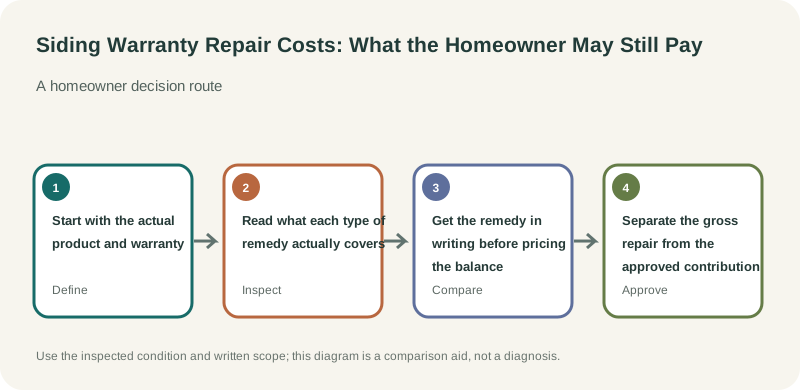
Read what each type of remedy actually covers
| Written remedy | Costs that may still be outside it | What to confirm |
|---|---|---|
| Replacement siding or accessories | Freight, removal, disposal, installation labor, trim, access, and finish blending | Product, quantity, delivery, usable profile, and which elevations are included |
| A cash payment or prorated allowance | Any part of the quote above the authorized amount, plus separately scoped work | Calculation basis, cap, payment timing, and whether the amount is credited to this job |
| Repair or refinishing at the manufacturer’s option | Access, preparation, substrate correction, or restoration outside the stated remedy | Approved method, authorized contractor, work boundary, and final appearance expectations |
These labels describe different kinds of contribution; none should be treated as payment for the whole project unless the written authorization says so. If the remedy requires inspection, documentation, or approval before work, do not budget against a maximum or a possible future credit. Confirm the required sequence and any deadline with the manufacturer before authorizing ordinary repairs.
Get the remedy in writing before pricing the balance
A contractor’s diagnosis and the manufacturer’s coverage decision answer different questions. The contractor describes the physical work. The manufacturer decides whether the warranty applies and what remedy its terms provide. Before authorizing ordinary repair work, request a written decision that identifies the covered product or defect, approved material or payment, applicable proration or cap, and any conditions the owner must satisfy. Keep the assessment and the exact warranty document with the estimate.
If there is an immediate exposure concern, ask a qualified contractor about temporary protection and document the condition before materials are disturbed when that can be done safely. Do not assume that emergency work, testing, removal, or temporary covering will be reimbursed. Ask the manufacturer how urgent protection should be handled and save receipts and photographs; a coverage decision remains governed by the written terms and authorization.
Separate the gross repair from the approved contribution
Ask for an itemized quote even when the manufacturer has agreed to provide material. The quote should show the areas and quantity, siding product and profile, removal and disposal, labor, trim and accessory work, wall or substrate correction, access equipment, finish work, cleanup, taxes, and any allowance for hidden conditions. Mark each line as included in the approved remedy, paid by another party, or still the homeowner’s responsibility.
Use the following calculation only after the remedy is confirmed:
Expected homeowner balance = the agreed project amount − the confirmed cash payment or usable credit, plus separately approved work and charges that remain outside that amount.
For example, suppose a contractor’s written repair quote is $6,800 and the manufacturer has confirmed a $1,500 cash payment that will be credited to the same work. The expected balance is $5,300 before any separately charged tax, change order, or other excluded work. Those figures are invented to explain the arithmetic; they are not a typical siding repair price or warranty outcome. If the remedy is replacement material rather than cash, do not subtract a retail sticker value unless the material is available, the contractor can use it, and the credit or supply arrangement is documented.
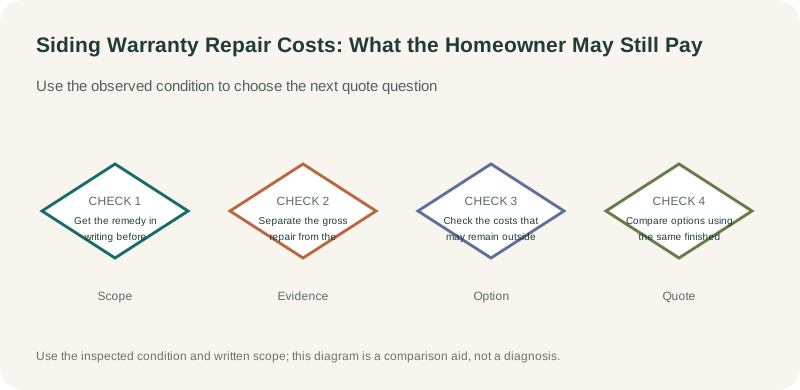
Check the costs that may remain outside the remedy
A product allowance may not include the labor needed to remove damaged siding and install the replacement. Confirm whether it covers delivery, trim and matching accessories, disposal, fasteners, weather barrier work, and painting or factory-finish restoration. A remedy for boards on one elevation may leave adjacent material visibly different after years of sun and weather exposure.
Access and restoration can be substantial parts of the job. A second story, roofline, tight side yard, landscaping, or attached deck may require staging or protection. Removing panels may reveal sheathing, flashing, framing, or a water-management condition that the siding warranty does not resolve. Ask the contractor to price the base repair separately from any concealed-condition work and to document the change-order process before opening the wall.
Workmanship coverage is a separate question. If an installation defect is suspected, identify the installer and its written workmanship terms rather than treating a manufacturer product warranty as a substitute. If the installer and manufacturer disagree about cause, keep each position in writing. A warranty decision also does not decide insurance coverage, association responsibility, or a legal dispute; those questions have different documents and decision-makers. A product’s advertised term is not a promise that every repair cost will be paid, and a listed remedy is not an independent estimate of what the physical work costs.
For a Canadian property, verify that the exact warranty applies in the province and territory and to the relevant purchase date; a U.S. warranty document or U.S. term should not be converted into a Canadian coverage assumption. Even a warranty sold across both countries may have a stated geographic exception. Use the applicable local document and obtain written confirmation for the actual claim.
Compare options using the same finished result
Compare an authorized repair with a larger replacement option only after the repair boundary and remedy are clear. The repair proposal should state which elevations and accessories will match and what appearance is accepted. The replacement alternative should use the same wall area and include removal, disposal, trim, access, and any wall work that both options need. This helps show whether a larger project buys a materially different result or simply adds work that the covered repair does not require.
Timing can affect the choice. A narrow repair may preserve sound cladding, but a discontinued profile or unavailable color may make a consistent match difficult. A larger project may reduce repeated mobilization or repair a wider failing area, yet it can also add demolition, finish, and restoration costs. Ask the contractor to identify the product availability, appearance tradeoff, and price for each boundary. Do not use a long warranty term by itself to predict remaining service life or a future repair cost.
Keep a claim and closeout file
Retain the warranty, product label, original invoice, photographs, inspection notes, written coverage decision, contractor estimate, approvals, change orders, payment records, and final product information. Record what was replaced and which areas were not inspected. If a future repair or sale raises a question, those records help distinguish a covered product remedy from work paid for by the homeowner.
The useful planning number is your written quote minus a remedy that is actually approved and usable, not a generic estimate of what warranties usually pay. For the physical work itself, continue to the material-specific siding repair or replacement guide that matches the affected wall.