
Leaving old siding in place can reduce tear-off and disposal, but an overcladding proposal is not automatically the lower-cost or lower-risk project. The existing wall, the new product, and the details around openings must be compatible.
What tear-off buys you
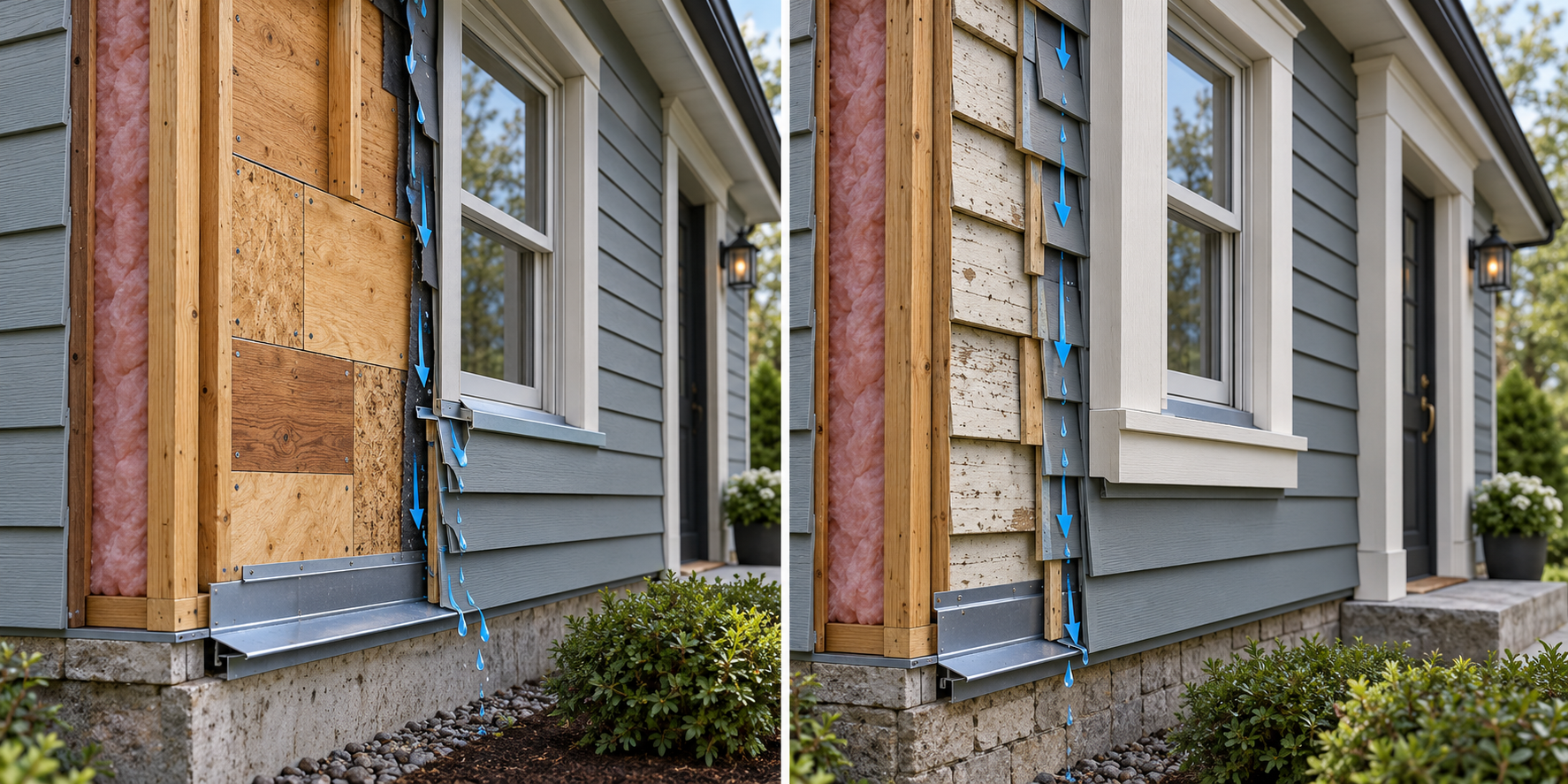
Removing cladding exposes more of the wall for inspection. A contractor may identify failed flashing, wet sheathing, rot, missing drainage layers, or poorly detailed windows before the new finish hides them. Those conditions are possibilities, not automatic findings.
Tear-off adds labor, disposal, temporary protection, and sometimes replacement of trim or accessories. Ask whether concealed repairs are priced by unit rate, allowance, or a separate authorization.
What overcladding changes
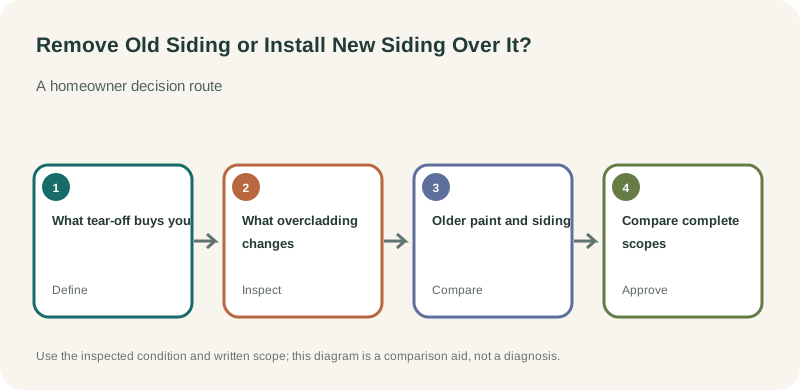
An approved system may be designed over a particular substrate, but no material can be assumed compatible with every existing siding. Added thickness can affect window and door jambs, sill and head flashing, corners, vents, penetrations, trim, and roof-edge transitions. A wall that is not flat or is already holding moisture may be a poor candidate.
Request the exact product and its current installation details. Do not rely on a generic statement that siding can go over siding.
Older paint and siding
In U.S. pre-1978 target housing, EPA says paid renovation can remain subject to the RRP Rule when newer siding was installed over older lead-painted siding unless the affected components are documented lead-free through an accepted qualified process. This is a federal U.S. context, not Canadian law.
Health Canada and Government of Canada guidance also make older Canadian paint and suspect asbestos-containing siding screening relevant to renovation planning. That guidance does not identify a particular property or establish one province-wide work method. Arrange qualified assessment and confirm local requirements before disturbing suspect material.
Compare complete scopes
Ask both options to state inspection access, removal, disposal, wall preparation, flashing, drainage layers, transitions, trim, hazard screening, permits, and change-order rules. Choose overcladding only when the complete system and details are suitable.
Conditions that decide whether an overlay is viable
An overlay is not simply a cheaper version of replacement. The installer needs to know whether the existing surface is flat, secure, dry, and suitable for the proposed attachment, and whether added thickness will interfere with windows, doors, roof edges, utility equipment, or required clearances. Buckling, loose panels, wet materials, soft sheathing, or repeated leakage are reasons to investigate the wall before covering it. A visually intact face does not prove that the layers behind it are sound.
Ask the bidder to identify the existing cladding and any known layers, explain how attachment will reach adequate backing, and show how trim and openings will be extended or reflashed. Request a written list of concealed conditions that would stop the overlay and require removal. If the contractor cannot establish what the new fasteners will engage or how water will drain at the altered details, the lower initial quote leaves an important assembly question unanswered.
Compare lifecycle and future access
Tear-off exposes more of the wall and can make it easier to inspect sheathing and correct transitions. That visibility has value when moisture history is uncertain, but opening the wall can reveal repairs beyond the original estimate. An overlay avoids some demolition and disposal, yet it may hide defects and can complicate a future repair or replacement. It also changes wall thickness and may require moving fixtures and extending trim.
Ask how either option affects future access to wiring, hose connections, meter equipment, and penetrations. Ask whether the existing layers remain documented and whether the new work can be repaired without removing a larger area later. These questions help distinguish a deliberate overlay on a suitable wall from concealment chosen only because the initial price is lower.
Check age and material hazards before disturbance
Older painted or installed materials can require a hazard assessment before cutting, sanding, or demolition. Requirements depend on the material, building age, jurisdiction, and work method. Do not infer that an overlay eliminates the need to identify or manage a hazard; penetrations and future maintenance may still disturb the old layer. Include assessment and any required controls as separately priced scope, and use the applicable local authority or qualified professional for the determination.
Check how new thickness changes the details
Adding a layer changes the depth at windows, doors, corners, roof edges, and utility blocks. Ask for a detail or site measurement that shows how trim extensions, sill projections, flashing laps, and accessory blocks will be handled. If fixtures remain in place, confirm that the finished assembly will not leave awkward gaps or interfere with service access. A proposal should identify work requiring an electrician, utility provider, or other trade rather than assuming siding installers can move every connection.
Also ask how the overlay affects the wall’s ability to dry and drain. The answer depends on the existing layers, climate, exposure, and proposed assembly; no single overlay rule fits every wall. If prior leaks or trapped moisture exist, obtain a qualified assessment before covering the surface. Keep whole-wall insulation or moisture redesign in the relevant envelope scope.
Consider the next replacement
An overlay can make a later tear-off more complicated because future contractors must remove additional layers and rediscover the concealed wall condition. Keep photographs and notes of the existing construction, repair locations, and attachment method before the new work hides them. Ask whether the added layer will affect future access to meters, wiring, or vent terminations and how it is recorded for maintenance.
Compare initial savings against the added preparation or demolition that may be required later. The estimate should describe the selected installation and any stated future limitation without claiming a precise future cost that cannot be known today.
Ask for the evidence behind either recommendation
A contractor favoring tear-off should identify what needs to be exposed or corrected: known moisture damage, poor attachment, incompatible layers, or details that cannot be integrated through the new thickness. A contractor favoring overcladding should describe how the existing wall was found to be sound and how the new work will be attached and drained. Ask for photographs, measurements, and product instructions that support the proposed option. Neither method should be selected from a price difference alone.
If uncertainty remains, price a limited exploratory opening before committing to a whole-house approach. The test should be placed where it can answer a real question, then restored or incorporated into the final work. Agree what finding would change the decision and how the next stage would be priced. A small investigation fee may prevent a much larger hidden-condition disagreement once the entire project begins.
Keep a record of the number of existing layers, attachment method, repairs, and transitions before they are covered. That documentation reduces uncertainty for future siding work and makes the current quote more useful to later owners.