
Cladding maintenance is a recurring ownership cost: inspection, cleaning, finish work, sealant renewal, small repairs, and access. Frequency depends on the assembly, material, coating, exposure, and local conditions.
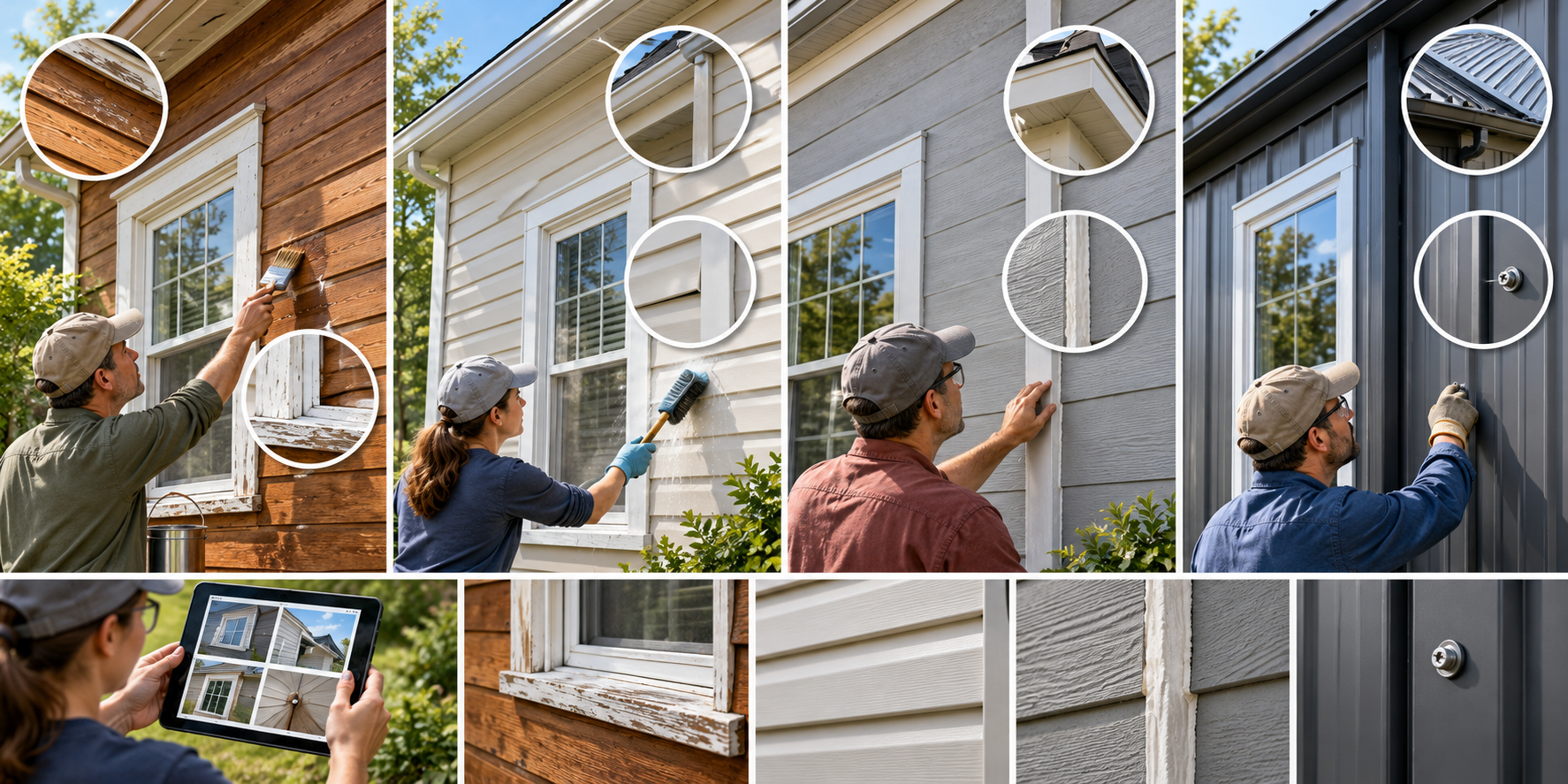
| Material | Recurring work to consider |
|---|---|
| Wood | Inspection, gentle cleaning, repainting or staining, and board or trim repair. |
| Vinyl | Cleaning, inspection, and panel or trim replacement. |
| Fiber cement | Inspection, cleaning, finish renewal, board repair, and product-specific detailing. |
| Metal | Cleaning, coating and fastener review, dent or corrosion repair. |
| Stucco or EIFS | Joint and crack review, finish renewal, sealant, and moisture investigation. |
| Masonry | Gentle cleaning, inspection, repointing, and selected sealant work. |
BC Housing cautions that inappropriate pressure washing can damage cladding, sealants, mortar, and hidden wall components. Follow material and manufacturer care instructions.
Cleaning can expose damage but does not cure a water path. Recoating renews a finish but should not be relied on to repair a significant crack. Sealant is not a substitute for flashing or drainage.
The evidence does not provide a dependable Canadian maintenance price list or universal U.S. schedule. Budget by task and use local quotes. When maintenance becomes repeated repair, compare accumulated access and finish costs with replacement.
Build a maintenance plan from product instructions
Ask for the current care instructions for the installed product and keep the manufacturer, profile, finish, and color information with home records. Cleaning methods that are suitable for one material or coating may damage another. Avoid assuming that aggressive washing, strong chemicals, or a generic sealant is safe. The maintenance plan should describe inspection frequency, safe access, compatible cleaning, and the conditions that call for professional repair, while following product guidance and local safety practice.
Inspect the whole wall rather than only the field material. Pay attention to roof and deck intersections, window and door trim, penetrations, corner joints, ground clearance, and places where sprinklers or roof runoff keep the surface wet. Record changes with photos from consistent viewpoints. A new stain, open joint, loose panel, or recurring crack can be more useful as an early diagnostic clue than as a reason to apply caulk immediately.
Budget for small work and eventual renewal
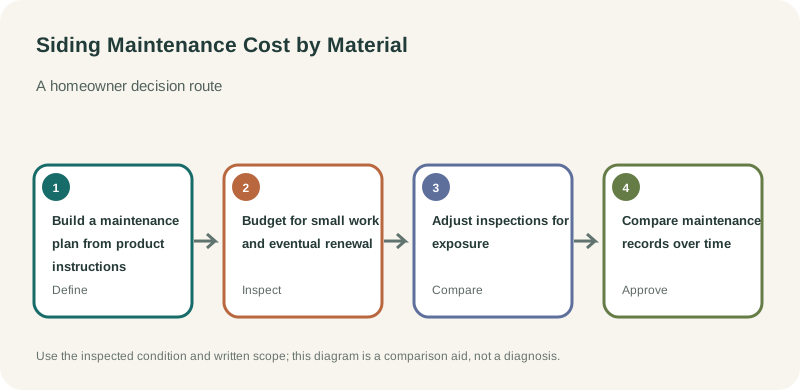
Separate predictable care from uncertain repairs. Cleaning or planned coating work may be schedulable; hidden rot, storm damage, or water-entry investigation is less predictable and should not be represented as a fixed annual expense. Retain invoices and note what area was repaired so future contractors can tell whether symptoms have returned. For wood and coated surfaces, track finish condition and manufacturer-recommended renewal rather than using a single lifespan estimate for every exposure.
When repair costs recur, compare the accumulated work with a larger section replacement and ask whether the same detail is failing. Materials that differ in repainting, cleaning, and patch matching also differ in how maintenance is carried out, not just how often it occurs. A useful ownership comparison describes tasks and access requirements alongside any quoted service price.
Adjust inspections for exposure
A wall under a deep overhang has different wetting and sun exposure from a wind-driven corner or a wall beneath a leaking gutter. Tailor inspection to the home’s conditions: check the areas affected by runoff, sprinkler spray, tree contact, ground splash, strong sun, and freeze-thaw exposure. Look for changes in joints, finish, panel movement, soft trim, and staining. A ground-level visual check cannot verify concealed layers or safely replace roof access by a qualified professional.
Ask a contractor to distinguish maintenance from corrective work. Cleaning, repainting, replacing a cracked panel, and repairing a leaking flashing detail should be separately described. If a maintenance plan recommends frequent caulking, ask what specific joints are being treated and whether they are designed to be sealed. Blanket sealing can interfere with drainage paths.
Compare maintenance records over time
Keep a simple log of date, elevation, product, work completed, photos, and cost. This helps reveal whether the same corner or opening repeatedly needs service and makes future bids more accurate. When considering a material change, compare the actual maintenance tasks and access costs from the current wall with the care instructions for the proposed product. A single annual allowance hides the difference between predictable finish care and unexpected hidden repairs.
Build a reserve without pretending costs are predictable
A useful reserve separates planned finish care from uncertain repairs. List recurring tasks supported by product instructions, such as inspections, cleaning, or coating renewal, then keep a separate contingency for storm damage, concealed moisture, and access equipment. The latter varies by house and cannot be predicted as a fixed annual amount from a material label. Review invoices every few years to see whether the actual experience supports changing the reserve.
Ask contractors to identify whether a maintenance recommendation is required by the product maker, a warranty condition, or the contractor’s preference. Record the distinction. A routine service contract may simplify scheduling but should specify the inspections and work included, exclusions, cancellation terms, and whether repair findings lead to separately priced work.
Know when maintenance has become replacement planning
Repeatedly repairing the same elevation, unavailable matching parts, and widespread finish failure are reasons to request a replacement comparison. They are not automatic proof that replacement is necessary. Ask for a condition map and compare the cost of correcting only failed areas with a complete system proposal. Keep unrelated roof, gutter, and opening work separate unless it is needed to make the cladding detail function.