
The cheapest siding quote is not necessarily the cheapest exterior decision. Compare the installed system, preparation, maintenance, repairability, and likely follow-on work—not just the price of the visible boards or panels.
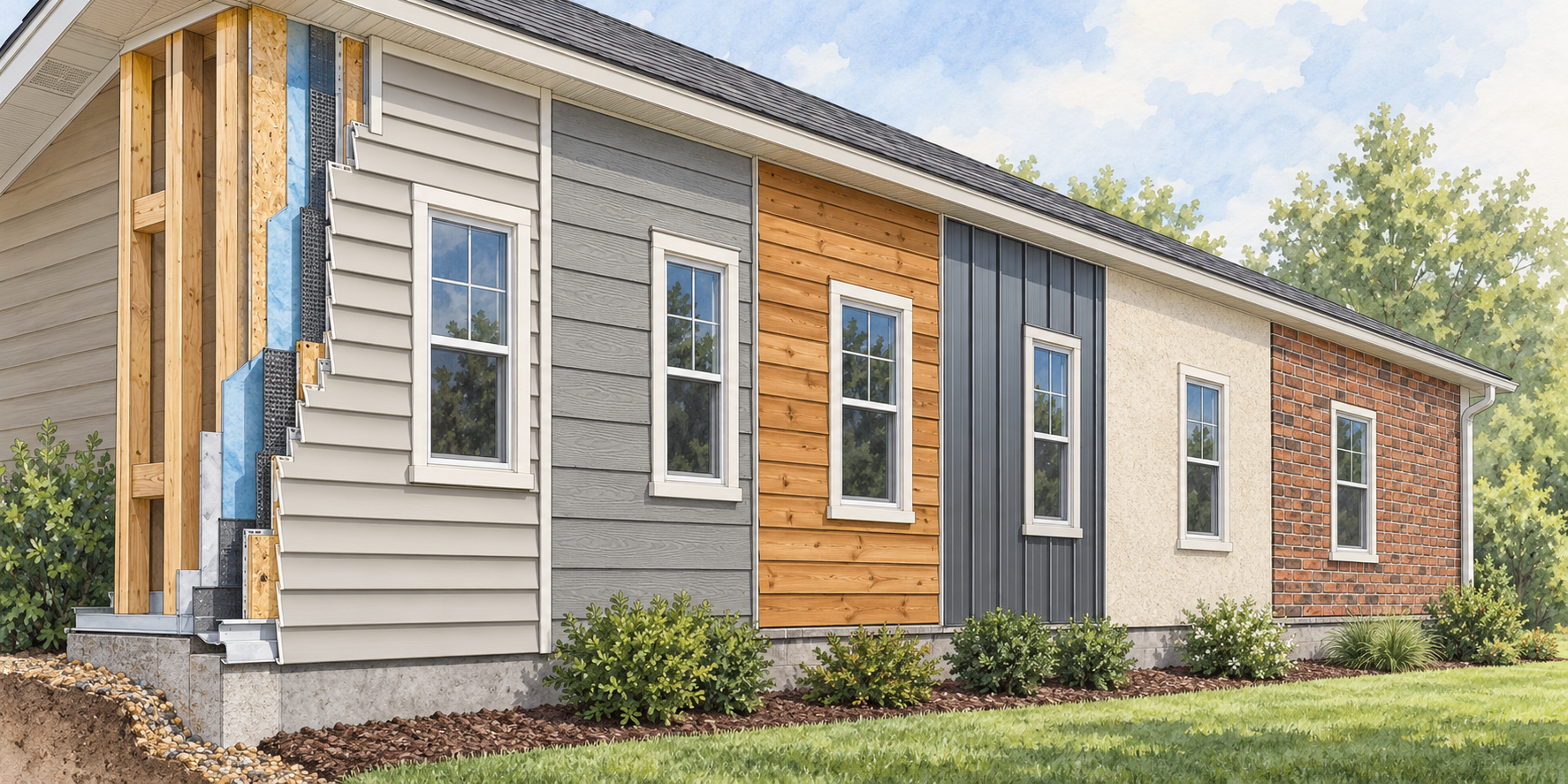
A directional U.S. cost reference
A 2026 specialist U.S. market comparison reports total siding replacement at roughly $8,000 to $30,000 nationally, with a $19,000 average and a 2,000-square-foot example averaging $12,252 for vinyl. Its illustrative installed material examples range from $6.13 per square foot for vinyl to $20 per square foot for brick veneer. The source uses its own measurement and estimating basis, so these figures are comparison signals, not bids and not Canadian prices.
| Material | Typical economic pattern | Quote questions |
|---|---|---|
| Vinyl | Often lower material and labor cost; individual panels can be replaceable, but aged colors can be hard to match. | Are tear-off, accessories, insulation, and replacement of damaged sheathing included? |
| Fiber cement | Material handling, cutting, trim, finishing, and skilled installation can increase labor. | Which product and installation documents govern clearances, flashing, and fastening? |
| Natural wood | Species, grade, profile, waste, finishing, and future repainting or staining shape the total. | Is priming, finishing, and repair of the substrate included? |
| Engineered wood | Product families differ; panel, profile, coating, and manufacturer requirements matter. | What exact product is being quoted, and what care requirements apply? |
| Aluminum or steel | Metal quality, coating, profile, corrosion exposure, trim, and dent repairability change the economics. | How will aged finish, fasteners, and exposed edges be handled? |
| Stucco or EIFS | Removal, lath or drainage layers, openings, texture matching, and moisture investigation can dominate. | Is this traditional stucco or a synthetic system, and what is behind it? |
| Brick or stone veneer | Labor, support, corners, openings, flashing, and drainage details make installation intensive; replacement matching can be difficult. | Is the quote for a drained veneer system, and who owns flashing and weeps? |
What the material price leaves out
Exterior cladding sits in front of a water-management system. A drainage plane or water-resistive barrier should connect with flashing around windows, doors, and penetrations. Stucco and non-structural masonry may need an additional drainage or bond-break layer. If tear-off reveals failed flashing, wet sheathing, rot, or framing damage, the repair belongs in a separate allowance rather than being hidden inside a vague “wall preparation” line.
Height, corners, gables, dormers, narrow side yards, scaffolding, lifts, and landscaping protection affect labor. So do disposal, replacement of trim, vents, shutters, house numbers, light fixtures, and penetrations. Ask whether the quote measures exterior wall area or uses floor area as a shortcut; the two are not interchangeable.
Maintenance and repairability
Vinyl is usually cleaned rather than repainted. Wood depends more heavily on its finish and exposure. Fiber cement and stucco may require recoating, but a new coating is not a substitute for repairing a significant crack or water path. Masonry can be durable yet expensive to replace, while a more easily patched material may show a visible mismatch after years of weathering.
Climate changes the decision without producing one universally best material. Rain, freeze-thaw cycles, wind, sun, coastal exposure, and local workmanship affect performance and maintenance. Compare the likely maintenance tasks and the cost of future access, not a universal service-life promise.
Questions before selecting a material
- What wall area, openings, stories, and access conditions were measured?
- Does the price include removal, disposal, trim, flashing, and wall preparation?
- What hidden conditions trigger an allowance or change order?
- Which manufacturer documents and local requirements apply?
- What maintenance and repainting will the material need?
- Is the Canadian quote based on local pricing, or was a U.S. number merely converted?
If the wall assembly itself is failing, a building-envelope assessment may be more useful than choosing a new finish first. For a whole-project quote anatomy, see siding replacement cost.
Compare complete assemblies
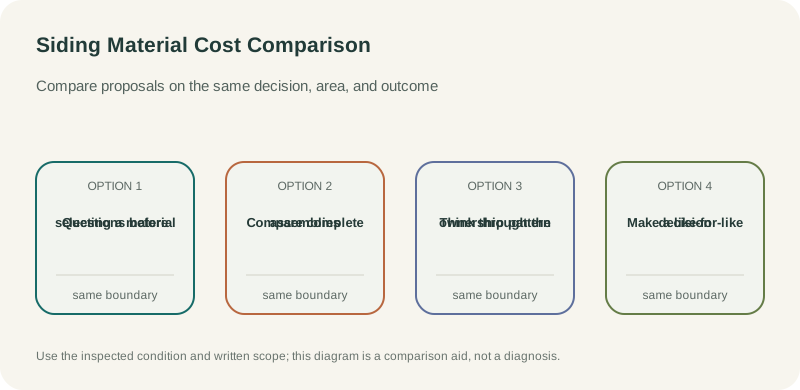
Material prices are easiest to compare when each proposal answers the same project question. A vinyl quote that assumes an accessible one-story elevation and no tear-off is not comparable with a fiber-cement quote that includes removal, new trim, field finishing, and a lift. Before comparing totals, align the measured elevations, openings, removal, disposal, accessories, flashing transitions, wall preparation, finish work, protection, and cleanup. Ask each bidder to identify exclusions and the rule for authorizing hidden repairs.
The wall system matters as much as the visible product. Some projects involve a drainage plane, flashing at openings, a drainage or bond-break layer, support, or other details behind the finish. Those are not interchangeable across siding, stucco, EIFS, and masonry. If a bidder describes a product as “maintenance-free” or says an overlay will solve moisture, ask which product and wall assembly that statement applies to and what inspection supports it.
An allowance can make a quote more honest when the wall cannot be assessed until removal. It should still say what condition triggers the allowance, how the work will be priced, and whether the owner receives photographs or approval before the scope expands. A vague contingency may hide uncertainty rather than make it manageable.
Think through the ownership pattern
The lowest initial quote can lead to a different ownership pattern than a higher one. Compare the work needed to keep the material presentable, how a small repair is made, whether an aged finish can be matched, and whether future access will require the same staging as installation. A material that is economical to patch may be harder to blend after years of sun. A material with a more involved installation may still fit a homeowner who values its appearance or wants to avoid a recurring finish task.
These are not lifespan guarantees. A coating, exposure, installation detail, or concealed water path can change the maintenance picture. The useful question is not “Which material lasts longest?” in isolation. Ask what the quoted product requires on this wall, who will perform that upkeep, and what it will cost to reach the surface again.
When one finish requires broader removal or substrate correction, compare that complete scope with a repair or another material only after defining the condition each option would leave behind. A new face over an unresolved water path can preserve the visible problem while adding another layer to investigate later.
Make a like-for-like decision
For each bid, record:
- the product, profile, finish, and manufacturer documents that define it;
- the elevation and quantity being priced;
- tear-off, disposal, accessories, and trim;
- water-management transitions and who completes them;
- the stated treatment of wet or damaged substrate;
- access, protection, taxes, cleanup, and change-order terms;
- the maintenance and repair assumptions that matter to you.
Then compare options against the same priorities: upfront budget, disruption, maintenance, repairability, appearance, and the ability to inspect the wall. If a technical issue such as recurring wetting, incompatible layers, or structural movement dominates the quote, resolve that scope before choosing a finish. The right comparison can end with different materials on different homes because the wall condition, exposure, local skill, and homeowner priorities differ.
Turn a material comparison into a project comparison
A useful comparison starts with one house and one defined scope. Give every bidder the same measured wall area, number of stories, openings, corners, trim, and access constraints. Then ask each to price the same finish level and to state whether the figure includes removal, disposal, water-resistive barrier repairs, flashing, furring or a drainage space, starter and finish accessories, and touch-up. A material-only price cannot answer which installed assembly is less expensive.
Compare at least two versions of the same project when an option changes the wall preparation. For example, a replacement over sound, compatible backing is a different scope from tear-off with sheathing replacement allowances. Keep those alternatives on separate lines; otherwise a lower bid may simply omit work another bidder has included. The same rule applies to painting: preparation and coating are comparable only when the substrate condition and preparation standard match.
Match maintenance expectations to the house
Ask what routine care looks like in the home’s actual exposure. A shaded wall near sprinklers may stay damp and collect growth; an exposed south or west wall may fade or show heat-related movement. These conditions do not produce a universal material ranking, but they change how often cleaning, finish work, or localized repairs may be needed. Ask manufacturers for current care instructions and confirm that proposed cleaners, coatings, and replacement parts are compatible with the chosen product.
Repairability also has a practical side. Keep product, color, profile, and installation records, and ask whether replacement pieces are readily available locally. A nominally durable finish can still be expensive to maintain if a small impact requires replacing a large visible section for a consistent appearance. Conversely, an easy-to-patch surface may need more frequent finishing. Treat future repair access and visual matching as ownership considerations, not as guaranteed savings.
Use a short decision record
Write down the priorities that matter most: initial installed cost, expected maintenance, appearance, fire or impact performance where verified, compatibility with the wall, and tolerance for visible patching. Eliminate options that cannot be installed over the existing assembly safely or with documented system details. For the remaining options, compare complete written scopes and the care commitments you are willing to keep. This avoids choosing from broad material labels when product, wall preparation, workmanship, and local access account for much of the actual project difference.
Test assumptions with written options
A homeowner can ask for one base proposal using a clearly specified product and a second proposal that changes only one material or finish choice. Keep wall preparation, trim, access, demolition, and contractor assumptions the same. If several variables change together, the price difference cannot be attributed to a particular material. Request the expected material quantity, waste, labor, and accessory package for each option; those details help identify whether a low figure reflects a different system or an incomplete takeoff.
Consider three practical service cases rather than a single promised lifespan: routine cleaning and finish care; a localized impact or water repair; and a larger section replacement when a component is discontinued or repeated defects appear. Ask for the product’s maintenance instructions and examples of available replacement pieces. The evidence does not establish reliable future repair costs for every material, so describe likely tasks and uncertainty without converting them into a false lifetime-cost ranking.
Use a decision matrix that reflects your priorities
Before selecting, rank appearance, installed price, maintenance effort, repairability, and disruption. Then record any must-haves, such as matching an existing trim profile or completing work without disturbing a porch. An option that wins only on initial price may not fit a homeowner who prioritizes easy patching; a premium finish may not justify its cost if future maintenance is unacceptable. Review the same priorities with every bidder so the final choice follows the household’s actual tradeoffs.