
Stucco replacement can mean a new traditional cementitious finish, removal and reconstruction of a wall-facing system, or a repair described too broadly. Identify the system before comparing prices.

Traditional stucco and EIFS are different systems. EIFS has its own components, drainage approach, joint details, and manufacturer requirements. Do not combine their cost or repair assumptions.
A substantial stucco project may include removal, disposal, lath or reinforcement, water-resistive layers, bond-break or drainage details, substrate repair, openings and flashing, trim, scaffolding, texture, color, and finish. Building-science guidance identifies drainage planes behind cladding and an additional drainage layer behind stucco and non-structural masonry.
Homewyse’s May 2026 U.S.-oriented model gives $10.69–$17.33 per square foot for basic conventional three-coat stucco installation under favorable conditions. Its example includes building paper, metal lath, and scratch, brown, and finish coats; it does not price EIFS, every removal and retrofit condition, or hidden wall repair. Treat it as one source-specific installation model, not a complete replacement budget or Canadian benchmark. Obtain a local quote with a defined system, wall area, removal scope, and concealed-condition allowance.
Ask whether the proposal is finish renewal, localized repair, recoat, full removal, or wall reconstruction. Confirm drainage, flashing, trim, access, cleanup, permits, and change-order terms. If enclosure failure dominates, use the appropriate building-envelope scope.
Establish the wall system before comparing bids
A stucco proposal should state whether the work is traditional cement plaster, a manufactured finish over a named base system, or another assembly. Ask what layers are included: supporting substrate, water-resistive barrier, drainage provisions where applicable, lath or reinforcing, base coats, finish, control joints, and trim. The product and assembly details matter because “stucco” is not one interchangeable installation, and a finish-only recoat is not equivalent to removing and rebuilding the wall system.
Walk openings, deck attachments, roof intersections, corners, utility penetrations, and transitions with the bidder. Ask how each detail sheds water and how the system manufacturer’s or applicable local requirements are addressed. If existing stucco is removed, confirm who inspects the exposed wall, documents sheathing condition, and prices unexpected repairs. If new work covers the old surface, establish how adhesion, soundness, added thickness, and moisture conditions will be evaluated.
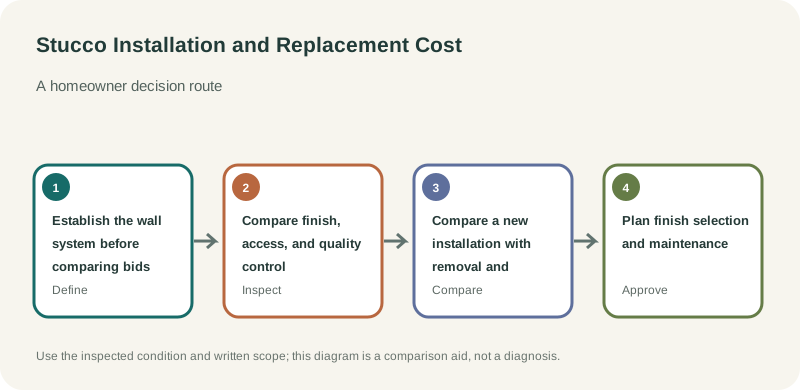
Compare finish, access, and quality control
Finish texture and color can affect labor, sample approval, and the visibility of later repairs. Request a representative sample on the actual substrate and agree when it becomes the reference. Clarify curing and weather limits, protection of windows and paving, scaffold or lift costs, cleanup, and how cold, hot, or wet conditions may affect scheduling. A contract should identify the included surface area and treatment at corners and returns rather than relying on a broad square-foot description alone.
Ask who supervises the work and what inspections or photographs occur before each layer is covered. Keep the product data, mix or finish identification, details, and warranty paperwork. These records will help diagnose future cracking or water concerns and distinguish a finish blemish from a failure that requires broader investigation.
Compare a new installation with removal and replacement
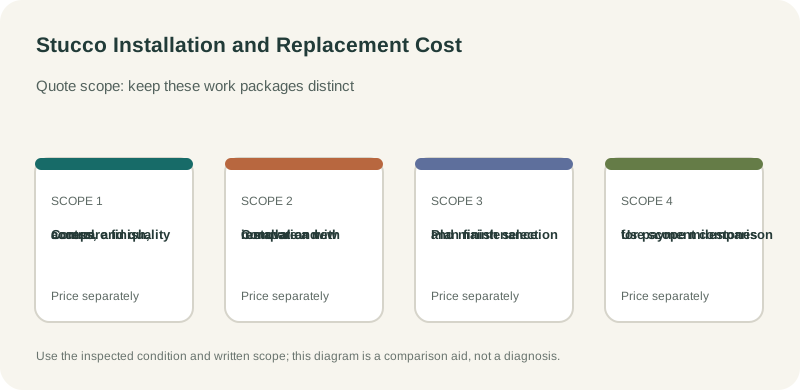
New construction and replacement are not directly comparable. New work may include substrate preparation but not demolition, disposal, temporary weather closure, or repair of an existing wall. A replacement quote should show what layers will be removed, what is retained, and what happens when sheathing or framing is damaged. Ask for those stages in separate lines so an estimate for new stucco is not used as a shortcut for an occupied-home recladding project.
For each option, confirm the finish area, openings, corners, control or movement joints, returns, and transitions. Clarify who supplies and installs flashing and who signs off on the water-management layer before plaster covers it. If another trade prepares the backing, assign responsibility for inspection and correction before the stucco crew arrives.
Plan finish selection and maintenance
Texture and color can look different under changing light and on broad uninterrupted walls. Review a sample at the home and include any approved control-joint layout. Ask how cleaning, future coating, and localized repair will affect the selected finish. Keep extra finish material or batch identification if the manufacturer recommends it. A recoat may change the surface appearance without renewing concealed layers, so make the intended level of work clear in the contract.
Use scope milestones for payment comparison
For a large stucco project, compare not only the total but also the payment milestones and what work is complete at each stage. Tie progress payments to agreed deliverables such as removal, substrate approval, water-management inspection, base layers, and final finish. Ask how the contractor handles a failed inspection or concealed damage before continuing. This helps the homeowner see when a change affects cost and protects against paying for a finish before the underlying layers are accepted.