
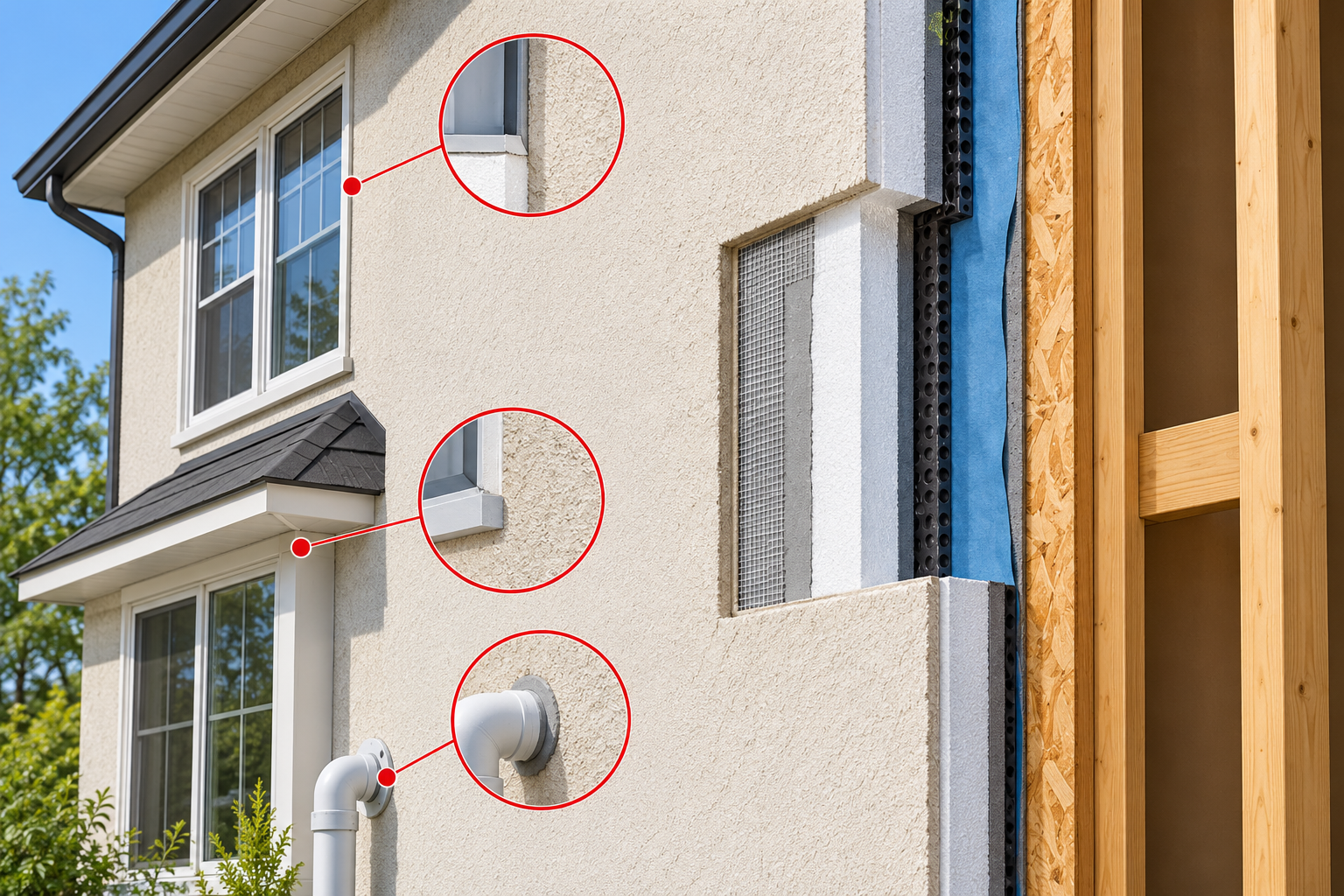
EIFS, or exterior insulation and finish systems, is not simply traditional stucco with a different price. Cost depends on system generation, manufacturer, drainage design, joints, penetrations, impact, and the extent of moisture investigation.
Identify the system
Ask for the product family, installation era, finish, insulation, drainage approach, prior repairs, and available documents. Similar-looking synthetic finishes can have different components and approved methods. Do not accept a generic patch specification when the system is unknown.
A quote may cover sealant-joint renewal, penetration detailing, impact repair, finish blending, localized removal, sheathing or framing repair, testing, drying, and reinstallation. Moisture investigation should be selected by a qualified building-envelope professional; staining does not prove a particular entry path.
Drainage layers and flashing must remain functional. EIFS repair should not become a plan to seal every visible gap.
The evidence provides no reliable national EIFS repair price or Canadian benchmark. The stucco cost signal is not a universal EIFS rate. Ask for a system-specific local quote separating diagnosis, openings, testing, removal, repair, access, and finish matching. If comprehensive wall or mold remediation dominates, use that specialist scope.
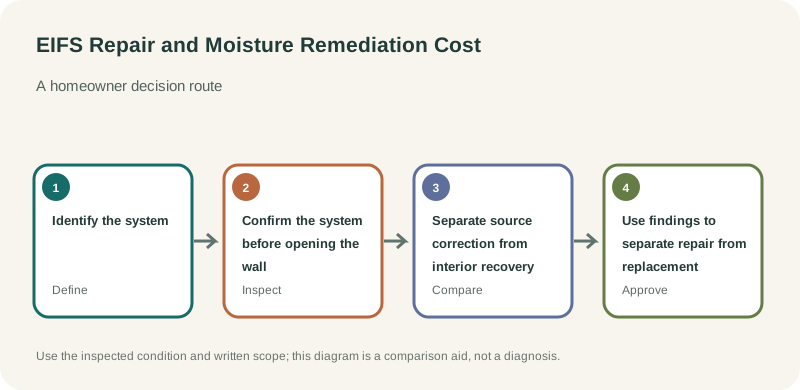
Confirm the system before opening the wall
EIFS describes a family of exterior insulation and finish assemblies, and age, manufacturer, drainage design, and prior repairs can affect how a particular wall should be handled. Ask the contractor to identify the system as far as available records allow and to explain the basis for the proposed repair. Product-specific details should be confirmed through manufacturer documentation or a qualified assessment; a generic patch detail may not suit an older or unidentified assembly.
Moisture investigation and finish repair are separate scopes. Ask what observations prompted the investigation, which locations will be tested or opened, what access is required, and whether the price includes restoration of the test area. A moisture reading or stain by itself does not define the source or affected area. The contractor should explain how findings will be recorded and how you will approve any expanded opening or remediation before work proceeds.
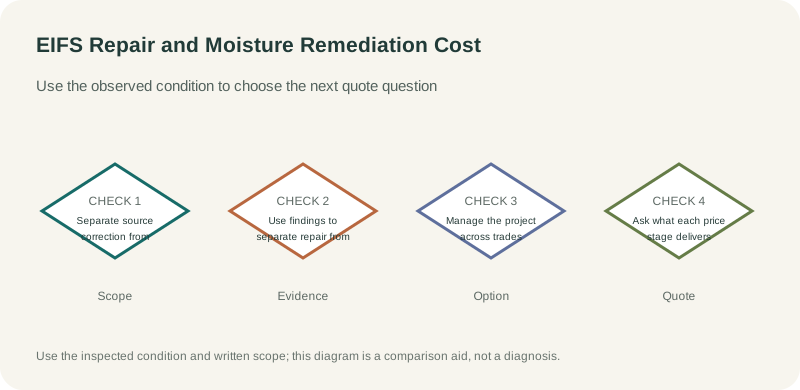
Separate source correction from interior recovery
Water may enter through an opening, roof intersection, penetration, joint, or another part of the wall. The quote should identify the suspected entry path and state whether the proposed work corrects that detail or only replaces damaged finish. If insulation, sheathing, framing, or interior materials are affected, clarify which trades handle drying, removal, replacement, and verification. Broad envelope diagnosis and remediation may require a separate building-science or restoration scope rather than an EIFS patch estimate.
Ask for a repair detail, compatible materials, finish-matching plan, and photographs of concealed work. Compare bids only when they investigate similar areas and include the same testing and restoration boundaries. Because product and wall conditions vary, the available evidence does not support a universal installed cost range or one repair method for every EIFS building.
Use findings to separate repair from replacement
Once a test opening or inspection is complete, ask for a simple location map that distinguishes dry and apparently sound areas from areas requiring repair. The report should state what was observed directly, what remains concealed, and whether the proposed repair follows a verified system detail. If only a limited patch is justified, define its finish boundary and how it will blend. If damage is broad, request an alternate scope that addresses the affected wall area without assuming the entire building needs a new system.
Ask whether the quote includes removal of wet materials, disposal, drying time, replacement insulation or sheathing, compatible drainage details, and finish restoration. A remediation estimate may exclude interior materials or contents. Establish who verifies that the wall is ready to close and what documentation is delivered before new layers cover the opening.
Manage the project across trades
EIFS repair may involve the cladding contractor, window or roof trades, and an interior restoration team. Identify who owns each interface and who checks that one trade does not undo another’s work. If a window, deck ledger, roof edge, or pipe penetration is implicated, price its correction separately. A single line for “EIFS repair” is not enough when the source lies at a different component.
Keep the investigation record, system identification, test locations, photographs, repair detail, and product data together. This information limits repeated exploratory openings if the problem returns and gives future contractors a basis to match materials.
Ask what each price stage delivers
A useful estimate may have three stages: initial inspection and system identification, targeted opening or testing, and repair or restoration after findings. Request a deliverable for each stage, such as a location map, photos, moisture observations, or a written repair detail. Ask whether testing fees are credited toward construction and whether any opening can remain temporary while a specialist reviews findings. This makes the cost of uncertainty visible before a large remediation scope is authorized.
Compare proposals on the same locations and test methods. One contractor may price only a patch while another includes interior removal and wall replacement. Ask each to state what it excludes, especially drying, environmental testing, framing review, window or roof work, and interior finishes. Broader remediation costs should not be hidden inside an undefined exterior repair allowance.
Decide when to involve another specialist
If moisture is widespread, the source is unclear, or the repair crosses several building systems, ask whether a building-envelope professional or restoration specialist should define the scope before construction. This may add diagnostic cost but can reduce repeated openings and competing contractor recommendations. The decision is project-specific and should be based on the evidence found, not the assumption that every EIFS repair needs a full building investigation.
Evaluate proposals by what they can establish
A visual inspection may identify obvious cracking, impact, or sealant failure but cannot necessarily confirm concealed moisture extent. A test opening can provide direct evidence at one location without proving every wall is sound. Ask the contractor to say what each step can and cannot establish, how many locations will be checked, and whether the results will be reviewed by an independent building-envelope professional when findings are complex. Avoid treating a single meter reading as a full wall diagnosis.
The estimate should identify whether the contractor has experience with the specific EIFS or finish system and how system details will be verified. If manufacturer identification is unavailable, the proposal should state that limitation and explain the basis for compatible repair materials. Do not assume an old detail matches a current product guide or that a generic sealant repair solves a drainage concern.
Compare the resulting repair plans
After diagnosis, request a marked drawing or photo set for each proposed repair area, plus the layers to be removed and restored. Ask for separate quantities for cladding, insulation, sheathing, framing, flashing, interior finishes, and temporary protection. If widespread damage is found, compare a localized repair with a broader wall scope and the reasons for the selected boundary. A transparent staged estimate is more useful than one large remediation allowance with no trigger or documentation.