
Contractors use recoat, resurface, and restucco inconsistently. Define whether the proposal changes only the finish, repairs the system, or removes and rebuilds the wall-facing assembly.
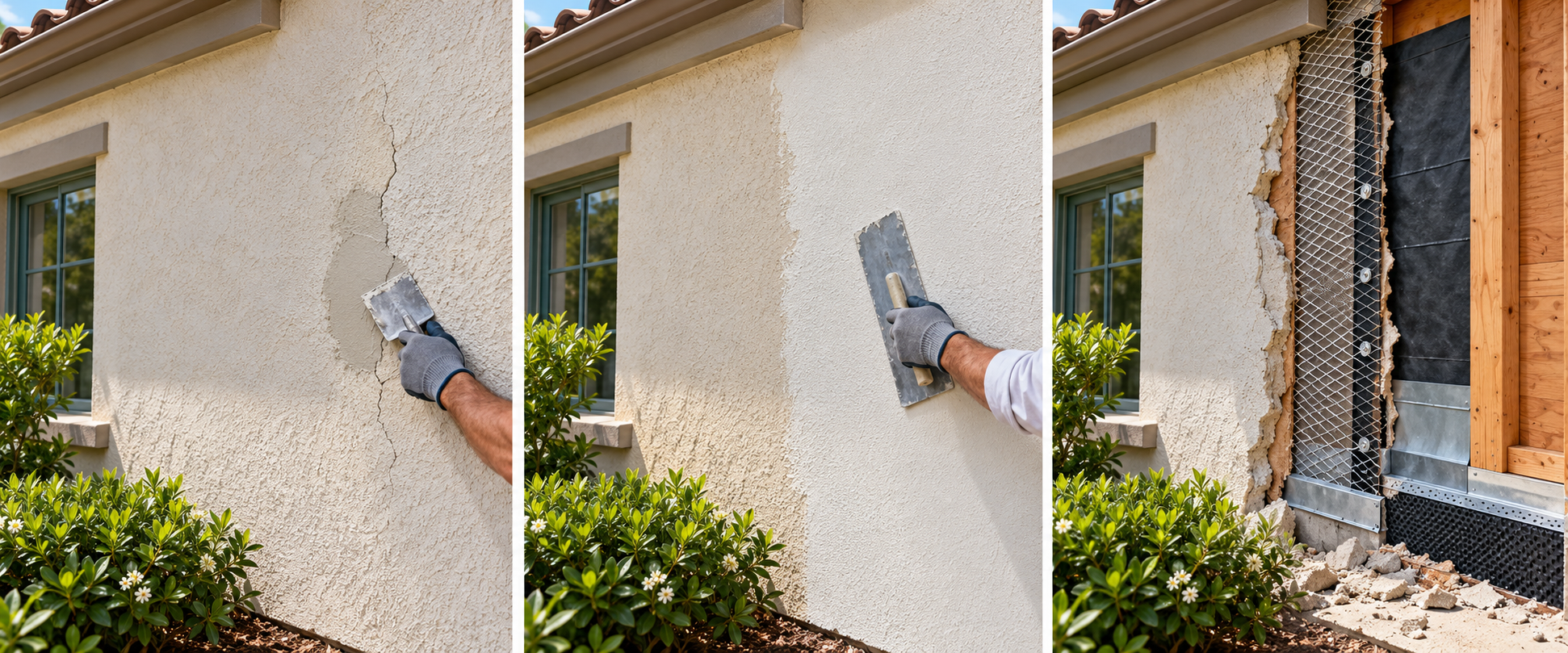
For a narrowly defined U.S. cost signal, Homewyse’s September 2026 model lists $19.75–$23.86 per linear foot for a basic stucco-crack treatment in favorable conditions. The described task fills and blends a crack; it is not a diagnosis that a particular crack is cosmetic or suitable for that work. Do not compare it with a system repair, EIFS remediation, or a full recoat without matching the inspected condition and scope.
Finish problem
Recoating or resurfacing can fit a sound substrate with faded or worn finish. The quote should state cleaning, preparation, compatible coating, texture, color, coats, access, and joint or trim repairs. A new finish is not a universal cure for a significant crack or water entry.
System problem
Delamination, widespread cracking, recurring patches, soft areas, staining, or interior moisture may require investigation beyond the finish. Openings, penetrations, flashing, drainage layers, lath, and substrate can all affect scope. Do not assign a structural cause from a photograph or generic crack-width rule.
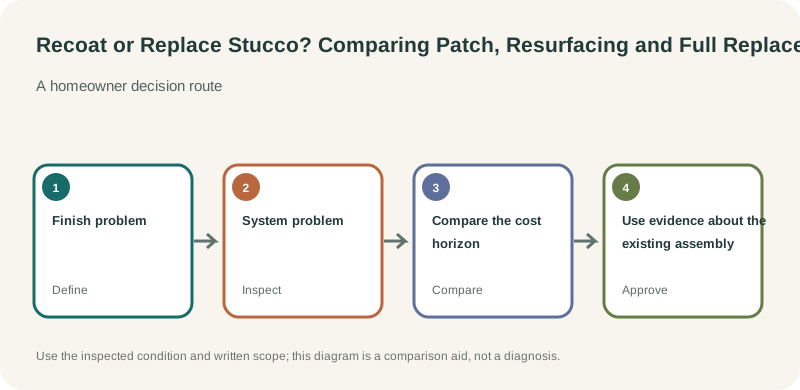
Compare the cost horizon
Request a defined patch option, a recoat option with compatibility stated, and a replacement option showing removal, disposal, drainage, openings, substrate, access, and finish. Compare recurring maintenance and the risk of paying twice if a recoat hides an unresolved defect.
No dependable Canadian benchmark was captured. Use local quotes and choose the least extensive scope that responsibly addresses the actual condition.
Use evidence about the existing assembly
Before choosing a recoat, establish whether the substrate is sound, attached, and dry enough for the proposed system. A finish layer cannot reliably correct loose base coats, recurring water entry, movement, or deteriorated backing. Ask how the contractor will test adhesion, map hollow areas, assess cracks, and check vulnerable transitions. The method should be appropriate for the actual stucco system; if the system type is uncertain or moisture damage is suspected, price investigation before committing to a new finish.
A replacement scope should state whether it removes the finish only or takes the assembly back to the substrate. Those are very different projects. Confirm whether disposal, weather protection, sheathing repairs, water-resistive layers, drainage details, lath, joints, finish, and opening details are included. If the proposal uses allowances, ask what quantities and unit rates apply and how concealed conditions will be documented.
Compare outcomes and disruption
A recoat may be less disruptive and preserve a sound assembly, but it can change thickness and detail transitions. Full replacement allows more of the wall to be inspected but creates demolition, protection, and repair uncertainty. Neither option automatically solves a leak; the source and the proposed correction must be explicit. Ask how each option handles windows, doors, roof edges, decks, and penetrations, especially if those are where symptoms recur.
Compare both bids over the same elevations and finish goal, then consider how much original material remains serviceable and what risk is left after the work. If the evidence for hidden moisture is weak, avoid treating an expensive full replacement as proven necessary. If clear system failures are found, avoid pricing only a cosmetic layer. A staged diagnostic scope can be useful when it resolves a material uncertainty before a large commitment.
Ask for options tied to test findings
If a contractor has not opened or tested the wall, request an initial scope that states what can be determined visually and where uncertainty remains. If limited testing is proposed, agree on locations and what decisions each opening will inform. Then ask for conditional prices: patch and recoat where the system is sound, repair of isolated damaged backing, and broader removal where failure is confirmed. This staged approach can prevent both an unnecessary full replacement and a finish-only project that cannot solve the underlying problem.
Before work, compare the finish area and transitions for each option. Recoating may alter thickness at window returns, trim, and penetrations; full replacement may require resetting those components. Ask for a marked plan that shows how the crew will terminate the work and preserve drainage details.
Set expectations for appearance and documentation
A recoat may reduce the visibility of patches but not erase all color or texture differences. Ask for a sample and agree on acceptable variation. Replacement may allow a more uniform new surface but can expose concealed damage and lengthen the schedule. Photograph the wall before and after, retain the system and finish details, and record any areas intentionally left in place. Those records help a future owner understand whether the assembly was renewed or only refreshed.
Set a decision point before the wall is closed
If replacement is selected, agree on a review point after removal and before new layers are installed. The contractor should document the substrate and water-management details and present any change order at that stage. If the wall is sound, proceed under the agreed base scope; if it is not, compare the priced repair options. This checkpoint makes the choice between recoat and replacement actionable instead of leaving all risk inside a single allowance.