
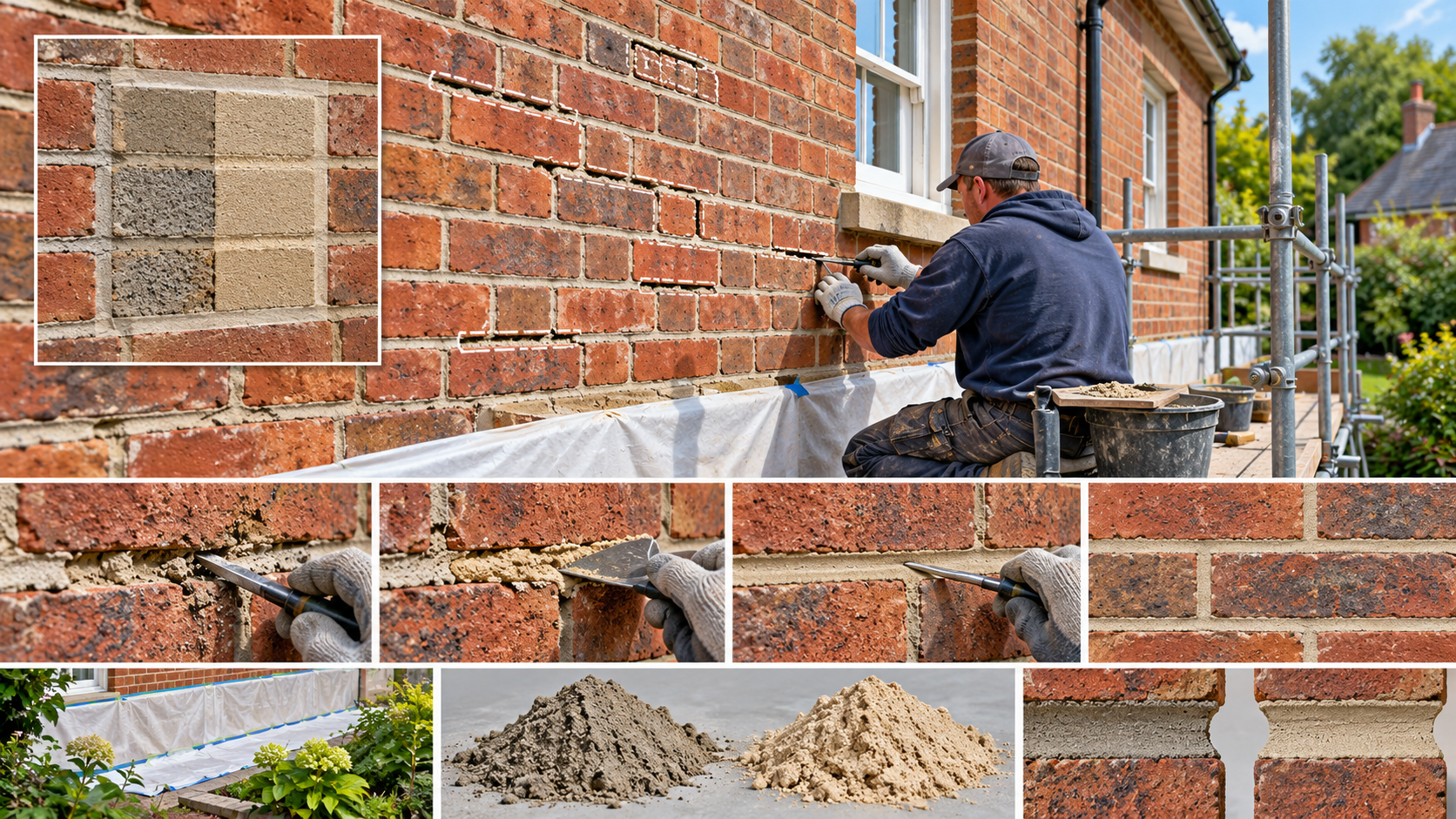
Repointing removes defective mortar from selected joints and places fresh mortar. It is not the same as smearing a new layer over a wall, and contractors may use tuckpointing differently by region.
What the quote includes
Ask for affected wall area, joint depth, mortar removal method, preparation, new mortar, tooling, cleaning, access, protection, and disposal. Height, roof access, scaffolding, narrow side yards, chimneys, and hard-to-match masonry increase labor.
The evidence does not establish a dependable national residential repointing price or Canadian benchmark. A local quote should identify whether the unit is area, linear foot, elevation, or project.
Mortar compatibility
Brick Industry Association guidance says mortar strength, composition, color, joint preparation, and compaction affect the repair. Mortar stronger than the original can concentrate stress and damage brick faces. Existing masonry should be assessed before selecting a mix.
Only defective joints should normally be repointed. Sound original joints can be preferable to unnecessary replacement. Older or historically significant masonry may need mortar characterization and preservation input.
If bricks are cracked or spalled, unit replacement may be a separate line. If water enters through flashing, weeps, openings, or a broader wall assembly, repointing alone may not solve the leak. Ask for sample joints and a mapped scope. Compare with chimney repointing cost when roof access changes the project.
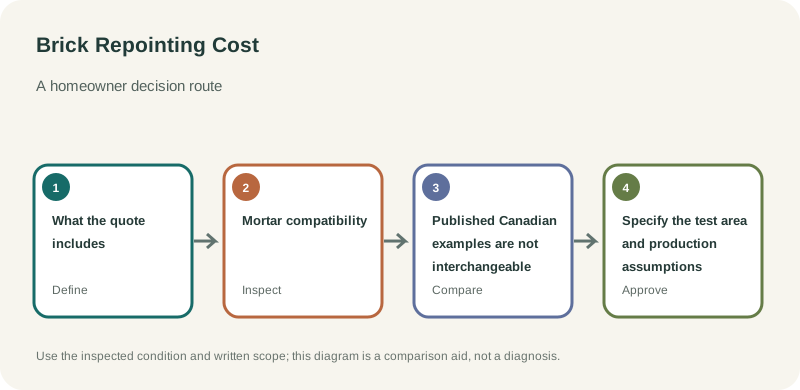
Published Canadian examples are not interchangeable
Two 2026 sources provide local orientation, but they describe different units and scopes. RealCraft’s Ontario planning guide lists brick repointing or tuckpointing at CAD $10–$30 per square foot. It cautions that these are planning estimates and says its benchmarks use Ontario data where provincial data is available, with Canadian market data used otherwise; the page does not identify which inputs underlie this specific row.
Burnaby Masonry Co.’s June 16, 2026 Metro Vancouver guide describes a single-wall repointing project at CAD $800–$2,000, small spot work starting around CAD $400, and larger full-perimeter work or jobs that include brick replacement exceeding $3,000. The contractor does not publish a project sample or normalized dimensions. Its figures are observations from its own Lower Mainland work, not an independently audited market series.
Do not compare the per-square-foot Ontario row directly with the Vancouver wall-project examples or combine them into a Canadian range. A quote should state the wall area or joint quantity, access and staging, mortar removal and replacement scope, and whether brick units, flashing, or water-source correction are separate. These local observations help explain why asking for the measured work matters; they cannot tell a homeowner what a particular wall should cost.
Specify the test area and production assumptions
Repointing bids are difficult to compare when one contractor measures only visibly open joints and another includes a full elevation. Ask for the measured area or joint quantity, the depth of removal, how sound mortar will be protected, and how dust and debris will be contained. A small test area can establish the appearance and removal method before the full job is priced or approved. Confirm the finished joint profile and whether color is intended to blend or remain distinguishable from historic work.
Protect the wall during and after work
Ask how the contractor will protect brick faces during mortar removal, manage dust, and keep water out while joints are open. Clarify whether scaffold, lift, weather protection, cleanup, and final washing are included. Cleaning after repointing should follow masonry guidance and should not use a method that damages the brick or fresh mortar. Ask when the work may be exposed to rain or cold and what curing protection is included.
A quote should identify compatible mortar selection as a technical judgment based on the existing masonry, not simply the hardest available mix. If the building is older or historically significant, involve an appropriate masonry specialist and verify local preservation requirements before work. Keep the test-panel approval and mortar details with the project record so later repairs can be matched and assessed.
Compare access methods and daily setup
A chimney stack or tall façade may require scaffold that remains in place for several days, while a lower wall may be reached with smaller equipment. Ask whether scaffold rental, assembly, inspection, tie-in, and removal are included and whether access must remain clear around the house. If neighbors, a public sidewalk, or a shared driveway are affected, clarify permits and protection responsibilities before the work begins.
Request the estimated work duration and the weather conditions that could delay repointing. Fresh mortar needs appropriate protection and curing; schedule and temporary covering can affect labor. If the contractor expects to work around occupants, ask how dust and debris are contained and how windows, doors, and mechanical intakes are protected.
Understand the work sequence behind the price
A careful repointing scope begins with a condition survey and a sample area. The sample demonstrates the removal depth, joint profile, mortar appearance, and how the method affects the brick. After approval, the crew removes defective mortar, prepares the joint, places compatible new mortar, tools it, protects it during curing, and cleans the wall as appropriate. Ask each bidder to describe this sequence and what part of the wall will be treated; a one-line “tuckpointing” allowance does not define it.
The wall area and joint condition determine production, while height, scaffold, roof access, and protection determine setup. A low wall with isolated failed joints is different from a tall elevation with widespread deterioration. Request the mapped locations, measured quantity, removal depth, unit basis, and access plan. If only a small area needs work, ask how the contractor’s minimum charge and mobilization affect the total.
Know when repointing is not enough
Repointing restores mortar joints; it does not replace spalled brick, stabilize a moving wall, repair a failed lintel, or automatically stop water entering through openings and flashings. Ask whether those conditions were observed and how they affect the proposed repair. If bricks are soft or displaced, compare unit replacement or a broader assessment. If cracks suggest movement, obtain the appropriate structural evaluation before treating the crack as a joint defect.
Older and significant buildings may require mortar that is compatible with the original masonry and specialist input. Preserve the test-panel approval, mortar description, and photos. For a chimney, access, weather, and roof interfaces materially alter the job, so compare the dedicated chimney-repointing scope rather than reusing a wall estimate.
Interpret local examples without combining them
RealCraft’s Ontario guide provides a per-area planning figure but does not disclose the exact inputs for its repointing row. Burnaby Masonry publishes Lower Mainland project examples with different units and boundaries. Neither is a representative national survey. Keep their geography and units attached to the figures, and ask local contractors for the wall area, joint quantity, access, brick replacement, flashing, and cleanup included. Do not average the two examples or treat their difference as a reliable regional range.
A sound final bid identifies what is included, which defects remain outside the work, how concealed conditions are handled, and how the cured repair will be inspected. These details make the quote useful even when published price benchmarks are sparse.
Make bid comparisons decision-ready
Ask each mason to identify whether the measured work is a whole wall, selected elevations, individual joints, or a chimney section. Have the contractor specify the mortar removal depth, the amount of defective mortar included, how sound joints are protected, and whether brick replacement is part of the price. Confirm scaffold, lift, dust control, public-sidewalk protection, weather cover, final cleaning, and disposal. For two bids, use the same access assumption and sample-joint approval so the difference reflects scope rather than presentation.
Request a test panel before full production on prominent or older masonry. Let it cure enough to judge color and texture, then approve the joint profile in writing. The approval should not waive the need for compatible materials or sound workmanship. If the trial damages brick or proves difficult to match, pause and revisit the removal method before extending the work.
A complete proposal should also state what does not get repaired: spalled units, lintels, flashings, wall ties, movement cracks, or moisture behind the veneer. These exclusions matter because repointing is only one part of masonry maintenance. Keep estimates for those separate conditions rather than assuming they are included under a broad mortar-repair label.
Keep a maintenance record
After the mortar has cured, retain the approved sample, mortar description, photographs, and invoice. These records help later contractors match the repair and identify whether the same joints have deteriorated again.
Ask the contractor to list any maintenance recommendation separately from the contracted repointing so future work is not confused with the completed repair.
On a multi-day job, ask how open joints are protected at the end of each shift and whether scaffold can remain safely in place between work days. Include those arrangements in the schedule and access quote.