
Stucco repair may be a patch, crack treatment, finish blend, delamination repair, impact repair, or an opening into the wall to investigate moisture. The appearance of the defect does not define the complete scope.
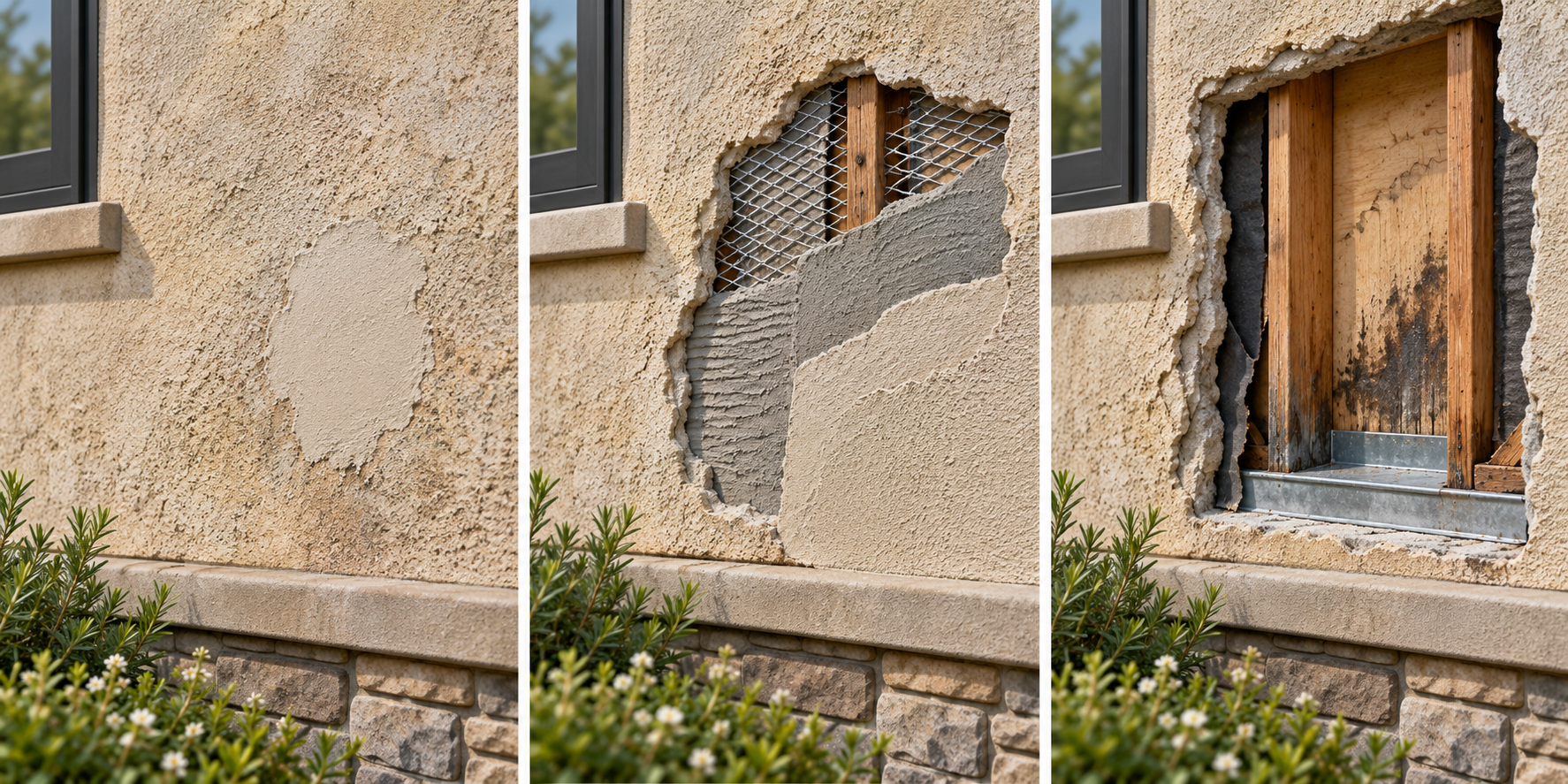
Common quote lines include inspection, access, removal of loose material, substrate or lath repair, patching, texture and color matching, appropriate sealant, finish work, and cleanup. High walls and aged finishes can cost more than the patch material.
Homewyse’s September 2026 U.S.-oriented model gives $48.72–$58.81 per square foot for a basic stucco repair, with a 10-square-foot minimum and favorable site conditions. The task removes damaged stucco, prepares the lath, and applies and finishes two coats. It does not distinguish traditional stucco from EIFS, diagnose a crack, or include every hidden repair. This is one estimator model, not a contractor-bid distribution or a Canadian price.
A Calgary example, kept local
Calgary Parging’s 2026 guide reports CAD $550–$1,125 for small patch work and CAD $1,250–$2,650 for medium repairs involving two or three areas. The contractor says its ranges draw on more than 1,360 written estimates issued in Calgary and nearby communities from 2020 through 2026, adjusted to its stated 2025–2026 labor and material rates. The listed prices are before Alberta GST.
This is a contractor’s own estimate history, not an independently audited price index. It is useful as a dated local example of how a small patch and several matched areas may be scoped; it does not establish prices elsewhere in Alberta or Canada. The source also separates different work, such as a wall-section replacement or a large EIFS make-safe project, rather than treating every stucco repair as the same service. Ask a local contractor to identify the system and affected area before comparing those scopes.
Other local price examples are not regional averages
Two additional contractors publish task-specific examples that help show how their own quotes distinguish a patch from a larger opening. MV Construction’s 2026 British Columbia guide lists $600–$2,000 for a patch under about 10 square feet and $3,500–$12,000 for a 20–80-square-foot section repair that replaces paper or lath and corrects flashing. Its larger $14,000–$45,000 elevation-repair band describes work where wet or rotted sheathing is found. These are one contractor’s estimate bands, not a sampled BC price distribution.
Stucco Wall Systems’ 2026 GTA price list gives $120–$400 per routed, meshed, base-coated, texture-matched crack, $450–$1,200 for a small patch up to about 20 square feet, and $18–$34 per square foot for a water-damage section rebuild from the substrate. The provider says these are its own prices; the page does not disclose a broader job sample.
Neither source states an ISO currency code or tax treatment. Treat each dollar sign as the publisher printed it, confirm the currency and current scope directly, and do not combine these provider examples with the Calgary CAD figures or turn them into a BC, GTA, or Canada-wide average. The task descriptions are more useful for comparing what a quote includes than for predicting a home’s final bill. See MV Construction’s BC repair guide and Stucco Wall Systems’ GTA crack-repair price list.
Do not infer a structural cause from crack appearance or width alone. Stucco can be affected by movement, impact, shrinkage, water entry, joint failure, or substrate conditions. Ask what evidence supports the proposed repair and whether openings and penetrations were checked.
Repair suits localized damage with an identified system and sound substrate. Delamination, recurring cracking, widespread moisture, or incompatible repairs may support broader work. Traditional stucco and EIFS need separate decisions. Compare with recoat or replace stucco.
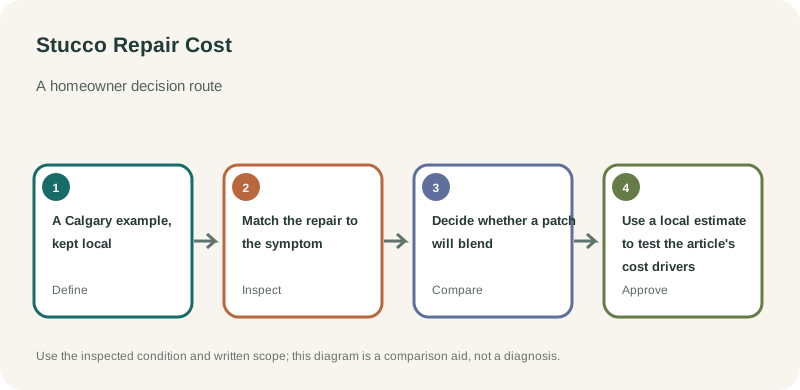
Match the repair to the symptom
Hairline finish cracks, hollow or detached areas, impact holes, failed joints, and water-damaged backing can require different methods. Ask the contractor to map the affected locations, describe how loose material was identified, and state whether the repair is cosmetic, a patch through the plaster layers, or an opening that exposes the wall behind. A surface patch can improve appearance while leaving a moisture source unchanged, so the quote should explain the suspected cause and any limitations of a visual assessment.
The Calgary contractor guide cited above is a local example, not a national price schedule. Use it to understand the kinds of distinctions a market source may report, then request local written estimates for the actual wall and finish. Ask each contractor to identify the area measured, access assumptions, finish matching, demolition and disposal, substrate repairs, and whether testing or water investigation is separate. Small patches can carry a minimum charge for setup and color or texture matching.
Decide whether a patch will blend
New stucco may differ from an aged wall in color, texture, sheen, and weathering even when the same general finish is used. Ask for a sample and discuss whether the proposal aims for a discreet patch or a larger plane that ends at a natural corner or control joint. If appearance is critical, price both boundaries. A larger area may blend better but increases preparation, masking, access, and finishing labor.
Recurring cracks, widespread hollow areas, staining, or damp interior surfaces suggest the problem may extend beyond a local patch. In that case, compare repair with a system assessment or the recoat/replacement options. A contractor should explain what evidence would expand the work once the surface is opened and how the change will be priced and approved.
Use a local estimate to test the article’s cost drivers
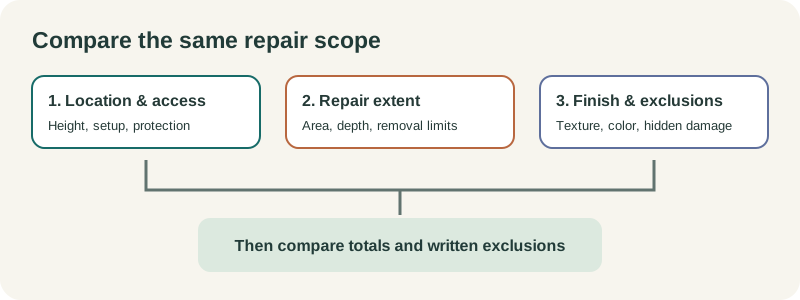
When collecting bids, ask each contractor to use the same marked crack, patch, or elevation and to state whether the price is per opening, area, visit, or fixed project. Compare mobilization, access, demolition, material, finish matching, and concealed repair separately. The Calgary source is a geographically narrow example; its prices should not be applied to another city or converted into a national range. A local written estimate is necessary for the home’s actual surface, access, and wall condition.
For a repair with uncertain depth, ask for a first-stage diagnostic price and a maximum authorized allowance. The contractor should document what finding permits additional removal and who approves the amount. If a test patch is included, define whether it is temporary or part of the final repair and how the finish will be restored if the project stops.
Record what remains outside the patch
The final invoice should say whether adjacent cracks, staining, or hollow areas were inspected and whether they were left unchanged. Keep the test-area location, product and finish detail, and photos with the house records. If the same symptom returns, this makes it easier to distinguish a failed patch from a new movement or moisture problem and to get a more informed follow-up estimate.
Read a repair estimate through three possible scopes
Surface finish repair: The damaged finish is localized, surrounding plaster is attached, and no moisture evidence suggests a deeper problem. Price patch preparation, finish matching, access, and the sample area. The result may remain visible because aged stucco and new material differ in color and texture.
Repair through the plaster layers: Hollow or detached areas, repeated cracking, or impact damage may require removing material to a sound boundary and rebuilding more than the finish coat. Ask how that boundary will be determined and whether lath or substrate repairs are included. A larger patch may be needed to reach stable material, but the contractor should show the evidence for expanding it.
Opening for wall investigation: Staining, soft backing, or recurring wetting may justify opening the wall to identify moisture and water-management conditions. Price the investigation separately from repair. Clarify who evaluates sheathing, insulation, flashing, and interior materials and who restores each layer. Traditional stucco, synthetic finishes, and EIFS require different details; do not transfer a generic patch price between them.
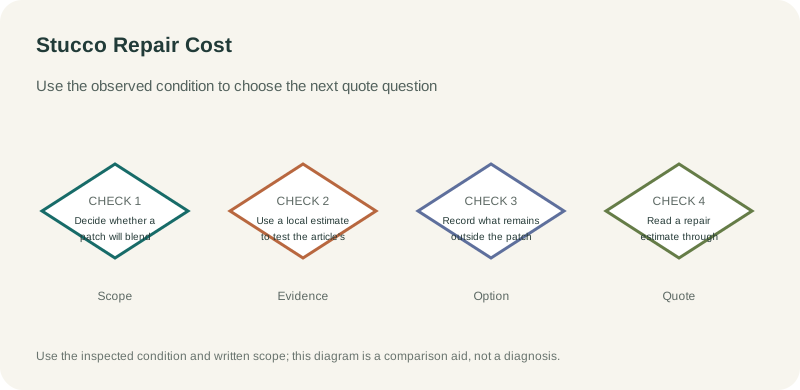
Use the Calgary example carefully
The Calgary guide provides local examples of small and medium repair categories and identifies a contractor estimate-history basis. It is useful for understanding why a limited patch and several matched areas can be priced differently. Its geography, time period, pre-GST amounts, and provider-specific definitions limit broader comparison. A homeowner outside that service area should not scale the figures by square footage or exchange rate. Ask local contractors to price the actual measured area and include the same setup, finish, and hidden-work assumptions.
Review alternatives and closeout
Compare a repair with a recoat or broader replacement when damage repeats, patches cannot blend, or the existing system is failing across a wall. Request a marked plan for each option and identify what remains untouched. A recoat refreshes a surface but does not automatically renew the backing. Replacement exposes more of the assembly and can reveal additional work. The decision turns on the condition found, appearance goals, access, and tolerance for concealed-condition risk—not on one contractor’s preferred scope.
After repair, retain photographs, finish and product details, and any moisture or test observations. Note nearby areas that were not opened. If a crack or stain returns, the record can show whether the same location failed again or a different part of the wall became wet.
Use a written repair boundary
Before work starts, mark the limits of the proposed repair on an elevation photo. State which cracks, patches, or hollow areas are included and whether related joints or opening details will be checked. The same markings can accompany each local estimate, making it easier to see whether one contractor includes a larger finish plane or more investigation. If the repair boundary expands after removal, require photos and an approved price before continuing where the wall can safely remain protected.
For a house with several separate patches, ask for both individual repairs and a combined visit. One mobilization may reduce duplicated access costs, but every location should still have its own scope and finish treatment. If the surface is likely to show color or texture differences, compare a spot repair with a broader area bounded by corners or control joints. Do not enlarge the work only to hide a mismatch if the substrate remains sound and the appearance tradeoff is acceptable.
The closeout note should list product and finish, repair locations, any backing exposed, areas not opened, and maintenance guidance. This evidence makes future estimates more reliable and helps identify recurrence.
A written repair boundary and retained finish sample make a later localized repair more comparable if the appearance or moisture condition changes.
Ask when the repaired area can be exposed to rain and how the crew will protect fresh material if weather changes during the job.