
Compare the cost of delivered heat, not a gas therm or kilowatt-hour in isolation. The result depends on the local gas tariff, electricity rate, furnace efficiency, heat-pump seasonal performance, climate, backup heat, cooling value, and fixed gas charges. Regional prices can reverse the answer.
A fair comparison
Gather annual gas use attributable to heating, current gas and electricity tariffs, furnace efficiency, heat-pump performance data for the climate, and expected backup operation. Estimate the useful heat the furnace provides after its efficiency losses. Then estimate the electricity required for the heat pump to provide the same service under the expected conditions.
The heat pump’s rated performance is not a universal seasonal result. Outdoor temperature, defrost, distribution, sizing, controls, and backup settings matter. Use equipment-specific data from the proposed design and have the HVAC professional explain the assumptions; equipment selection remains a separate category.
Add fixed charges and cooling
If gas service remains for backup, the comparison must retain its customer charge, minimum bill, and maintenance. If gas is cancelled, include the cost to replace other remaining gas loads and retire service. A heat pump may also provide cooling value, but count it only if the alternative would otherwise require a separate cooling system or operating cost.
Scenario model
- Favorable heat-pump case: moderate electricity price, efficient seasonal operation, limited backup, and a high delivered gas cost.
- Close case: similar delivered costs after efficiency, with fixed charges and capital cost deciding the result.
- Difficult heat-pump case: high winter electricity price, frequent resistance backup, poor distribution, or a building load that has not been addressed.
Use dated local rates. EIA state and regional electricity data provides US context, but it is not a Canadian tariff. Canadian homeowners need local electricity and gas inputs. Do not convert one market’s estimate into the other.
Operating cost is not conversion cost
Include heat-pump installation, electrical capacity, controls, duct or distribution work, gas retirement, and restoration in the project comparison. A lower annual bill may not recover a large conversion cost during a short ownership horizon. A failing furnace or a planned service upgrade can change the capital comparison.
When the result changes
Recalculate if the enclosure improves, the heat-pump model changes, backup is added, the utility rate changes, or gas service is retained for one appliance. Ask for a written load and performance assumption before signing. The right choice is the one with a credible installed scope and acceptable bill sensitivity, not a universal fuel verdict.
A simple delivered-heat model
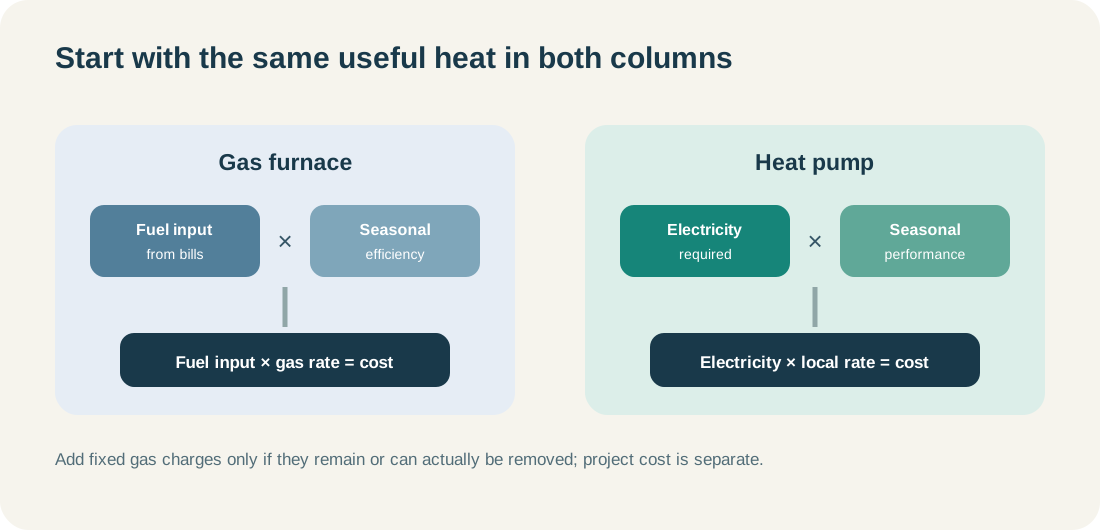
For gas, start with annual heating fuel, remove the portion used for other loads, and apply the system’s efficiency assumption. For the heat pump, use the proposed equipment’s seasonal or temperature-specific performance and the home’s expected heating load. Apply each utility’s actual tariff and add fixed charges that remain. State whether cooling and maintenance are included.
Do not use a single coefficient of performance as a guarantee for an entire season. Defrost, distribution, sizing, controls, and weather affect operation. Ask the designer to identify the performance basis and backup threshold, then run a less favorable case.
What to ask before choosing
Request the proposed heat pump’s seasonal and cold-weather performance basis, backup assumption, gas-service status, and building-load assumption. Ask whether the model includes cooling and whether both quotes include comparable distribution and controls.
Ownership decision
Compare annual operating cost with installation, electrical work, gas retirement or retained charges, financing, and equipment life. For a short horizon, a modest bill difference may not recover conversion capital. For a long horizon, repeated gas maintenance, an aging furnace, and future fuel charges may matter more.
A quote-comparison example
One contractor may propose an all-electric heat pump with a service upgrade and gas retirement. Another may propose a dual-fuel system that leaves the furnace and gas account. Compare annual cost only after adding those different capital and fixed-charge assumptions. If both systems use existing ducts, confirm whether duct repairs, controls, condensate, and commissioning are included in both quotes.
Ask for the temperature or operating condition at which backup takes over and whether the estimate assumes envelope improvements. Those details can shift both the energy result and the capacity project. A precise annual number without them is less useful than a broad range tied to an explicit scenario.
Turn the gas quote and the heat-pump quote into one model
Start with the heat the home requires, not the rated input printed on either appliance. Use gas invoices to estimate seasonal consumption and identify space-heating use separately where other gas appliances share the meter. Then estimate delivered heat using the furnace’s seasonal performance assumption. For the heat pump, use a performance estimate appropriate to the local climate, design load, and intended backup sequence—not a single catalog efficiency at a mild test condition.
A simple annual comparison has four rows: useful heat required; gas units and electricity units needed to deliver it; the applicable variable price for each fuel; and fixed charges or other costs that change if a service is retired. Keep the equipment and installation capital cost in a separate section. If gas remains for cooking, a fireplace, or a water heater, the customer charge may continue, so it is not a saving from changing the furnace. If the gas account can end, verify which fixed charges disappear and what termination or service work costs.
A U.S. national forecast can be a sensitivity case but not the household’s tariff. EIA’s September 2026 outlook lists national residential natural-gas price scenarios of USD 15.93 per thousand cubic feet for 2026 and USD 14.08 for 2027. It also lists the national residential electricity scenario at 18.20 and 18.59 cents per kilowatt-hour. These are forecast inputs, not local tariffs or a direct comparison of delivered heat; regional charges, taxes, and equipment performance remain outside them. Use current local bills for the main estimate and label any EIA case as a dated U.S. sensitivity.
Run a mild, expected, and cold-weather case. Show how colder temperatures, defrost, or resistance backup alter the heat-pump share. State whether cooling service is included as an added benefit rather than assigning it an invented cash value. The resulting comparison can indicate an operating-cost direction, but the full investment decision also includes installation cost, maintenance, service retirement, and equipment timing.
Check whether both estimates serve the same rooms
A gas furnace and a heat pump may differ in distribution, thermostat zones, and rooms they can serve. Confirm whether the existing furnace supplies all conditioned space and whether the proposed heat pump has the same coverage. If a heat pump relies on portable heaters, existing gas backup, or a second system in some rooms, include that energy use rather than comparing only the central equipment.
Account for domestic hot water if gas supplies it and the project changes it. Do not include water heating in the space-heating comparison unless both alternatives include the same service. Note any cooling service added by the heat pump separately.
This boundary check can explain a surprising bill estimate. A lower modeled heating cost may be offset by a retained gas water heater or a fixed charge that cannot be removed.
Show the break-even rate relationship
A transparent model can calculate the electricity-to-gas price relationship at which annual variable heating costs are equal. Use the same heat requirement, heat-pump seasonal performance, and gas-system seasonal efficiency for both choices. Then vary one assumption at a time: electricity tariff, delivered gas cost, or backup share. This reveals whether the result is robust or depends on a narrow price combination.
Keep the fixed gas account charge outside that variable break-even equation, then add it only in the case where service can close. This distinction helps a homeowner compare heat-pump performance with the actual decision to retain or retire gas. If the household cannot split shared gas use reliably, keep a range for space-heating consumption rather than assigning all gas to the furnace. Bills from a season when the water heater or fireplace use changed may not be directly comparable. A utility or qualified energy professional can help establish a better baseline before the homeowner treats a small modeled difference as a reason to replace equipment. Write down the model’s time horizon and price basis. If it compares one year of bills, it does not answer whether a higher installation cost pays back. If it projects several years, it should state whether rates are held constant or changed and whether future maintenance is included.
This makes the calculation easier to review when an installer or household member changes one assumption. It also prevents a short-term energy-price forecast from being described as a guaranteed lifetime cost.
Use a break-even comparison, not a single forecast
For the same useful heat demand, estimate gas input by dividing delivered heat by the furnace’s seasonal efficiency, then apply the variable gas price. Estimate heat-pump electricity by dividing delivered heat by seasonal performance, then apply the applicable electricity rate. Keep units consistent and document the assumptions. Add only those fixed charges that actually disappear when service closes.
The break-even point is the combination of rates and equipment performance where the two variable annual costs match. If the household’s expected rates are near that threshold, small changes in weather, backup, or tariff can reverse the result. Show that sensitivity instead of claiming one system is universally cheaper.