
The capacity problem appears when several reasonable loads share one service. Heating, water heating, cooking, drying, vehicle charging, and resistance backup each have their own operating pattern. Their nameplates can identify what equipment is proposed, but adding those numbers together is not a compliant whole-home demand calculation and can lead either to false alarm or false confidence.
The loads that change the decision
Heating can be the dominant winter concern, especially when electric resistance backup operates. A heat-pump water heater adds a controllable load but still needs space, wiring, and suitable operation. Induction cooking and electric drying are intermittent. EV charging may be flexible, but an owner may expect it to run overnight or during a cold-weather peak. Solar and storage can change the operating plan but do not automatically solve service capacity.
The proposed equipment matters. A low-temperature heat pump, resistance backup, standard water heater, managed EV charger, and unrestricted charger produce different design assumptions. Do not accept a generic “electrification load” allowance as a substitute for equipment-specific planning.
Connected load versus demand
Connected or nameplate load describes what equipment could draw under stated conditions. Calculated demand considers the accepted method, expected operation, existing loads, equipment controls, and sometimes historical demand. The relationship is technical and code-aware. A professional may recognize diversity or managed loads where the local rules allow it, but a homeowner should not turn an example into a DIY service approval.
How controls change the equation
Load management can delay EV charging, shed water heating, or coordinate selected loads so they do not run together. That can preserve capacity, but it changes household behavior and must use compatible, listed, and locally accepted equipment. Ask what gets priority during a cold snap, whether resistance backup is restricted, and what happens if a controller or communications link fails.
Scenario thinking
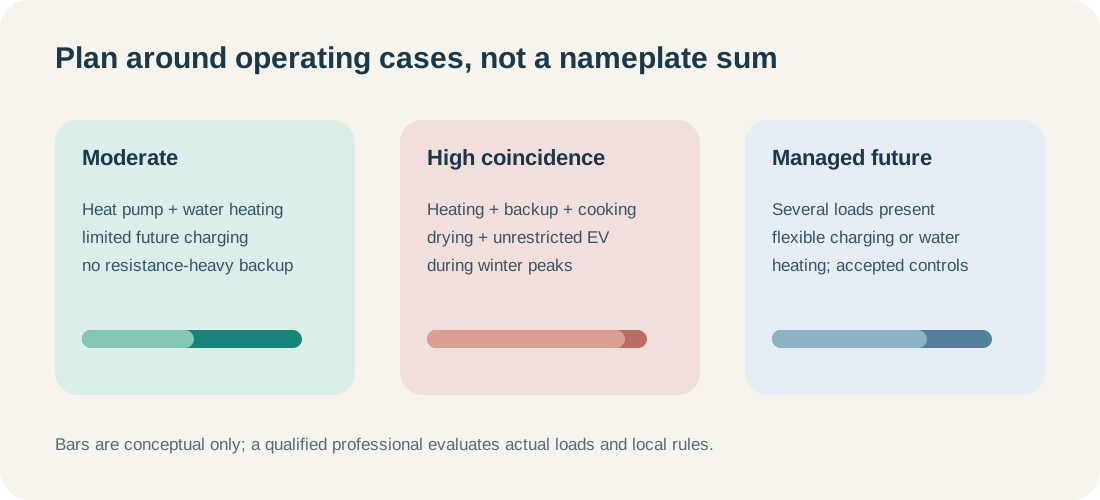
- Moderate electrification: heat pump and water heater with limited future charging, adequate existing demand margin, and no resistance-heavy backup.
- High coincident demand: heat pump, electric backup, cooking, drying, and unrestricted EV charging expected during winter peaks.
- Managed future: several loads are present, but charging and water heating can be scheduled and the control strategy is accepted.
The same home can move between these cases as occupancy, vehicles, equipment, or backup settings change. Capacity planning should include the intended future state rather than only today’s first phase.
What the professional should deliver
Provide service and panel information, equipment data, future loads, utility demand history where relevant, and proposed control assumptions. Request a written result that names the limiting condition, included loads, excluded loads, and whether a service, panel, utility, or management project is recommended. Recheck the result if equipment models or future plans change.
The cost of this review is small compared with ordering incompatible equipment or discovering a utility constraint after walls are closed. It may show that a service upgrade is unnecessary, that readiness work should happen now, or that unrestricted capacity is the better long-term investment.
Build the future-load brief
Give the professional one list with current loads, proposed equipment, future EV or addition plans, backup heat, solar or storage relationship, and expected operating priorities. State whether vehicle charging must finish by a fixed departure time and whether water heating can be scheduled. A “future” load that is actually a near-term requirement belongs in the current design.
Ask for a normal-demand case, a cold-weather case, and a managed-load case if controls are proposed. The result should identify which load creates the constraint and what changes if it is smaller, delayed, or controlled. Do not accept an answer that simply adds every nameplate value or silently omits the load most likely to operate during a peak.
Avoid designing only for the first phase
If the first project is a heat pump but the intended future includes an EV and electric water heating, include those loads in the planning conversation even when their circuits are deferred. Otherwise the homeowner may choose a control or service arrangement that must be replaced. Conversely, mark speculative loads clearly so the assessment does not create unnecessary capacity work.
Capacity is a lifecycle choice
Controls can preserve a service but add operating rules and replacement risk. A larger service can simplify future expansion but may involve utility work and capital. Choose against the household’s expected future state, not only the first appliance. Record the loads included so a later installer does not mistake an old calculation for permission to add more demand.
Panel space and calculated headroom are different evidence
A Berkeley Lab study modeled U.S. single-family panel stock and simulated load-calculation methods. It estimated that roughly 22% of homes lacked an open breaker slot, while the modeled amount of additional demand the stock could support varied materially depending on the calculation method. These estimates explain why panel appearance alone is an unreliable proxy for capacity. They do not evaluate an individual home, establish a Canadian condition, or guarantee that a load-management design will be accepted.
For a property-level review, create one load schedule with four statuses: existing and fixed; planned with a selected model; likely but not yet selected; and speculative. The professional should know which category each load occupies. Include the heating system’s design input and any resistance backup, water-heater recovery, cooking, drying, EV charging level and schedule, workshop loads, solar or storage, and any future suite or addition. Mark flexible loads and describe how much interruption the household accepts.
Request a base calculation and a future-case check. The base case documents what is installed now. The future case includes loads that are likely to arrive during the ownership horizon. If the answer changes only when speculative equipment is added, show that explicitly; it may be more economical to preserve an upgrade route than to build that capacity immediately. If the answer depends on controls, get the operating sequence and failure response in the written design.
The project cost is not simply the sum of equipment nameplates or the sum of circuit prices. It may include a load assessment, panel changes, service conductors, utility engineering, trenching, controls, branch circuits, and coordination. Ask the electrician to assign each item to the limiting condition it solves. That prevents a proposal from using “electrification load” as an unexplained allowance and helps identify whether a smaller first phase can proceed without compromising the intended final home.
Revisit the schedule whenever equipment models or operating modes change. The original calculation remains valid only for its stated assumptions.
Give the reviewer a usable load schedule
A useful load schedule records more than appliance names. Include the existing service and panel data; existing major load ratings; selected or candidate equipment models; EV charger output and expected hours; heat-pump backup details; water-heater type and recovery settings; and future additions. Mark the source for every number: nameplate, utility record, contractor proposal, measured demand, or placeholder assumption.
Ask the professional to identify uncertain entries and test whether they change the result. If unknown cooking equipment barely affects the conclusion, the homeowner may not need to delay a first phase. If the answer turns on a speculative second vehicle, show that as an alternate case. This is more useful than building one calculation around the most pessimistic assumption without explaining it.
Keep a dated copy of the final schedule with equipment bids and service documents. If the actual models or controls differ at installation, ask whether the design remains valid. The cost of refreshing a schedule is generally easier to compare than the risk of relying on a calculation that describes a different home.
Do not confuse a flexible load with a small load
A load can be electrically significant and still be managed if its timing is genuinely flexible. Another load may be lower in average energy use but essential at the exact time of peak heating or cooking. Ask the designer to identify both peak demand and operational priority; energy use over a month does not establish whether two devices can safely operate together.
The schedule should explain minimum service expectations, not only maximum equipment ratings. For example, state the latest acceptable vehicle-ready time or whether a water heater may pause during a heating peak. Those constraints help the professional compare controls with capacity changes and keep the design aligned with how the household lives. A final capacity note should identify any assumption that is not yet known, such as the heat-pump model, resistance backup, or future charger. State who will verify it and when. If the equipment selection changes after the calculation, ask whether the reviewer considers the result still valid before installation.
Keep this note with the service documents. It helps future electricians distinguish a studied load from a placeholder and prevents a preliminary planning case from being mistaken for a final design. When a load is deferred, record the reason and a recheck trigger. A future EV may be excluded until the household selects a charger, while a resistance backup load should be identified even if the heat-pump model is not final. This keeps omissions intentional and helps the next reviewer see whether an equipment change requires a new calculation.