
Sometimes. A 100-amp service does not by itself prove that electrification will work or fail. The answer depends on the home’s calculated demand, proposed equipment, physical panel condition, future loads, any accepted controls, and the utility and jurisdiction. “Every electrified house needs 200 amps” is as unreliable as “100 amps can handle anything.”
What actually limits the project
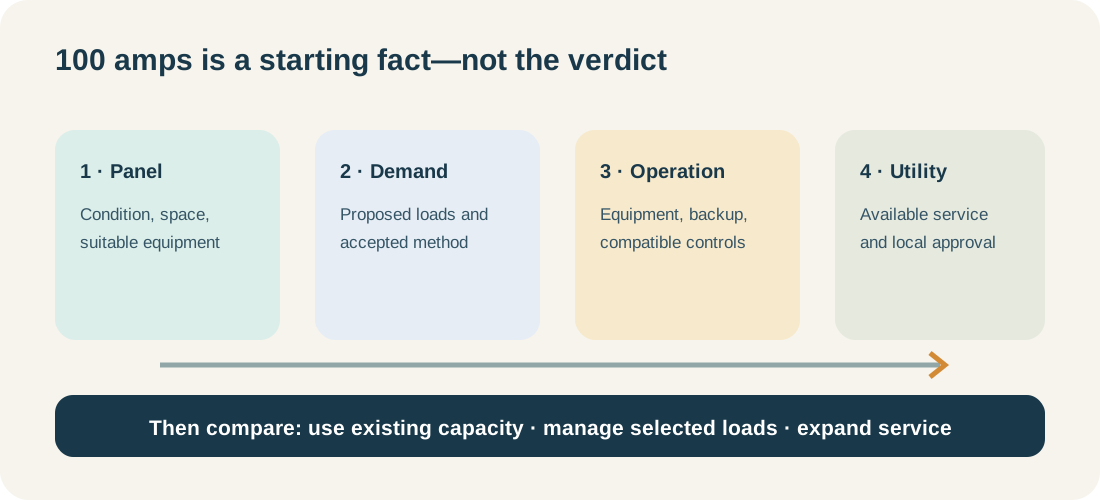
Separate four questions:
- Does the panel have physical space and suitable condition?
- Can the service support the proposed demand under the locally accepted calculation?
- Can equipment and controls operate as designed within that capacity?
- Can the utility provide the requested service at the property?
Breaker positions answer only part of the first question. Breaker-handle totals are not a compliant substitute for a demand assessment. A heat pump, water heater, cooking equipment, EV charger, and resistance backup may not run at full output at the same moment, but how that diversity is recognized is technical and jurisdiction-specific.
The proposed load matters more than the label
An efficient heat pump and a high-demand electric resistance system create different planning problems. A lower-power or scheduled EV charger may interact differently with the service than unrestricted charging. A house that keeps gas for backup or cooking has a different future load from one that retires every fuel. These are design choices, not loopholes; the actual equipment and controls must be listed, compatible, and accepted for the intended use.
Historical utility demand can be useful where an accepted method allows it, but past demand does not prove future demand. A mild winter, an unoccupied room, or no EV charging may simply mean the historical record did not exercise the loads you are adding. For example, BC Hydro describes a meter-data method using 12 months of actual use in its service territory; its availability and approval do not establish a method for every jurisdiction, and the method may not be available for new construction or an account with less than a year of history.
Ways a project may fit
A professional may find adequate capacity without a service upgrade. The project may also use lower-demand equipment, schedule flexible loads, or add a listed load-management system that prevents selected loads from operating together. These choices can reduce the infrastructure investment, but they may introduce priority rules, charging delays, monitoring requirements, subscriptions, or serviceability questions.
The goal is not to squeeze every future load into today’s service at any cost. If the household expects a second EV, larger heating capacity, workshop equipment, or a remodel, a narrow solution may be false economy. Compare the cost of controls with the value of simpler future expansion.
When an upgrade is the better choice
A service upgrade becomes more attractive when the calculation shows little spare capacity, the equipment needs are non-negotiable, controls would inconvenience the household, the service is obsolete or deteriorated, or future loads make the managed solution temporary. Utility-side constraints can still determine whether the upgrade is quick or requires engineering, transformer work, trenching, or a long schedule.
The cost comparison should include panel and service work, utility charges, permits and inspections where applicable, controls, equipment changes, installation delays, and future modification. A cheaper interior solution is not cheaper if it excludes the utility or restoration work.
A durable 100-amp plan
The plan should state proposed heating equipment, backup mode, water-heating recovery, cooking and drying assumptions, EV charging schedule, and controlled loads. It should record panel condition, service information, utility response, and the professional responsible for acceptance. This makes the answer useful when equipment is replaced or the home is sold.
Avoid paying for a temporary workaround that makes later expansion harder. If management is chosen, ask whether another future load can be added without replacing it. If an upgrade is chosen, ask for the utility scope before treating it as a simple panel job.
Questions for the project team
Ask for a written load calculation using the actual proposed loads. Ask which future loads were included, how backup heat is treated, what controls are assumed, and who confirms code acceptance. Ask the utility whether the service rating is available at the property and whether transformer or meter work is possible.
If the answer is “200 amps required,” ask what fact drives that conclusion. If the answer is “100 amps is fine,” ask what equipment, operating restrictions, and future assumptions make it true. Those details—not the service label—determine whether the plan is durable.
How a 100-amp decision can go wrong
A heat-pump quote may assume no electric backup, then change when the installer selects auxiliary resistance heat. An EV charger may be treated as a future load but omitted from the calculation. A panel may have room while the service has no spare capacity. These are scope failures, not arguments for or against 100 amps.
Ask for normal and difficult cases. Include winter heating, water-heating recovery, cooking, drying, charging, and equipment that can operate together. If management is proposed, show the priority order and the household consequence when two loads compete.
Economic decision points
Staying with 100 amps may save a service project and preserve capital, but controls, lower-demand equipment, or later expansion have costs. Upgrading may simplify ownership, but an indoor panel price is not the complete utility project. Include delay, trenching, restoration, application fees, and the value of unrestricted future capacity.
The right answer is a written capacity path: what works now, what is deferred, what is managed, what the utility must confirm, and what future change would invalidate the conclusion.
What national modeling can tell you—and cannot
A peer-reviewed Berkeley Lab study modeled panel ratings, breaker space, and added-load headroom across the U.S. single-family housing stock using stated panel assumptions and simulated electrical-code methods. It estimated that about 22% of homes had no available breaker slots, while modeled headroom changed materially with the calculation pathway. This is useful context for why empty spaces and calculated demand are different questions. It does not determine whether a particular 100-amp house can electrify, establish a Canadian result, or replace an on-site review.
For the home in front of you, ask the electrician to separate the constraints in writing. A crowded panel can sometimes be addressed without changing service rating; a panel with empty positions can still have a demand or conductor limitation. If a report says there is capacity, check which future loads and controls were included. If it says a service upgrade is required, ask whether a different equipment selection or listed management strategy was considered and whether the local authority accepts it.
This distinction also improves the budget. Price a panel-condition or space correction, a demand-management path, and a service expansion as different alternatives rather than assuming every electrical issue leads to the same project. Utility work can add customer cost or delay beyond the electrician’s interior quote. A study about the housing stock cannot quantify that local work.
A durable answer therefore has three parts: the capacity method and assumptions, a practical operating plan for any controlled loads, and the utility’s response to the requested service. Keep the 100-amp label as one input in that record, not as a shortcut around it.
Test a realistic household schedule
Capacity options affect daily life, so ask the designer to describe a winter evening rather than presenting only an amperage result. Which loads can run together? Does water heating pause during cooking or charging? Is vehicle charging complete before the next morning? What happens if a household member overrides the schedule? If resistance backup is restricted, under what weather or equipment condition is that limit reached, and how will the homeowner know?
A control plan that depends on perfect behavior may be a poor fit for a household with changing schedules. A system that supports the current heat pump but prevents a future workshop or second vehicle may also shift costs rather than avoid them. Have the professional list what is managed, what remains unrestricted, and which new load would trigger reassessment.
If the household expects to sell, keep the assumptions and manuals with the home records. A future owner should be able to understand that 100-amp service was accepted under a defined equipment and operating plan, not because the rating alone guarantees capacity.
Include the household’s peak routine
A design that fits only when every flexible load is carefully scheduled may not suit the household. Describe a typical winter morning and evening, including cooking, laundry, hot-water use, charging, and heating recovery. Ask which combinations the management system will permit and what happens when the schedule is ignored. If a second person uses the vehicle or a guest room is added, test that case too.
This does not mean every convenience requires a service upgrade. It means that the economic comparison should value the restrictions honestly. A household may prefer a managed system and lower initial cost, while another may pay more for fewer operating rules.